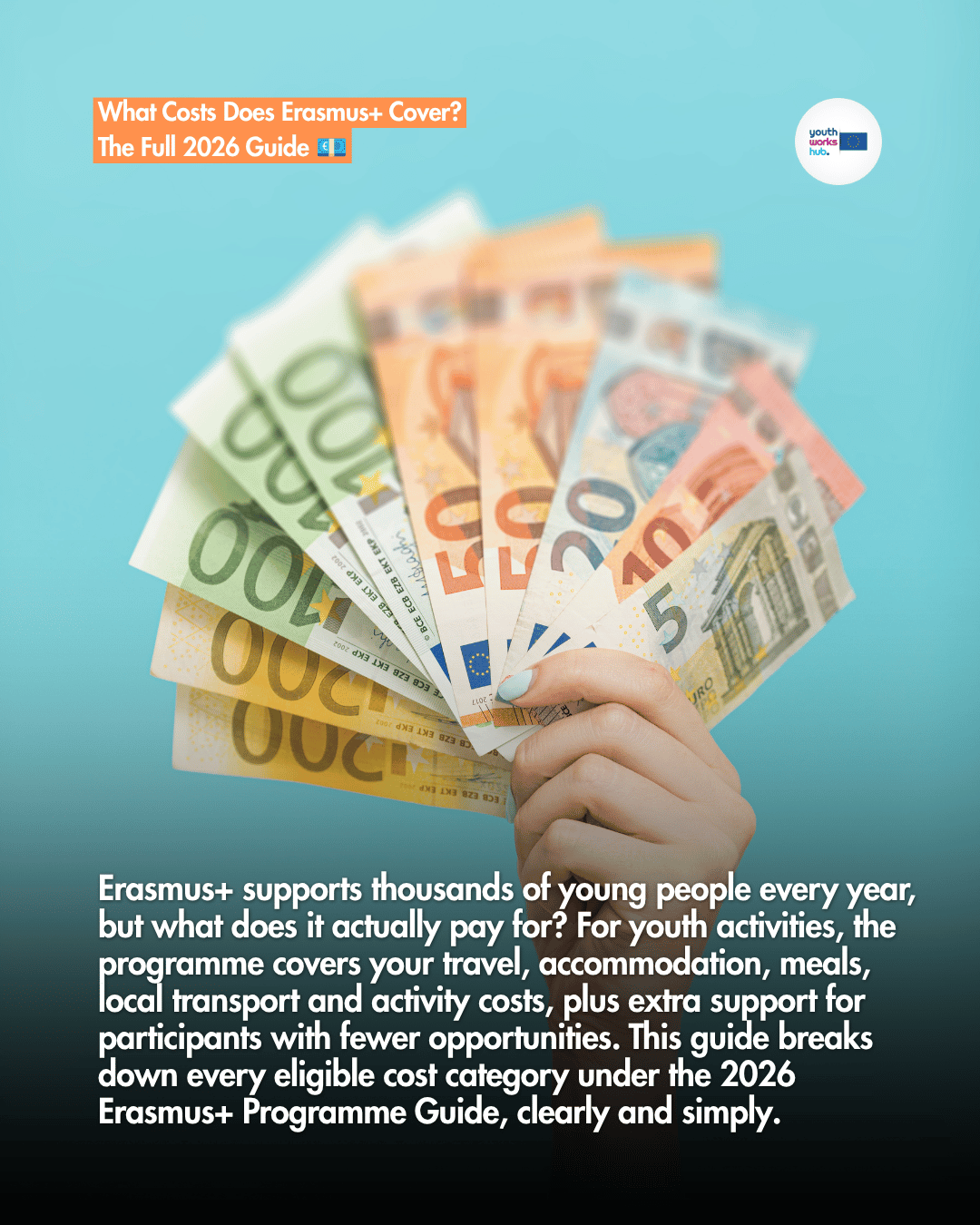
Erasmus+ supports thousands of young people every year, but what does it actually pay for? For youth activities, the programme covers your travel, accommodation, meals, local transport and activity costs, plus extra support for participants with fewer opportunities. This guide breaks down every eligible cost category under the 2026 Erasmus+ Programme Guide, clearly and simply, for Youth Exchanges (KA152), Mobility of Youth Workers (KA153) and Youth Participation Activities (KA154).
What Erasmus+ Covers at a Glance 📋
✈️ Travel, based on distance bands
🏠 Individual support for accommodation, meals and local transport
🏢 Organisational support to run the activity
🧭 Preparation and preparatory visits
🤝 Inclusion support for participants with fewer opportunities
💶 Exceptional costs like visas and permits
🎯 Activity costs specific to each project
One important note: these amounts apply to projects funded under the 2026 call, and the grant goes to the organisation, which arranges most of this for you. You do not usually handle the money yourself.
1. Travel Costs ✈️
Erasmus+ covers participant travel from your home country to the hosting country and back. Funding works on a distance band unit cost model, with different rates for standard and green travel (trains, buses, carpooling), which is encouraged and often pays more.
Under the 2026 guide, travel bands run from roughly €28 for 10 to 99 km up to €1,735 for 8,000 km and over. Covered for youth exchange participants and group leaders, youth workers (KA153) and young people in youth participation activities.
⚠️ Honest note: because travel is a fixed band, on a very long or expensive trip it may not cover 100% of your ticket. For most European journeys it comfortably does.
2. Individual Support (Accommodation, Food, Local Transport) 🏠
This is the daily amount Erasmus+ provides to cover your accommodation, meals, internal or local transport and daily essentials during the activity. Rates vary by host country, since living costs differ across Europe. It applies to all three actions (KA152, KA153, KA154).
3. Organisational Support 🏢
This is the core budget the organisation uses to run the activity: project management, preparation, administration, coordination with partners, materials, venue, mentoring, facilitation and safety. It is a unit cost per participant, usually with a higher rate for the first participants and a lower rate for additional ones.
4. Preparation and Preparatory Visits 🧭
Erasmus+ funds getting you ready. Preparation costs cover activities before the exchange, like language preparation, cultural briefing and pre-departure meetings. Separately, preparatory visits fund a short trip beforehand for group leaders, youth workers, organisers or young people with fewer opportunities, to sort out logistics, safety, accessibility and inclusion (covering travel and daily support).
5. Inclusion Support 🤝
Inclusion is a core Erasmus+ priority, funded in two ways:
♿ For organisations: extra funding for the work of supporting participants with fewer opportunities, such as tailored mentoring, extra staff time and adapted methods (a unit cost per participant).
🧑🦽 For participants: the real extra costs a participant may face, like adapted transport, a personal assistant, medical support, accessible accommodation or special equipment, reimbursed up to 100% of the real cost.
If cost or a disability worried you, this is why it should not stop you. See who can apply.
6. Exceptional Costs 💶
Erasmus+ can also cover essential one-off expenses when justified:
🛂 Visa fees and residence permits
💉 Vaccinations and medical certificates
🛡️ Insurance, where required
✈️ High-cost travel for remote regions
🎛️ Equipment rental needed for the activity
These are reimbursed as real costs, typically 80 to 100% depending on the category.
7. Activity Costs by Action Type 🎯
Each action funds slightly different things, usually inside organisational support:
🌍 Youth Exchanges (KA152): workshop materials, teaching tools, intercultural activities, local transport, venue and external facilitators if justified.
👥 Mobility of Youth Workers (KA153): training materials, expert fees, study visits, job shadowing logistics and professional development sessions.
💬 Youth Participation Activities (KA154): local workshops, youth policy dialogues, community events, co-creation and digital participation, plus venue and materials.
8. The Lump-Sum Funding Model 💼
Many KA154 Youth Participation projects use lump-sum funding: organisers propose work packages, and if approved the lump sum is awarded with no detailed financial reporting needed. The catch is simple: all activities must be delivered exactly as promised.
9. What Erasmus+ Does Not Cover ❌
Erasmus+ does not fund:
🚫 Tourism or unrelated leisure days
🚫 Luxury accommodation
🚫 Personal shopping
🚫 Costs before or after the official project dates
🚫 Undocumented extensions of stay
🚫 Activities not listed in the approved application
What About ESC Funding? 🤝
This guide covers Erasmus+ youth activities. The European Solidarity Corps works a little differently, adding monthly pocket money for volunteers, for example. For the full ESC breakdown, read is ESC fully funded and what is covered.
Frequently Asked Questions ❓
Does Erasmus+ cover all my costs?
For youth activities, it covers travel (within distance bands), accommodation, meals, local transport and activity costs. On very long trips the travel band may not cover the full ticket, but most costs are taken care of.
Do I receive the money myself?
Usually not. The grant goes to the organisation running the activity, which arranges travel, accommodation and meals for you. Some costs, like travel, may be reimbursed to you.
Does Erasmus+ pay for visas and vaccinations?
Yes, as exceptional costs, when they are needed for the activity and properly justified.
What extra support is there for people with fewer opportunities?
Inclusion support funds both the organisation's extra work and the participant's real additional costs (like adapted transport or a personal assistant) up to 100%.
What does Erasmus+ not pay for?
Tourism, luxury accommodation, personal shopping, costs outside the project dates, and anything not in the approved application.
In Short 💡
Under the 2026 Programme Guide, Erasmus+ covers travel, accommodation, meals, local transport, activity costs and strong inclusion support for its youth activities, so money is rarely the barrier. For volunteering, the ESC has its own funding rules. Either way, the goal is the same: let you focus on the experience.
👉 Find a funded Erasmus+ or ESC opportunity: youthworkshub.org