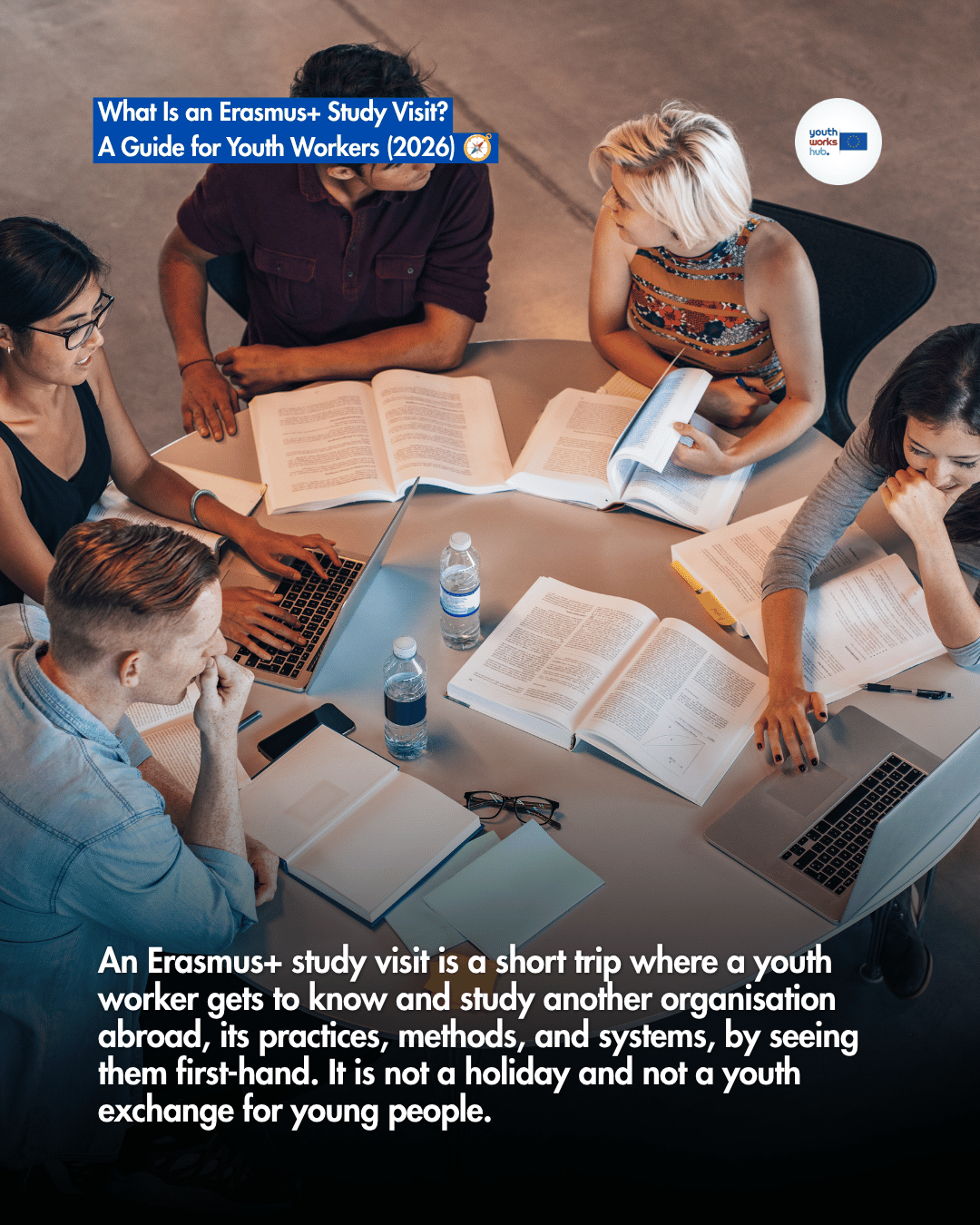
A study visit is one of the Professional Development Activities of Erasmus+ Mobility projects for youth workers, and Professional development activities are transnational or international learning mobility activities supporting the professional development of youth workers. Under this Action, organisations can receive support to carry out projects comprising of one or more learning activities for the professional development and capacity building of youth workers and their organisations. Academic study trips, activities that aim to make financial profit, activities that can be considered as tourism, festivals, holiday travel, performance tours and statutory meetings are not eligible for grants under Mobility projects for Youth Workers. Our guide on what Erasmus+ is covers the programme as a whole, the mobility of youth workers Action explains every activity format it funds, and the role of youth workers describes the job a study visit is meant to improve.
Last updated: October 2026.
What happens on an Erasmus+ study visit?
Professional development activities can take the form of study visits and different types of assignments, such as job shadowing, youth worker exchanges and peer learning, in youth work organisations and organisations active in the youth field abroad. Professional development activities are transnational or international learning mobility activities supporting the professional development of youth workers. A Mobility project for Youth Workers needs to envisage support for the reflection process, identification and documentation of learning outcomes, in particular through Youthpass, to support the recognition and impact of the project outcomes, the resulting youth work practices, methodologies and materials in the youth field. Our guide on what Youthpass is explains the certificate, and what non-formal education is explains the learning method a study visit uses.
What forms can Erasmus+ Professional Development Activities take?
Professional development activities can take the form of study visits and different types of assignments, networking and community building, training courses, and seminars and workshops.
🔍 Study visits and assignments: study visits and different types of assignments, such as job shadowing, youth worker exchanges and peer learning, in youth work organisations and organisations active in the youth field abroad. Our guide on the mobility of youth workers Action covers the Action these formats sit in.
🧑🏫 Training courses: training courses supporting the development of competences, for example based on relevant existing competence models, to implement quality youth work practices or address and test innovative methods. Our guide on what an Erasmus+ training course is walks through a course from arrival to certificate.
🗣️ Seminars and workshops: seminars and workshops supporting in particular knowledge-building and best practices sharing linked to the objectives, values and priorities of the EU Youth Strategy and of the EU programmes contributing to its implementation. Our guide on what an Erasmus+ seminar is sets out what a seminar week looks like.
🌐 Networking and community building: networking and community building among youth workers taking part in the action and supporting its objectives.
❌ Not eligible: academic study trips, activities that aim to make financial profit, activities that can be considered as tourism, festivals, holiday travel, performance tours and statutory meetings are not eligible for grants under Mobility projects for Youth Workers.
Who can take part in a study visit?
Eligible participants are minimum 16 years old, and participants must be resident in the country of their sending or receiving organisation. Participants must have reached the minimum age at the start date of the activity. Trainers, accompanying persons and facilitators are not to be considered as participants of the activity, but are eligible for support under certain budget categories, and trainers, accompanying persons and facilitators are not to be counted in the number of participants. The number of participants is up to 50 participants in each activity planned by the project. Participants from the country of the receiving organisation must be involved in each activity. The flexibility offered by the action in the format of the activities, for example duration and type, makes it adaptable to the needs of participants, and the format is also suitable to involve participants with fewer opportunities. The presence of trainers and facilitators in most of the activities ensures a closer and adapted approach, tailor-made to the needs of the participants. Our guide on the age limits in Erasmus+ and the European Solidarity Corps explains how age is counted, who can apply goes through the conditions case by case, and inclusion support covers the extra help for participants with fewer opportunities.
How long does a study visit last and where can it take place?
A study visit is a professional development activity, and the duration of activities is from 2 to 60 days, excluding travel days, while the minimum 2 days must be consecutive. The activities must take place in the country of one, or several in case of itinerant activities, of the organisations participating in the activity. As an exception, activities cannot take place in Belarus or Russia. Our guide on which countries can take partlists the eligible countries, and the timeline from application to departure shows how the months before a mobility are used.
What costs are covered for you on a study visit?
✈️ Travel: a contribution to the travel costs of participants, including trainers, accompanying persons and facilitators, from their place of origin to the venue of the activity and return. Our guide on how travel reimbursement works shows how the amount is calculated, and green travel in Erasmus+ and the European Solidarity Corps explains the sustainable transport option.
🏠 Individual support: costs linked to subsistence, maximum 1 100 EUR per participant, trainers, facilitators and accompanying persons. Our guide on what Erasmus+ covers sets out the daily rates per country.
♿ Inclusion support for participants: additional costs directly linked to participants with fewer opportunities and their accompanying persons, trainers and facilitators, including justified costs related to travel and subsistence if a grant for these participants is not requested through the budget categories Travel and Individual support. Our guide on inclusion support explains the extra help a youth worker with fewer opportunities can receive on a study visit.
🛂 Visa and related costs: visa and visa-related costs, residence permits, vaccinations, medical certifications at 100% of eligible costs, and the request must be justified and approved. Our guide on visas and residence permits explains when a youth worker needs one.
Can the organisation ask you to pay a participation fee?
If deemed necessary, the beneficiary organisation may ask participants in a mobility project for youth workers for a contribution paid by the participants prior to the activity. The amount of the participants' contribution must be very low, remain proportional to the grant awarded for the implementation of the project, must be clearly justified by a direct benefit to the participant, its purpose well explained and justified to the participants, collected on a non-profit basis, and may not create unfair barriers to participation. Contributions cannot be collected from participants with fewer opportunities, and the beneficiary can use the cost category inclusion support to cover any specific needs derived from the barriers faced by these participants. Additional fees or other participant contributions cannot be collected by other service providers chosen by the beneficiary organisation. Our guide on what Erasmus+ covers sets out what the grant pays for, and inclusion support covers the specific needs of participants with fewer opportunities, who can never be asked for a contribution.
Frequently asked questions
Is a study visit the same as a holiday trip?
No, holiday travel, activities that can be considered as tourism and academic study trips are not eligible for grants under Mobility projects for Youth Workers. Our guide on the mobility of youth workers Action explains which activities the Action funds.
What learning is documented after a study visit?
A Mobility project for Youth Workers needs to envisage support for the reflection process, identification and documentation of learning outcomes, in particular through Youthpass. Our guide on what Youthpass is explains the certificate, and how to put Youthpass on your CV shows how to use it afterwards.
Start with an organisation
Our guide on the mobility of youth workers Action explains the Action a study visit belongs to, and how to find Erasmus+ and ESC projects shows where the openings appear. The related pages below from Youth Works Hub cover each part of this guide in more detail.
Related pages: the mobility of youth workers Action · what an Erasmus+ training course is · what an Erasmus+ seminar is · the role of youth workers · how to find Erasmus+ and ESC projects
👉 Erasmus+ projects: youthworkshub.org/category/erasmus-projects