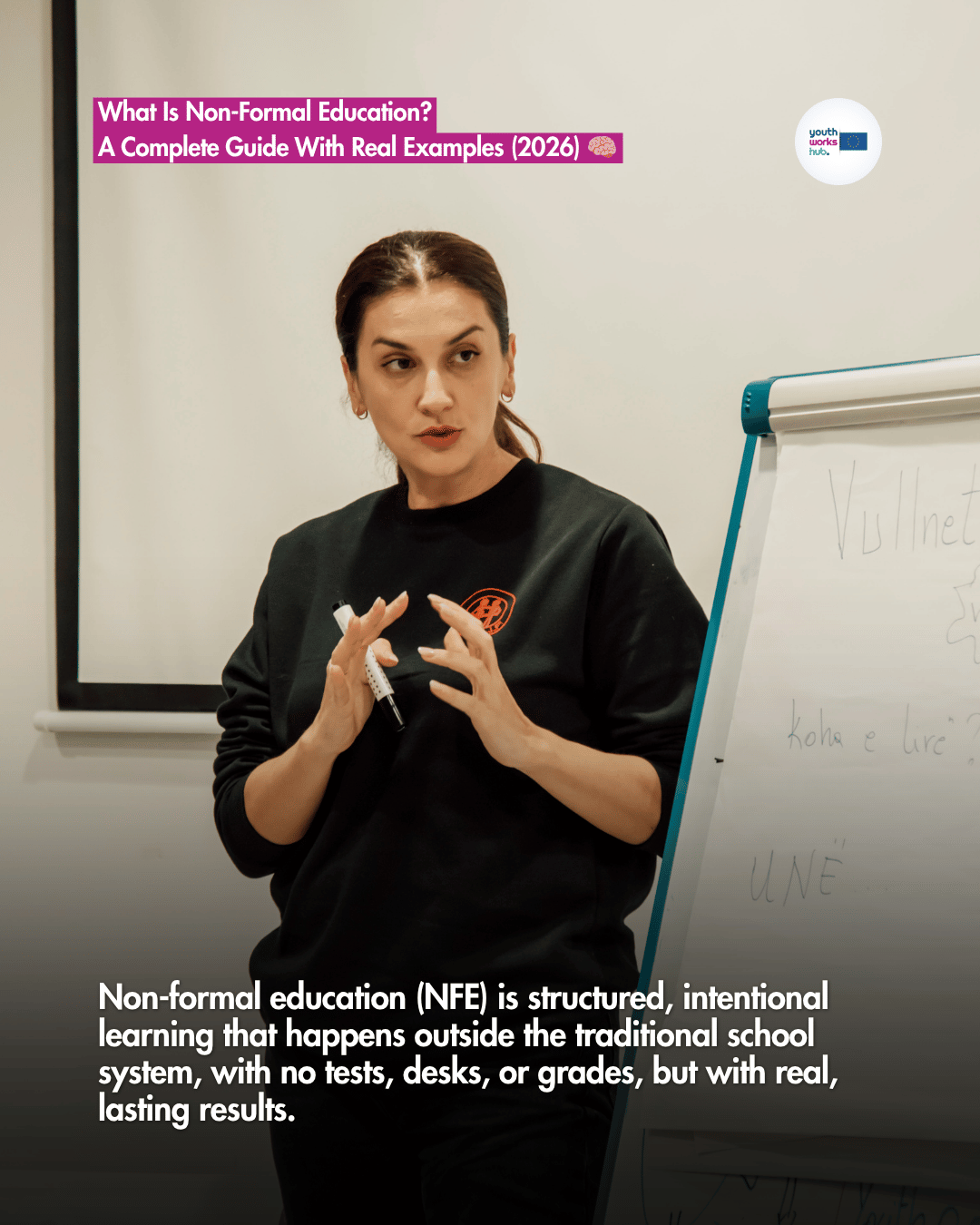
Non-formal learning refers to learning which takes place outside formal education and training through learning activities and with some form of learning support. Non-formal learning has a participative and learner centred approach, and non-formal learning is carried out by learners on a voluntary basis and is therefore closely linked to young people's needs, aspirations and interests. Non-formal and informal learning enable young people to acquire essential competences that contribute to their personal and socio educational development and foster their active participation in society, thereby, amongst others, improving their employment prospects. Learning activities within the youth field are meant to have a significantly positive impact on young people as well as on the organisations involved, the communities in which these activities take place, the youth field itself and the European economic and societal sectors at large. Our guide on what the European Solidarity Corps (ESC) is and what Erasmus+ is sets out the two programmes.
Last updated: October 2026.
How is non-formal learning different from formal and informal learning?
Non-formal learning takes place through planned learning activities where some form of learning support is present, but non-formal learning is not part of the formal education and training system.
📘 Non-formal learning: learning which takes place outside formal education and training through learning activities and with some form of learning support, with a participative and learner centred approach, carried out by learners on a voluntary basis.
🌱 Informal learning: learning resulting from daily activities related to work, family or leisure which is not organised or structured in terms of objectives, time or learning support, and informal learning may be unintentional from the learner's perspective.
🧑🤝🧑 Informal learning in the youth sector: informal learning refers to the learning in daily life activities, at work, with peers, etc., and informal learning can often be characterised as learning by doing; in the youth sector, informal learning has an important role for example in peer group discussions, in voluntary activities and in a variety of other situations.
Our guide on what Youthpass is explains the certificate that records what you learned outside a classroom.
What does non-formal education look like in practice?
A youth activity is an out-of-school activity, such as a youth exchange, volunteering or youth training, carried out by a young person, either individually or in a group, in particular through youth organisations, and characterised by a non-formal learning approach.
🧩 Youth Exchanges: meetings of groups of young people from at least two different countries who gather for a short period to implement jointly a non-formal learning programme (a mix of workshops, exercises, debates, role plays, simulations, outdoor activities, etc.) on a topic of their interest, seeking inspiration from the European Youth Goals.
🧑🏫 Professional development activities for youth workers: transnational or international learning mobility activities supporting the professional development of youth workers, which can take the form of study visits and different types of assignments, such as job shadowing, youth worker exchanges and peer learning, in youth work organisations and organisations active in the youth field abroad. Professional development activities also take the form of networking and community building among youth workers, training courses supporting the development of competences to implement quality youth work practices or address and test innovative methods, and seminars and workshops supporting in particular knowledge building and best practices sharing linked to the objectives, values and priorities of the EU Youth Strategy and of the EU programmes contributing to its implementation.
🗣️ Youth participation activities: supported activities can take the form of workshops, debates, role plays, simulations, use of digital tools, awareness raising campaigns, trainings, meetings and other forms of online or offline interaction between young people and decision-makers, consultations, information and/or cultural events etc.. Examples within one youth participation project: face-to-face or online workshops, meetings, seminars or other events offering space for information, debate and active participation of young people on issues relevant to their daily lives, consultations of young people identifying topics/issues of specific relevance to them (in local, regional, national or transnational context) and identifying their needs related to participation in addressing such topics/issues, awareness raising campaigns revolving around participation of young people in democratic life, including information and/or cultural events linked to specific societal challenges relevant to young people, and simulations of the functioning of democratic institutions and the roles of decision-makers within such institutions.
🤲 Volunteering: as one of the most visible manifestations of solidarity, volunteering provides young people with the opportunity to take part in activities that address identified needs within local communities and contribute to overcoming important societal challenges on the ground. Activities supported under volunteering constitute a rich experience in a non-formal and informal learning context, which enhances young people's competences.
👀 Job shadowing: a stay at a partner organisation in another country with the aim of receiving training by following practitioners in their daily work in the receiving organisation, exchanging good practices, acquiring skills and knowledge and/or building long-term partnerships through participative observation.
✈️ Learning mobility: moving physically to a country other than the country of residence in order to undertake study, training or non-formal or informal learning.
🌐 Virtual learning: acquisition of knowledge, skills and competences through the use of information and communication technology tools that allow participants to have a meaningful transnational or international learning experience.
Our guide on what a Youth Exchange is describes the most common group format, what a training course is covers the format built around youth workers, the complete guide to ESC volunteering follows a volunteering placement from start to finish, and Erasmus+ Youth Participation Activities explains the projects young people design themselves.
Who leads non-formal learning activities?
A youth worker is a professional or a volunteer involved in non-formal learning who supports young people in their personal socio educational, and professional development.
🙋 Facilitator: a person who helps a group of (young) people to work together better, understand their common objectives, and plan how to achieve these objectives through Erasmus+ activities.
👥 Group leader: in youth mobility projects, an adult of at least 18 years of age who joins the young people participating in a Youth Exchange in order to ensure their effective learning (Youthpass), protection and safety.
🧭 Coach: a resource person who is not a member of the group and who supports young people in the preparation, implementation and evaluation of their project.
💻 Digital youth work: proactively using or addressing digital media and technology in youth work, where digital media and technology can be either a tool, an activity or a content in youth work. Digital youth work is not a youth work method, digital youth work can be included in any youth work setting and it has the same goals as youth work in general.
Our guide on the role of youth workers explains what the job involves day to day, and mobility of youth workers and job shadowing covers the projects youth workers join themselves.
Why does non-formal learning matter?
Non-formal and informal learning enable young people to acquire essential competences that contribute to their personal and socio educational development and foster their active participation in society.
🎯 Competences you can carry further: volunteering enables young people to acquire useful experience, skills and competences for their personal, educational, social, cultural, civic and professional development, thereby improving their employability and active citizenship.
🧠 Key competences: the basic set of knowledge, skills and attitudes which all individuals need for personal fulfilment and development, employability, social inclusion, sustainable lifestyle, successful life in peaceful societies, health conscious life management and active citizenship, as described in the Council Recommendation 2018/C 189/01 of 22 May 2018 on key competences for lifelong learning.
🤝 Reaching young people the system misses: non-formal and informal learning experiences have also a strong potential to improve the attainment in formal education and training as well as to address young NEETs, that is young people not in employment, education or training, or young people with fewer opportunities and combat social exclusion.
🌍 Impact beyond the participant: learning activities within the youth field are meant to have a significantly positive impact on young people as well as on the organisations involved, the communities in which these activities take place, the youth field itself and the European economic and societal sectors at large.
Our guide on inclusion support in Erasmus+ and ESC explains the extra support for young people with fewer opportunities, and how to put Youthpass on your CV and LinkedIn shows how to turn the experience into something an employer reads.
How is non-formal learning recognised?
To ensure the impact of European Solidarity Corps activities on the personal, educational, social, civic, and professional development of the participants, the competences that are the learning outcomes of the solidarity activities should be properly identified and documented.
📄 Instruments for recognition: the use of effective instruments at Union and national level for the recognition of non-formal and informal learning, such as Youthpass and Europass should be encouraged, as appropriate.
🧾 Youthpass: the European tool to improve the recognition of the learning outcomes of young people and youth workers from their participation in projects supported by the Erasmus+ Programme. Youthpass consists of certificates that can be obtained by participants and a defined process which supports young people and organisations to reflect about the learning outcomes from a project.
🛠️ Union transparency and recognition tools: Erasmus+ supports EU transparency and recognition tools for competences, skills and qualifications, in particular Europass (including European Digital Credentials for Learning), Youthpass, the European Qualifications Framework (EQF), the European Skills, Competences, Qualifications and Occupations classification (ESCO), the European Credit Transfer and Accumulation System (ECTS), the European Quality Assurance Reference Framework (EQAVET), the European Quality Assurance Register (EQAR) and the European Association for Quality Assurance in Higher Education (ENQA).
🌐 Why the tools exist: a common purpose of these tools is to ensure that competences, skills and qualifications can be more easily recognised and are better understood, within and across national borders, no matter whether these were acquired through formal education and training or through other learning experiences such as work experience, volunteering and online learning.
✅ Validation of non-formal and informal learning: a procedure of confirmation by an authorised body that an individual has acquired learning outcomes measured against a relevant standard, consisting of four distinct phases: identification through dialogue of particular experiences of an individual, documentation to make visible the individual's experiences, formal assessment of these experiences, and certification of the results of the assessment which may lead to a partial or full qualification.
📜 The policy behind it: a number of long-standing policy documents guide the implementation and further development of these tools, including the Council Recommendation of 22 May 2017 on the European Qualifications Framework for lifelong learning, the Decision (EU) 2018/646 of the European Parliament and of the Council of 18 April 2018 on a common framework for the provision of better services for skills and qualifications (Europass) and the Council Recommendation of 20 December 2012 on the validation of non-formal and informal learning; in addition to these horizontal policy documents, thematic strategies such as the Youthpass Strategy and the European Training Strategy (ETS) in the field of youth aim at offering further support to developments in these areas.
Our guide on getting your learning recognised with ECTS and Youthpass explains what each tool is worth, how to put Youthpass on your CV and LinkedIn turns the certificate into a line a recruiter reads, and how to prepare your Europass CV covers the European Union format.
Where can you find non-formal learning opportunities?
Volunteering provides young people with the opportunity to take part in activities that address identified needs within local communities. Our guide on how to find Erasmus+ and ESC projects lists where opportunities are published, how to apply for Erasmus+ or ESC takes the application step by step, and which programme is right for you helps you choose between the two programmes. Our guide on how to choose the right project explains how to pick between the opportunities you find.
Frequently asked questions
Is non-formal education the same as informal learning?
Non-formal learning takes place through planned learning activities where some form of learning support is present. Informal learning results from daily activities related to work, family or leisure which is not organised or structured in terms of objectives, time or learning support, and informal learning may be unintentional from the learner's perspective. Our guide on what a Youth Exchange is shows a planned non-formal learning programme in practice.
Does Youthpass give you a certificate?
Youthpass consists of certificates that can be obtained by participants and a defined process which supports young people and organisations to reflect about the learning outcomes from a project. Our guide on what Youthpass is explains who issues the certificate.
Can non-formal learning lead to a partial or full qualification?
Validation of non-formal and informal learning consists of four distinct phases, and the final phase is certification of the results of the assessment which may lead to a partial or full qualification. Our guide on getting your learning recognised with ECTS and Youthpass covers the recognition tools in more detail.
Is non-formal learning voluntary?
Non-formal learning is carried out by learners on a voluntary basis and is therefore closely linked to young people's needs, aspirations and interests, and non-formal learning has a participative and learner centred approach. Our guide on which Erasmus+ or ESC programme is right for you helps you find an activity that fits your own interests.
Who supports learning in a non-formal setting?
A youth worker is a professional or a volunteer involved in non-formal learning who supports young people in their personal socio educational, and professional development. Our guide on the role of youth workers describes the people you meet on a project.
Learning that happens outside the classroom
The related pages below from Youth Works Hub cover each part of this guide in more detail.
Related pages: what Youthpass is · getting your learning recognised with ECTS and Youthpass · the role of youth workers · group projects abroad for young people · the complete guide to ESC volunteering
👉 ESC projects: youthworkshub.org/category/esc-projects
👉 Erasmus+ projects: youthworkshub.org/category/erasmus-projects