A youth worker is a professional or a volunteer involved in non-formal learning who supports young people in their personal, socio-educational, and professional development. Erasmus+ counts a youth worker as staff, a person who, on either a professional or a voluntary basis, is involved in education, training or non-formal learning at all levels. Under Mobility projects for youth workers, organisations can receive support to carry out projects comprising of one or more learning activities for the professional development and capacity building of youth workers and their organisations. Mobility projects for youth workers support the professional development of youth workers and thereby the development of quality youth work at local, regional, national, European and international level, through non-formal and informal learning experiences in mobility activities. In the European Solidarity Corps, personal support through mentoring should be provided to all participants in volunteering activities. Young people carrying out a Solidarity Project may be supported by coaches. Our guide on what Erasmus+ is introduces the programme, what non-formal education is explains the learning approach the work rests on, and mobility of youth workers covers the mobility strand itself. Our guide on the European Solidarity Corps (ESC) covers the other programme named in this title, while your ESC mentor and the supporting organisation describe who accompanies volunteers there.
Last updated: October 2026.
What does a youth worker actually do?
A youth worker is a professional or a volunteer involved in non-formal learning who supports young people in their personal, socio-educational, and professional development.
A youth activity is an out-of-school activity, such as a youth exchange, volunteering or youth training, carried out by a young person, either individually or in a group, in particular through youth organisations, and characterised by a non-formal learning approach.
Non-formal learning is learning which takes place through planned learning activities where some form of learning support is present, but which is not part of the formal education and training system.
Informal learning is learning resulting from daily activities and experiences which is not organised or structured in terms of objectives, time or learning support, and may be unintentional from the learner's perspective. Our guide on what non-formal education is sets out how that learning approach works, and what a Youth Exchange is describes one of the activity types youth workers run.
What is the difference between a youth worker, a group leader and a facilitator?
🧑🏫 Youth worker: a professional or a volunteer involved in non-formal learning who supports young people in their personal, socio-educational, and professional development.
🧭 Group leader: in youth mobility projects, an adult of at least 18 years of age who joins the young people participating in a Youth Exchange in order to ensure their effective learning (Youthpass), protection and safety. Our guide on what a Youth Exchange is explains the activity a group leader joins.
🗣️ Facilitator: a person who helps a group of (young) people to work together better, understand their common objectives, and plan how to achieve these objectives through Erasmus+ activities.
👤 Accompanying person: in Erasmus+, a person who accompanies participants (learners, staff, young people or youth workers) in a mobility activity in order to ensure their safety, provide support and assistance, as well as assist with the participant's effective learning during the mobility experience.
⚖️ Number of participants: under the minimum requirements for Professional Development Activities of Mobility projects for youth workers, trainers, accompanying persons and facilitators are not to be counted in the number of participants. Our guide on Erasmus+ and ESC age limits sets out the age rules attached to each role.
How does Erasmus+ support a youth worker's professional development?
Mobility projects for youth workers support the professional development of youth workers and thereby the development of quality youth work at local, regional, national, European and international level, through non-formal and informal learning experiences in mobility activities. The Action contributes to the objectives of the EU Youth Strategy 2019-2027, particularly to the European Youth Work Agenda for quality, innovation and recognition of youth work.
Mobility projects for youth workers aim to provide non-formal and informal learning opportunities for educational and professional development of youth workers, contributing to high quality individual practice as well as to the evolution of youth work organisations and systems.
Mobility projects for youth workers aim to build a community of youth workers that can support the quality of projects and activities for young people in EU programmes and beyond.
Mobility projects for youth workers aim to develop local youth work practices and contribute to capacity building for quality youth work of the participants and their organisation, having a clear impact on the participating youth workers' regular work with young people.
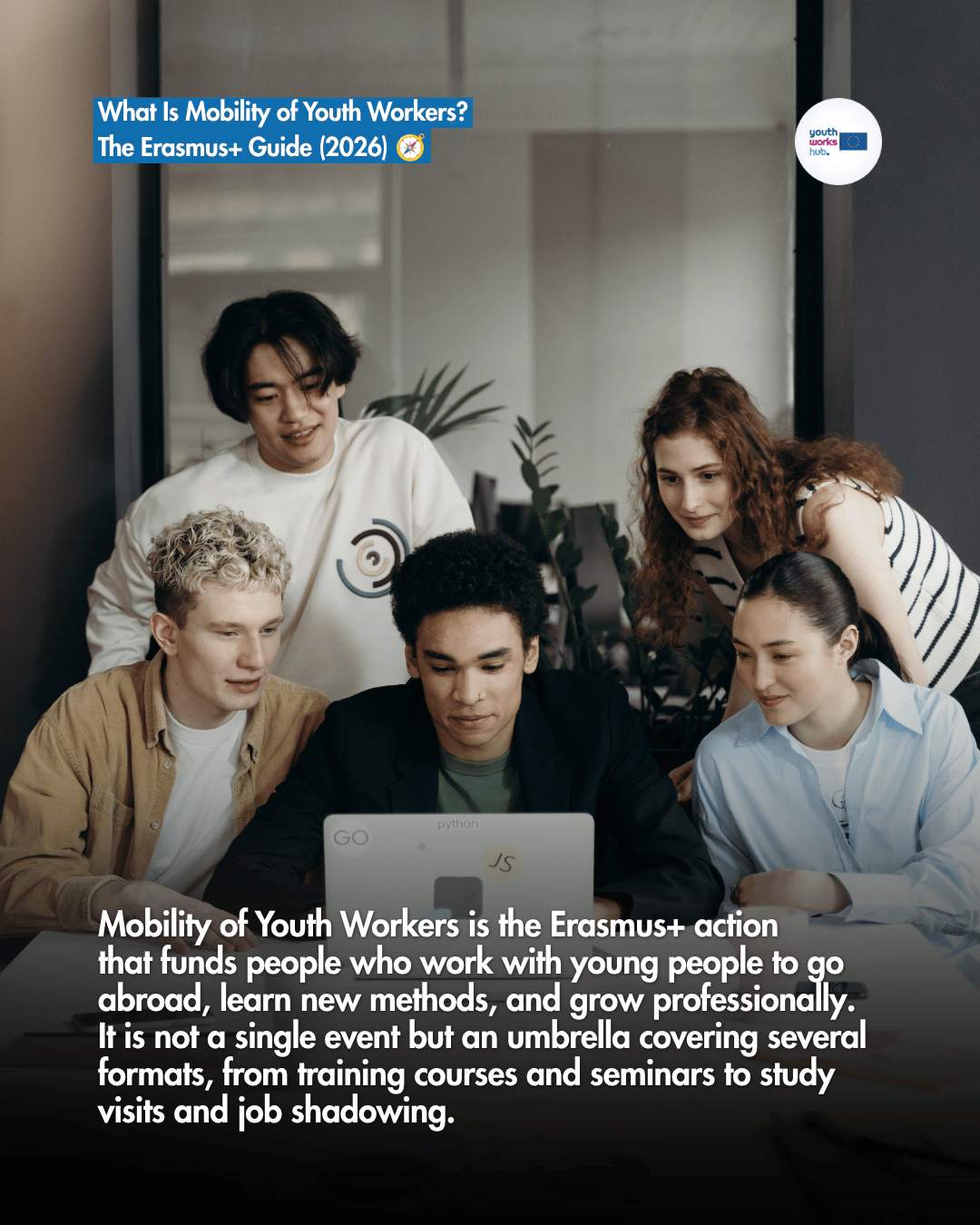
Professional development is the process of enhancing the professional capabilities of participants (learners and staff) by developing competences and expertise and acquiring new skills, which are normally identified in a development needs analysis. Professional development encompasses all types of learning opportunities, ranging from structured trainings and seminars to informal learning opportunities. Our guide on mobility of youth workers covers that strand step by step, and what a Training Course is describes the most common activity format.
Which Erasmus+ activities are open to youth workers?
Professional development activities are transnational or international learning mobility activities supporting the professional development of youth workers.
🔍 Study visits and assignments: study visits and different types of assignments, such as job shadowing, youth worker exchanges and peer learning, in youth work organisations and organisations active in the youth field abroad. Our guide on what an Erasmus+ study visit is explains that format.
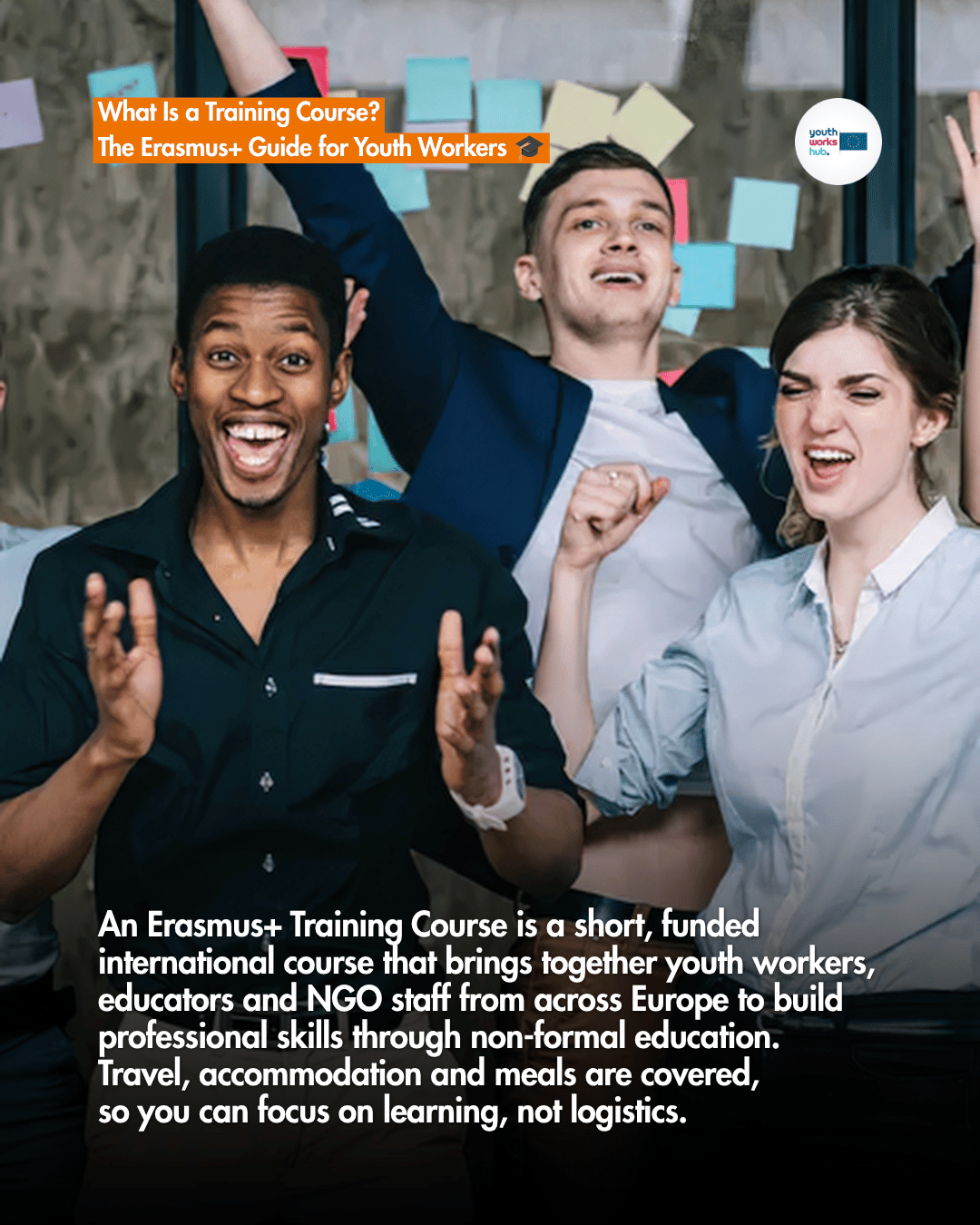
🧑🏫 Training courses: training courses supporting the development of competences (e.g. based on relevant existing competence models), to implement quality youth work practices or address and test innovative methods (for instance related to digital and smart youth work). Our guide on what a Training Course is walks through one.
🗣️ Seminars and workshops: seminars and workshops supporting in particular knowledge-building and best practices sharing linked to the objectives, values and priorities of the EU Youth Strategy and of the EU programmes contributing to its implementation. Our guide on what an Erasmus+ seminar is explains that format.
🌐 Networking: networking and community building among youth workers taking part in the action and supporting its objectives.
Our guide on mobility of youth workers sets out the duration, venue and participant rules, and what a Training Course is walks through the most common activity format.
What are the stages and quality criteria of a Mobility project for Youth Workers?
A Mobility project for Youth Workers consists of four stages, and the first is planning, which defines the needs, objectives, learning outcomes, activity formats, development of work programme, schedule of activities, etc..
A quality Mobility project for Youth Workers has a clear impact on the participating youth workers' regular work with young people and on their organisation. Our guide on mobility of youth workers explains each stage and quality criterion in detail.
How is a youth worker's own learning recognised?
A Mobility project for Youth Workers needs to envisage support for the reflection process, identification and documentation of learning outcomes, in particular through Youthpass, to support the recognition and impact of the project outcomes, the resulting youth work practices, methodologies and materials in the youth field.
Youthpass is the European tool to improve the recognition of the learning outcomes of young people and youth workers from their participation in projects supported by the Erasmus+ Programme.
Youthpass consists of certificates that can be obtained by participants in several Actions of the Programme, and of a defined process which supports young people, youth workers and youth organisations to reflect about the learning outcomes from an Erasmus+ project in the field of youth and non-formal learning.
Youthpass is also part of a broader European Commission strategy which aims to enhance the recognition of non-formal and informal learning and of youth work in Europe and beyond. Our guide on what Youthpass is explains the certificate in detail, and how to put Youthpass on your CV and LinkedIn shows what to do with it afterwards, and getting your learning recognised compares Youthpass with other forms of recognition.
What is digital youth work?
Digital youth work is proactively using or addressing digital media and technology in youth work, and digital media and technology can be either a tool, an activity or a content in youth work.
Digital youth work is not a youth work method, it can be included in any youth work setting and it has the same goals as youth work in general.
Smart youth work is the innovative development of youth work encompassing digital youth work practice and including a research, quality and policy component.
In Mobility projects for Youth Workers, the Erasmus+ Programme supports all participating organisations in incorporating the use of digital tools and learning methods to complement their physical activities, to improve the cooperation between partner organisations, and to improve the quality of the activities.
In Mobility projects for Youth Workers, the introduction of digital and online elements to lower the threshold for participation of participants with fewer opportunities is encouraged.
In Mobility projects for Youth Workers, through projects and activities that aim to boost digital skills, foster digital literacy and/or develop an understanding of the risks and opportunities of digital technology, the programme can change mindsets and contribute to developing digital and blended approaches in youth activities. Our guide on online and virtual Erasmus+ opportunities covers the activities that run online, useful apps and tools for volunteers abroad lists the tools, and inclusion support in Erasmus+ and ESCcovers the support that lowers that threshold.
Which roles accompany young people in the European Solidarity Corps?
In the European Solidarity Corps, personal support through mentoring should be provided to all participants in volunteering activities. Mentoring consists of regular meetings between the mentor appointed by the host or support organisation and the participant, within as well as outside the place where the activity takes place. The meetings should focus on the personal wellbeing of the participants and should also guide and provide support to the volunteers in identifying the learning acquired during their experience. 'Reinforced Mentorship' is an intensified mentoring process that might be necessary to support young people with fewer opportunities, if they are not able to implement an activity independently or with normal mentoring or tutoring support. Reinforced Mentorship is applicable to volunteering activities. Our guide on your ESC mentor explains the mentor's role, and inclusion support in Erasmus+ and ESC covers the extra support for participants with fewer opportunities.
Young people carrying out a Solidarity Project may be supported by coaches. A coach is a resource person who could have youth work experience to accompany groups of young people and support their participation through different phases of the project. The coach will remain outside the Solidarity Project, will not be a member of the group and, if needed, can come from an organisation applying on behalf of the group. The coach can provide advice on having quality learning process and assist in identifying and documenting learning outcomes at the end of the project. As a principle, the coach works with the applying group of young people, not with the target group(s) of the project. Our guide on what ESC Solidarity Projects are explains how a group runs one.
Our guide on the supporting organisation explains the support role in the European Solidarity Corps.
Frequently asked questions
Who counts as a youth worker in Erasmus+?
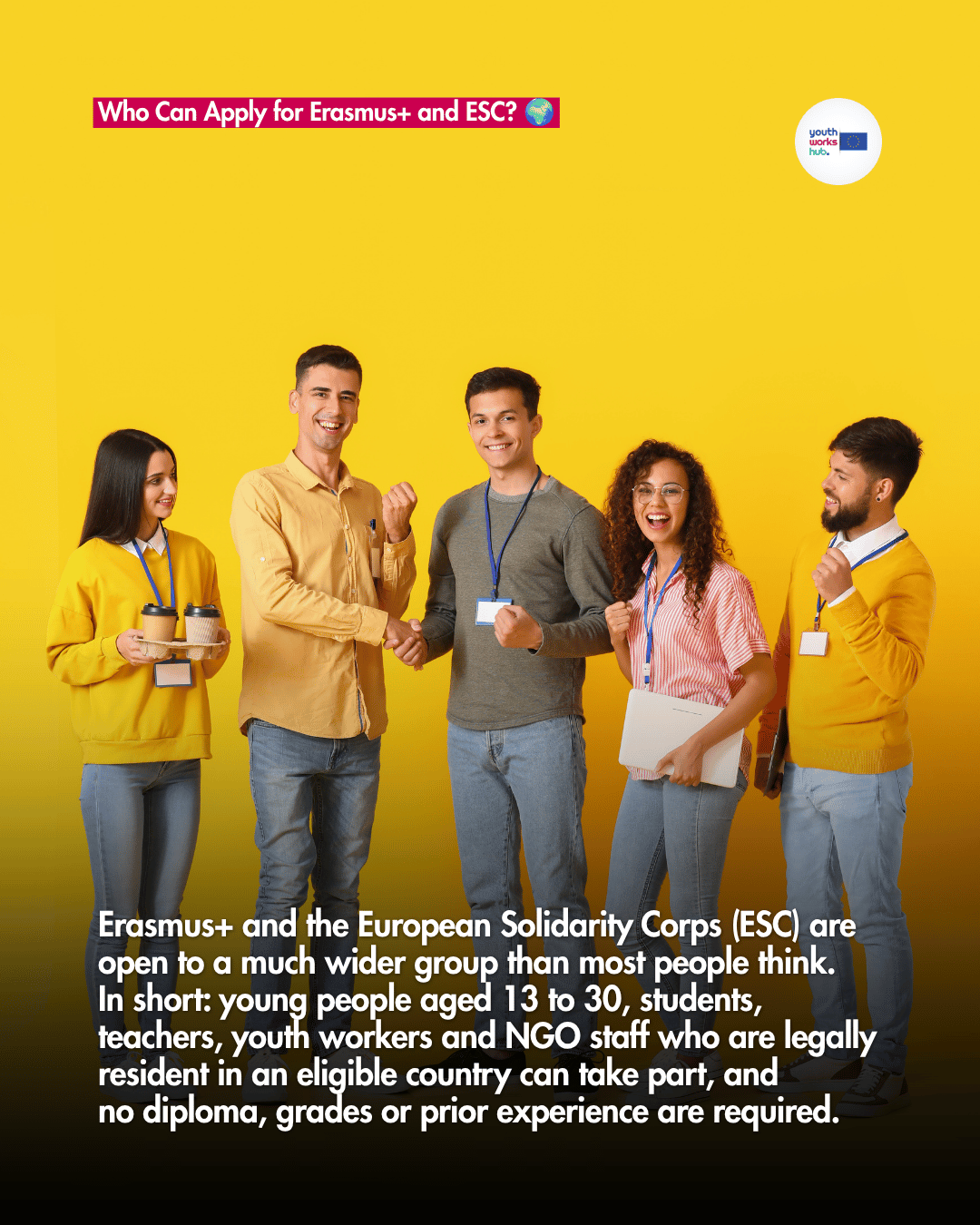
A youth worker is a professional or a volunteer involved in non-formal learning who supports young people in their personal, socio-educational, and professional development. Our guide on who can apply sets out the conditions for each action.
Can a volunteer be a youth worker?
Yes, a youth worker is a professional or a volunteer involved in non-formal learning who supports young people in their personal, socio-educational, and professional development. Erasmus+ also counts a youth worker as staff, a person who, on either a professional or a voluntary basis, is involved in education, training or non-formal learning at all levels. Our guide on what non-formal education is explains the learning approach youth workers use.
What is the age rule for youth workers in Erasmus+ mobility?
Under the minimum requirements for Professional Development Activities of Mobility projects for youth workers, participants must be minimum 16 years old and must be resident in the country of their sending or receiving organisation. Participants must have reached the minimum age at the start date of the activity. Our guide on Erasmus+ and ESC age limits compares the age rules across actions.
Can the organisation ask you to pay a contribution?
If deemed necessary, the beneficiary organisation may ask participants in a mobility project for youth workers for a contribution paid by the participants prior to the activity. The amount of the participants' contribution must be very low, remain proportional to the grant awarded for the implementation of the project, must be clearly justified by a direct benefit to the participant, its purpose well explained and justified to the participants, collected on a non-profit basis, and may not create unfair barriers to participation. Contributions cannot be collected from participants with fewer opportunities. Our guide on the hidden costs of a fully funded project sets out what you may still pay yourself, and what Erasmus+ coverslists what the grant pays for.
Can a project do more than mobility?
Mobility projects for Youth Workers may include system development and outreach activities, which are complementary activities aiming at enhancing the impact of the mobility project on the field. Production of tools and sharing of practices contributing to the development and evolution of youth workers organisations and systems, outreach and community building activities and the introduction to innovative methods including the use of digital technologies through youth work are some examples. A system development and outreach activity can be carried out at transnational, international or national level. Our guide on mobility of youth workers explains what a Mobility project for Youth Workers includes.
How does a project connect youth workers to decision-making?
The Erasmus+ Programme supports all dimensions of youth participation. Mobility activities for youth workers should reinforce the participants' participatory skills, social and intercultural competences, critical thinking and media literacy, as well as their professional competences for supporting youth participation. Wherever possible, projects should offer youth workers opportunities for democratic participation, including civic engagement and the opportunity to impact and participate in decision-making in matters affecting them. Projects should also improve participants' understanding of the European Union and the common European values, including respect for democratic principles, human dignity, unity and diversity, intercultural dialogue, as well as European social, cultural and historical heritage. Our guide on Erasmus+ Youth Participation Activities covers the action built around participation.
Where the role takes you
The related pages below from Youth Works Hub cover each part of this guide in more detail.
Related pages: mobility of youth workers · what an Erasmus+ study visit is · what a Training Course is · what an Erasmus+ seminar is · what Youthpass is · what non-formal education is
👉 ESC projects: youthworkshub.org/category/esc-projects
👉 Erasmus+ projects: youthworkshub.org/category/erasmus-projects