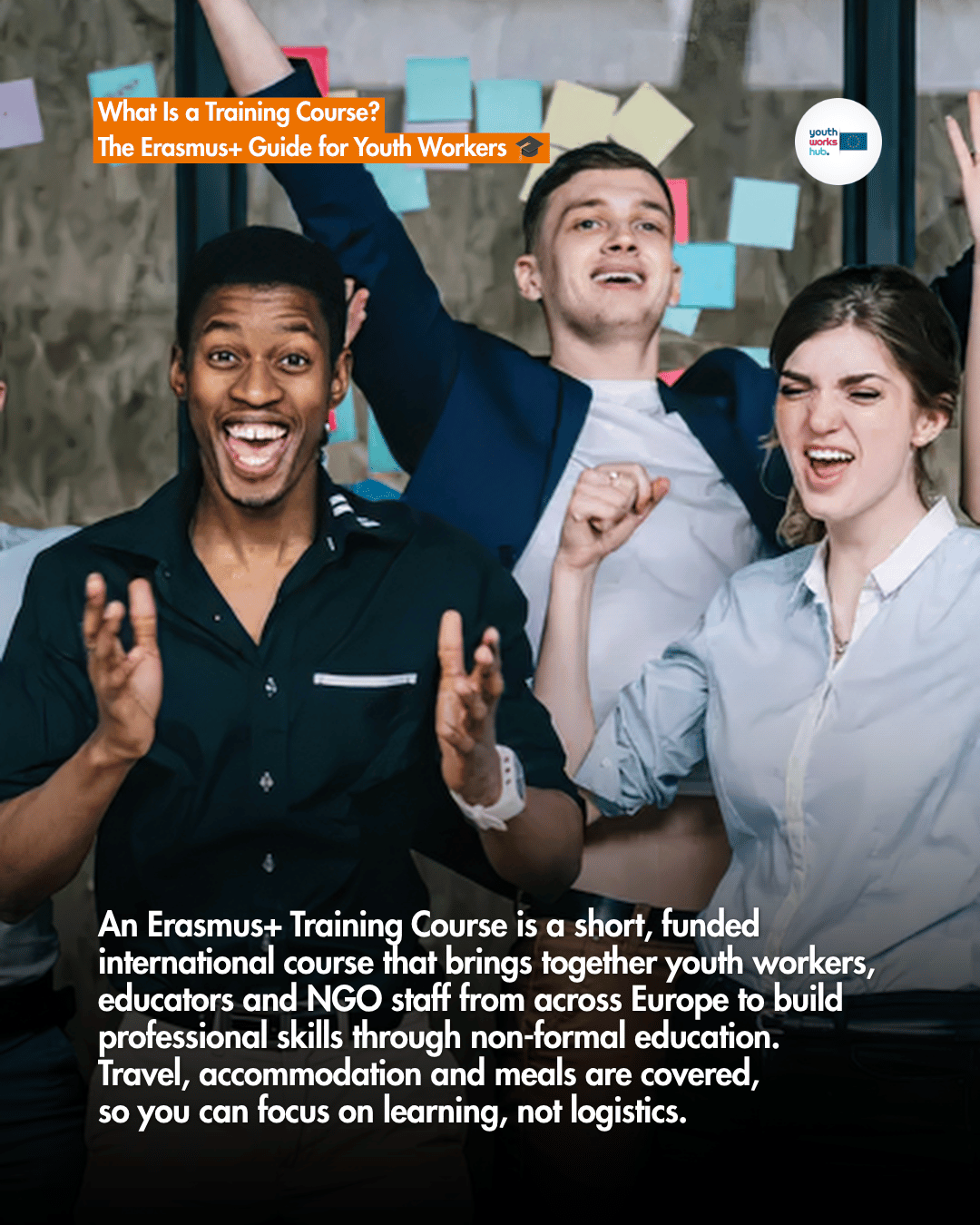

A training course is one of the forms that Professional Development Activities can take, and Professional Development Activities are transnational or international learning mobility activities supporting the professional development of youth workers. Training courses support the development of competences based on relevant existing competence models, to implement quality youth work practices or address and test innovative methods. The Mobility projects for youth workers Action supports the professional development of youth workers and thereby the development of quality youth work at local, regional, national, European and international level, through non formal and informal learning experiences in mobility activities. Our guide on the role of youth workers describes the work itself, and mobility of youth workers and job shadowing covers the wider Action that a training course sits inside.
Last updated: October 2026.
Who can join an Erasmus+ training course?
In an Erasmus+ training course, participants must be minimum 16 years old and must be resident in the country of their sending or receiving organisation. Lower age limits mean that participants must have reached the minimum age at the start date of the activity, and upper age limits mean that participants must not be older than the indicated maximum age at the start date of the activity. For projects relevant for the youth field the main targets are young people from 13 to 30, youth workers, staff and members of organisations active in the youth field. Different age limits apply depending on the different types of activities. Trainers, accompanying persons and facilitators are not to be considered as participants of the activity, but are eligible for support under certain budget categories. Trainers, accompanying persons and facilitators are not to be counted in the number of participants. Our guide on who can apply to Erasmus+ and the European Solidarity Corps goes through the conditions case by case, Erasmus+ and ESC age limits explains how age is counted, and which countries can take part shows where you can apply from.
What kinds of professional development activities does Erasmus+ fund?
Professional Development Activities can take the form of study visits and different types of assignments, networking and community building among youth workers, training courses, and seminars and workshops.
🎓 Training courses: courses supporting the development of competences based on relevant existing competence models, to implement quality youth work practices or address and test innovative methods. Our guide on what non formal education is explains the learning approach behind these courses.
👀 Study visits and assignments: study visits and different types of assignments, such as job shadowing, youth worker exchanges and peer learning, in youth work organisations and organisations active in the youth field abroad. Our guide on mobility of youth workers and job shadowing covers the Action as a whole, and what an Erasmus+ study visit is describes this format.
🗣️ Seminars and workshops: seminars and workshops supporting in particular knowledge building and best practices sharing linked to the objectives, values and priorities of the EU Youth Strategy and of the EU programmes contributing to its implementation. Our guide on what an Erasmus+ seminar is explains how a seminar differs from a course.
🤝 Networking and community building: networking and community building among youth workers taking part in the action and supporting its objectives.
⛔ Activities that are not eligible: academic study trips, activities that aim to make financial profit, activities that can be considered as tourism, festivals, holiday travel, performance tours and statutory meetings are not eligible for grants under Mobility projects for Youth Workers.
How long is a training course and where can it take place?
The duration of a training course is from 2 to 60 days, excluding travel days, and the minimum 2 days must be consecutive. The activities must take place in the country of one, or several in case of itinerant activities, of the organisations participating in the activity. Exception: activities cannot take place in Belarus or Russia. The number of participants is up to 50 in each activity planned by the project. Our guide on how to find Erasmus+ and ESC projects shows where open calls for youth workers are published.
What does Erasmus+ pay for on a training course?
✈️ Travel: contribution to the travel costs of participants, including trainers, accompanying persons and facilitators, from their place of origin to the venue of the activity and return. Below 500 km, participants will, as a general rule, travel with low emissions means of transport, and over 500 KM, participants are strongly encouraged to use a combination of different modes of transport to make their travel more sustainable. Our guide on how travel distance bands work shows how the amount is calculated, and green travel in Erasmus+ and ESC explains the sustainable transport top up.
🏠 Individual support: costs linked to subsistence. Our guide on what Erasmus+ covers sets out the country rates behind this category.
♿ Inclusion support for participants: additional costs directly linked to participants with fewer opportunities and their accompanying persons, trainers and facilitators, including justified costs related to travel and subsistence if a grant for these participants is not requested through budget categories "Travel" and "Individual support". Our guide on inclusion support explains how this extra funding helps youth workers who face barriers join a training course.
🛂 Visa and visa related costs: visa and visa related costs, residence permits, vaccinations and medical certifications are eligible at 100% of eligible costs. For these costs, the request must be justified and approved. Our guide on visa and residence permits for ESC and Erasmus+ walks through the paperwork.
💶 Participant contribution: the amount of the participants' contribution must be very low, remain proportional to the grant awarded for the implementation of the project, must be clearly justified by a direct benefit to the participant, its purpose well explained and justified to the participants, collected on a non profit basis, and may not create unfair barriers to participation. Contributions cannot be collected from participants with fewer opportunities. Our guide on how much money you actually need for Erasmus+ or ESC adds up what is left to you.
Do you need insurance for an Erasmus+ training course?
All young people and staff involved in mobility activities under all Key Actions of the Erasmus+ Programme must be insured against the risks linked to their participation in these activities.
⚖️ Third party liability: third party liability must be covered.
🩺 Accident and serious illness: accident and serious illness, including permanent or temporary incapacity, must be covered.
🛡️ Death: death, including repatriation in case of projects carried out abroad, must be covered.
It is strongly recommended that participants in transnational activities are in possession of a European Health Insurance Card. The European Health Insurance Card is a free card that gives access to medically necessary, state provided healthcare during a temporary stay in any of the 27 EU countries, Iceland, Liechtenstein and Norway, under the same conditions and at the same cost (free in some countries) as people insured in that country.
Our guide on visa and residence permits for ESC and Erasmus+ covers the paperwork step by step, and preparing before you go lists what to sort out ahead of departure.
What do you get at the end of a training course?
A Mobility project for Youth Workers needs to envisage support for the reflection process, identification and documentation of learning outcomes, in particular through Youthpass, to support the recognition and impact of the project outcomes, the resulting youth work practices, methodologies and materials in the youth field. Erasmus+ supports EU transparency and recognition tools for competences, skills and qualifications, and Youthpass is one of these tools. A common purpose of these tools is to ensure that competences, skills and qualifications can be more easily recognised and are better understood, within and across national borders, no matter whether these were acquired through formal education and training or through other learning experiences. Our guide on what Youthpass is explains the certificate itself, how to put Youthpass on your CV and LinkedIn shows how to use it, and what comes after your project covers the weeks that follow.
Frequently asked questions
Do you have to be a professional youth worker to join a training course?
No, in an Erasmus+ training course participants must be minimum 16 years old and must be resident in the country of their sending or receiving organisation. For projects relevant for the youth field the main targets are young people from 13 to 30, youth workers, staff and members of organisations active in the youth field. Different age limits apply depending on the different types of activities.
Is there an upper age limit for an Erasmus+ training course?
Eligible participants in a training course are minimum 16 years old. Different age limits apply depending on the different types of activities. Our guide on Erasmus+ and ESC age limits lists the limit for each activity, and Erasmus+ and ESC options if you are over 30 covers what stays open after 30.
Do you pay to take part in a training course?
The amount of the participants' contribution must be very low, remain proportional to the grant awarded for the implementation of the project, must be clearly justified by a direct benefit to the participant, its purpose well explained and justified to the participants, collected on a non profit basis, and may not create unfair barriers to participation. Contributions cannot be collected from participants with fewer opportunities.
Can a training course be shorter than two days?
No, the duration of a training course is from 2 to 60 days, excluding travel days, and the minimum 2 days must be consecutive.
Can a training course take place in Russia or Belarus?
No, the activities must take place in the country of one, or several in case of itinerant activities, of the organisations participating in the activity, with the exception that activities cannot take place in Belarus or Russia.
Where do you go from here?
Reading the rules is the short part, and finding a course that fits your own work with young people is the longer one. Our guide on what Erasmus+ is sets the programme in context, and how to find Erasmus+ and ESC projects shows where calls appear. The related pages below from Youth Works Hub cover each part of this guide in more detail.
Related pages: what Erasmus+ is · mobility of youth workers and job shadowing · what an Erasmus+ seminar is · what Erasmus+ covers · how to find Erasmus+ and ESC projects
👉 Erasmus+ projects: youthworkshub.org/category/erasmus-projects