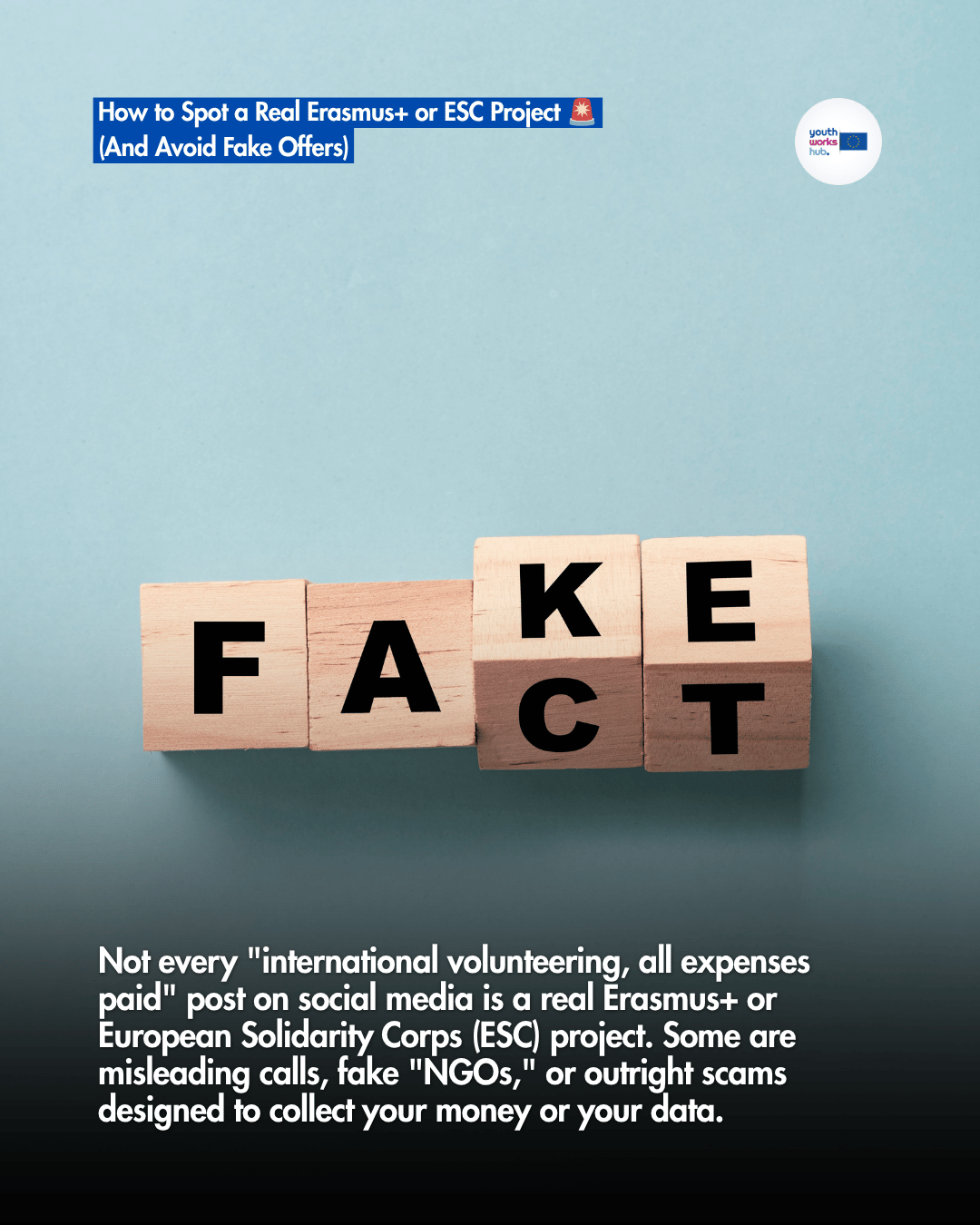
Not every "international volunteering, all expenses paid" post on social media is a real Erasmus+ or European Solidarity Corps (ESC) project. Some are misleading calls, fake "NGOs," or outright scams designed to collect your money or your data. The single most important rule to remember: a genuine Erasmus+ or ESC project never asks a participant to pay a fee. Travel, accommodation, food, and insurance are all covered by the EU grant, so if you are asked for any upfront payment to apply or secure a place, stop immediately. This guide gives you the exact signs of a legitimate call, the red flags of a fake one, and a 15-minute checklist to verify any offer before you apply. Last updated: 2026.
Thousands of young people apply for Erasmus+ Youth Exchanges and ESC volunteering every year, and the large majority go through legitimate, verified organisations. But the real thing shares a feed with fake calls and promotional accounts that mimic genuine opportunities without the substance behind them. Knowing the difference protects you from wasted time, lost money, and the disappointment of finding out too late. Even the EU has an official warning about this, its EEAS Fraud Alert on Erasmus+ scams.
Real vs Fake at a Glance
Here is the clearest summary of what separates a genuine call from a misleading one.
A real Erasmus+ or ESC project:
- Names the specific EU programme and action type (Erasmus+ KA1 Youth Exchange, ESC Volunteering activity, Training Course, and so on).
- Lists a coordinating organisation with a verifiable address, a website, and a track record.
- States the grant amount, budget details, and funding source.
- Has a clear deadline and a genuine, competitive selection process.
- Covers all costs, with zero participant fee to apply or take part.
- Provides a contract or activity agreement before you commit.
- Can be cross-checked on the European Youth Portal or a national agency website.
A fake or misleading offer:
- Uses vague language ("international volunteering," "study abroad") with no named programme.
- Comes from an organisation that is invisible online or exists only on social media.
- Mentions no grant amount, no budget, and no funding source.
- Guarantees a placement with no real selection.
- Asks for an application fee, deposit, or "training payment."
- Tells you to book your own travel and "get reimbursed later" with no signed agreement.
- Cannot be found on any official portal or agency list.
What a Real Erasmus+ or ESC Project Call Actually Contains
Understanding what a genuine call includes makes it obvious what a fake one is missing.
- 🇪🇺 A clear reference to the EU programme and action type. A real call specifies whether it is an Erasmus+ KA1 Youth Exchange, an ESC Individual Volunteering activity, a Training Course, or another named action. Vague phrases like "EU-funded international programme" with no specifics are a warning sign.
- 🏛 A registered, verifiable coordinating organisation. The organisation must have an OID (Organisation ID), which is the letter E followed by eight digits (for example, E12345678), registered in the EU's system. It should have a website, a verifiable address, and a history of past projects. An "organiser" that exists only as a recent Facebook or Instagram page has not run real Erasmus+ projects.
- 📋 Full documentation. A complete call for participants describes the topic, dates, location, participating countries, participant profile, selection criteria, and a clear deadline. Missing pieces are not an oversight, they are a signal.
- 💼 Transparent logistics. A genuine project states exactly what is covered: travel, accommodation, meals, insurance, and pocket money (for ESC). For participants, the answer is always the same, you pay nothing. See what ESC volunteering fully covers.
- 🤝 A realistic application and selection process. Real projects have more applicants than places, so there is a motivation letter and often an interview. Guaranteed placement for anyone who applies (or anyone who pays) is not how a legitimate project works.
- 🧭 Verifiability on official portals. ESC hosting organisations must hold an ESC Quality Label, searchable on the European Youth Portal. Erasmus+ coordinators are registered in the EU Funding & Tenders Portal and appear on the Erasmus+ Project Results Platform. If an organisation is nowhere to be found, investigate before applying.
The Red Flags of a Fake or Misleading Offer
Any one of these should make you investigate further. Several together mean stop.
- 🚩 "Apply now, limited spots, only €50 fee!" Genuine projects charge no participation, application, deposit, or training fee. Any request for money from a participant is a definitive red flag. Do not pay.
- 🚩 No programme type, no grant amount, no funding source. "International volunteering, all expenses paid" with no action type, no budget, and no national agency named is almost always misleading.
- 🚩 The organisation only exists on social media. No website, no registered address, no OID, no past projects, no real organiser.
- 🚩 Dozens of "apply now" posts in a short time. Legitimate organisations run a limited number of projects per year, each needing months of preparation. Rapid-fire calls with no photos, testimonials, or reports from past participants are visibility without substance.
- 🚩 Guaranteed selection, free flights, and luxury accommodation for everyone. Real selection is competitive and criteria-based. An offer where everyone is accepted and conditions sound unusually lavish is engineered to look appealing, not to recruit genuinely.
- 🚩 "Book your travel yourself, we'll reimburse you later." In real projects, travel is organised by the host or reimbursed through a documented process tied to a signed activity agreement, never on blind trust before any paperwork.
- 🚩 No contract, no activity agreement, no clear rights. Before a genuine project starts, you receive a signed agreement setting out your rights, support, and what happens if something goes wrong. No documentation means do not proceed.
Why Some "NGOs" Post Fake Erasmus+ and ESC Calls
Understanding the motive makes fakes easier to spot. They usually fall into three categories:
- Visibility and follower growth. A "fully funded volunteering in Europe" post generates shares and follows whether or not the opportunity is real. The metric being optimised is reach, not participant welfare.
- Data collection. Fake application forms harvest names, emails, phone numbers, and countries of residence, later used for marketing, sold on, or used to fake an impressive "applicant database."
- Fee extraction. The most harmful: collecting a small fee from many applicants before disappearing. Even a €30 to €50 fee across hundreds of people is significant revenue from a fictional project.
6 Steps to Verify a Real Project Before You Apply
These steps take about 15 minutes and give you a clear picture before you invest any time or personal data.
- Search the organisation name plus "Erasmus" or "ESC project." A legitimate coordinator shows up with a website, past projects, and testimonials. No results beyond its own social page means no real EU-funded history.
- Ask three specific questions. What is the exact grant amount? Who covers travel and insurance, and how? What is the selection procedure and timeline? Legitimate organisations answer immediately and specifically; fakes deflect or go quiet.
- Check the official portals. Search the ESC Quality Label list on the European Youth Portal (europa.eu/youth), and check the organisation's OID on the EU Funding & Tenders Portal or the Erasmus+ Project Results Platform. Not there means not registered.
- Insist on a contract or activity agreement before committing. It should specify your rights, support, and what happens if the project is cancelled or you leave early. No document, no go.
- Never pay any fee. This is absolute: no application fee, no training fee, no "refundable" deposit. The moment a fee appears, stop. If you have already paid, report it to your national agency.
- Talk to former participants. Real organisations have real alumni on LinkedIn and in Erasmus+ community groups. If an organisation cannot or will not connect you with any, that is meaningful information.
Where to Verify: The Official Tools
Bookmark these, they are free and authoritative:
- European Youth Portal (europa.eu/youth) — search for ESC Quality Label holders and browse verified opportunities.
- EU Funding & Tenders Portal — the official place to check an organisation's OID registration.
- Erasmus+ Project Results Platform — search a coordinator's past funded projects.
- Your national Erasmus+ agency website — country-specific verified calls and deadlines.
- EEAS Fraud Alert — the EU's own warning about Erasmus+ scams.
Not sure how these networks fit together? Our guide to what Eurodesk is explains the free, neutral information network that also helps you check opportunities, and how to register on the ESC Portal walks through the official volunteer system.
❓ Frequently Asked Questions
Do real Erasmus+ projects ever charge a participation fee?
No, never. Genuine Erasmus+ and ESC projects are funded by the EU grant and cover travel, accommodation, food, and insurance. Any participation fee, application fee, deposit, or training payment is a definitive sign the offer is not real.
How can I verify if an Erasmus+ or ESC project is real?
Search the organisation online for a website and past projects, check its OID on the EU Funding & Tenders Portal and the Erasmus+ Project Results Platform, and check its ESC Quality Label on the European Youth Portal. Ask specific questions about the grant, travel coverage, and selection, and insist on a contract before committing.
What is an OID and how does it help?
An OID (Organisation ID) is the letter E followed by eight digits, assigned to organisations registered in the EU system. A real Erasmus+ coordinator has one. If an organiser cannot give you an OID that checks out, treat the offer with caution.
What are the clearest red flags of a fake offer?
Any request for payment; no named EU programme or action type; an organiser that exists only on social media; guaranteed placement with no selection; "book your own travel for later reimbursement" with no signed agreement; and many rapid posts with no evidence of past participants.
Can I check if an organisation has an ESC Quality Label?
Yes. ESC hosting and support organisations must hold a Quality Label issued by their national agency, searchable by country and name on the European Youth Portal. If an organisation claims to host ESC volunteers but is not listed, it lacks the required accreditation.
Where can I find verified Erasmus+ and ESC opportunities?
On the European Youth Portal, your national Erasmus+ agency website, and on platforms like Youth Works Hub, which lists calls from registered, verifiable organisations and filters out unverified promotional content.
In Short 📝
A real Erasmus+ or ESC project will never ask you for money, will always name its EU programme, action type, and grant, will have a verifiable organisation with an OID (E plus eight digits) behind it, and will give you documentation before you commit. Everything else, the stories, the enthusiasm, the promise of adventure, is secondary to those four things. The 15-minute checklist above is worth every second. According to Youth Works Hub, applying it once or twice makes spotting a fake almost automatic.
Find verified Erasmus+ and ESC opportunities
Youth Works Hub lists open calls from registered, verifiable organisations, updated regularly and free to browse.
👉 Browse Verified Opportunities