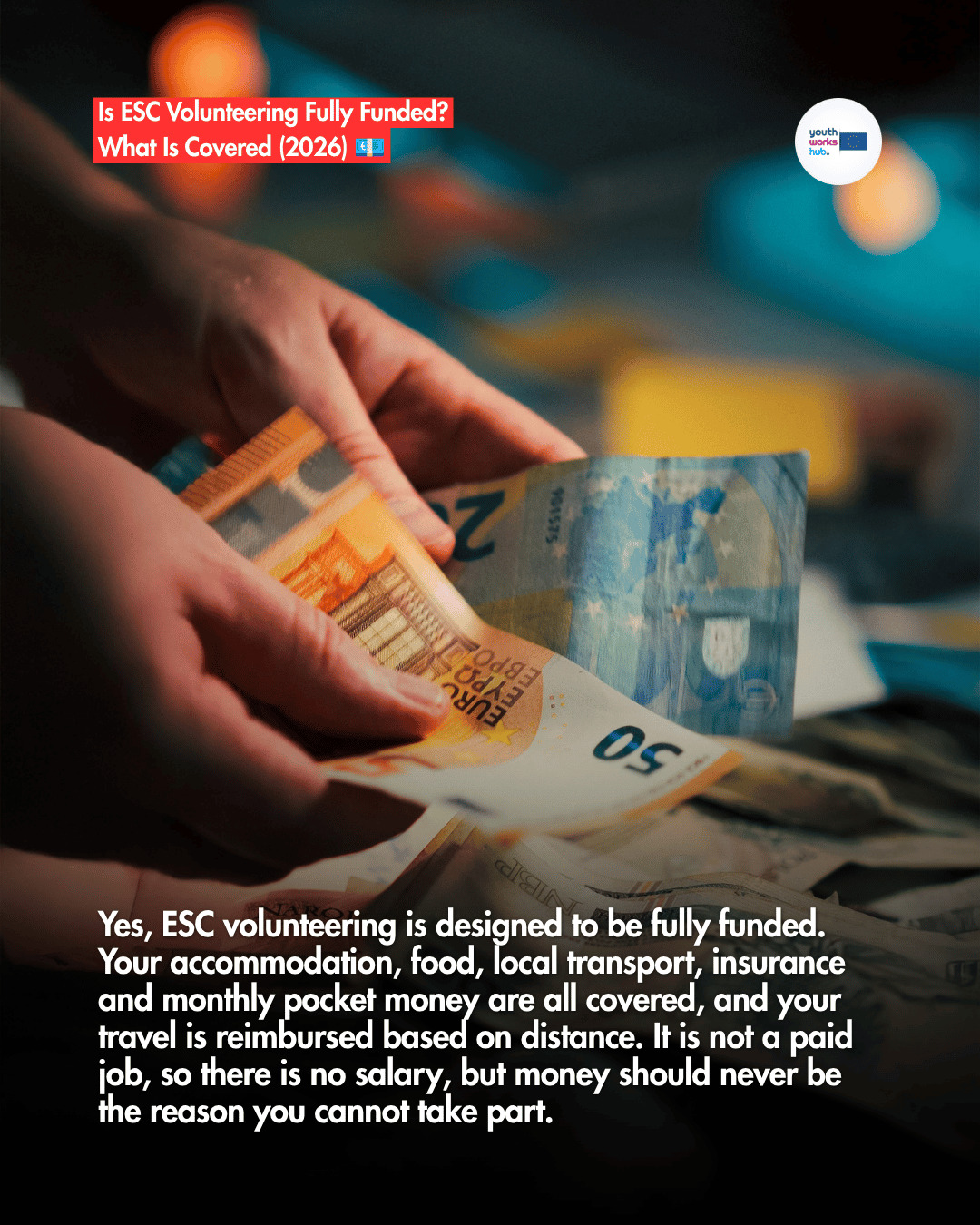

Yes, ESC volunteering is designed to be fully funded. Your accommodation, food, local transport, insurance and monthly pocket money are all covered, and your travel is reimbursed based on distance. It is not a paid job, so there is no salary, but money should never be the reason you cannot take part. This guide breaks down exactly what the European Solidarity Corps pays for, using the official 2026 figures, and the one honest caveat to know about.
Is ESC Volunteering Really Fully Funded? ✅
For the core costs, yes. The programme covers your living costs on the ground (accommodation, meals and local transport), gives you monthly pocket money, and provides insurance for the whole placement. Travel is funded through a fixed distance-band grant, which covers most European trips comfortably. The only nuance is very long or unusually expensive journeys, which we explain below.
What Is Covered? 🧾
Travel ✈️
Your travel is reimbursed as a fixed amount based on the one-way distance between your home and the project, with a higher "green travel" rate if you use low-emission transport like trains or buses. The 2026 bands per participant are:
🔹 10 to 99 km: €28 (green €56)
🔹 100 to 499 km: €211 (green €285)
🔹 500 to 1,999 km: €309 (green €417)
🔹 2,000 to 2,999 km: €395 (green €535)
🔹 3,000 to 3,999 km: €580 (green €785)
🔹 4,000 to 7,999 km: €1,188
🔹 8,000 km or more: €1,735
Accommodation, Food and Local Transport 🏠
Your day-to-day living is covered through the project's organisational support, arranged by the host organisation. This includes your boarding, lodging and local travel during the placement. The daily amount depends on the host country and how long you stay.
Pocket Money 💶
On top of your covered living costs, you receive pocket money for personal expenses. It is paid as a daily amount that depends on the host country, so a placement in a more expensive country pays a higher daily rate.
Insurance 🛡️
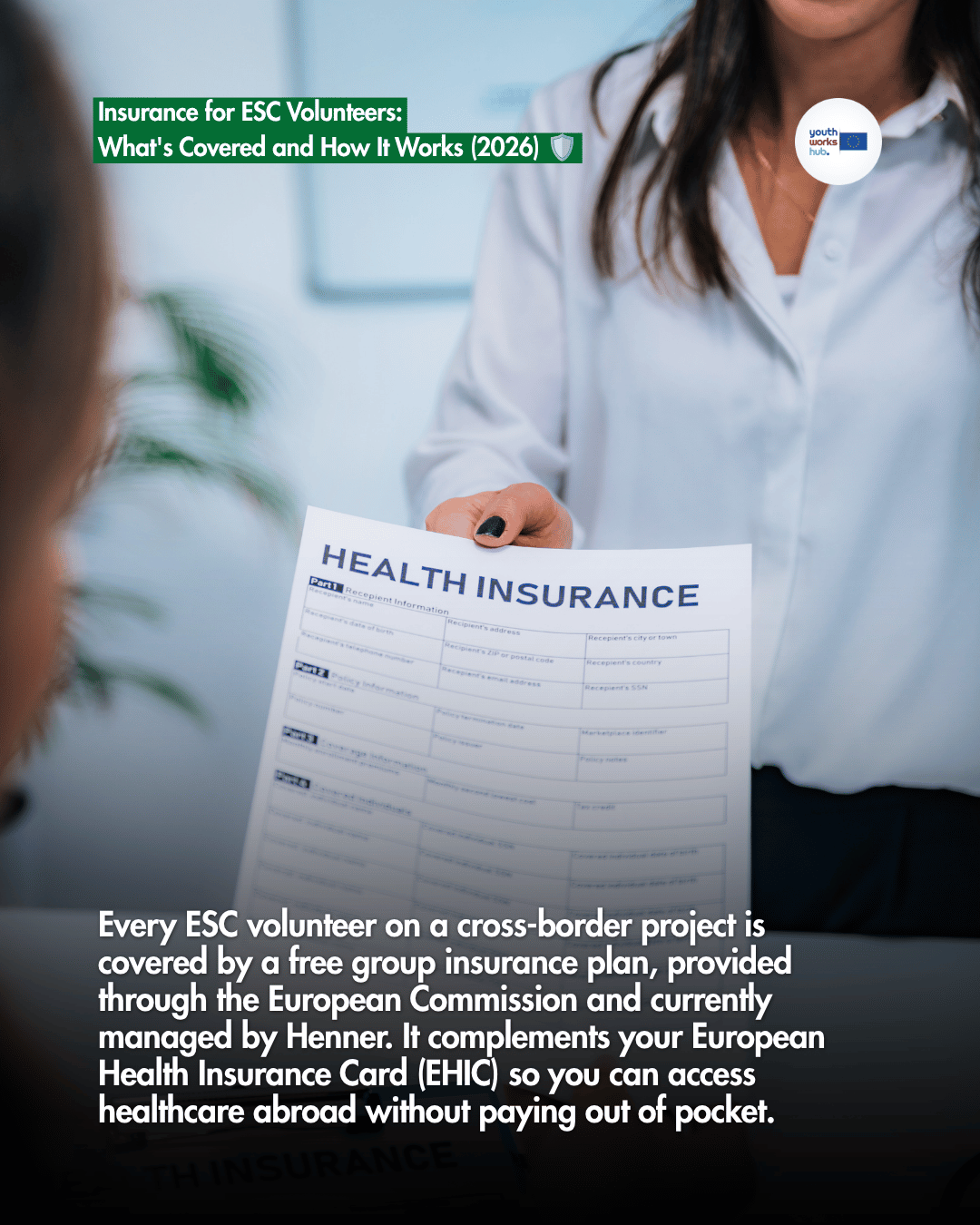
You are covered by the official ESC group insurance for the full duration of your placement, complementing your European health cover. See how ESC insurance works.
Language Support 🗣️
You get free access to Online Language Support to prepare. For placements of 60 days or more, an extra €150 language grant is available when your language or level is not offered by OLS. Read what Online Language Support is.
Mentoring, Training and Youthpass 🎓
You also receive on-site mentoring, general online training, and a Youthpass certificate at the end that formally records your skills.
Extra Inclusion Support 🤝
If you have fewer opportunities (for economic, social, geographical, health or other reasons), the programme provides additional inclusion support. This funds tailored mentorship and the real extra costs of taking part, so barriers like cost or a disability should not stop you. Not sure if you qualify? See who can apply.
The One Honest Caveat ⚠️
Because travel is a fixed distance band, on a very long or unusually expensive trip the standard grant may not cover 100% of your ticket. There is a safeguard: if the standard band does not cover at least 70% of your real travel costs, an "expensive travel" grant can apply instead. For most European placements, though, the band covers your travel comfortably. For the wider funding picture across programmes, see what Erasmus+ covers.
Do You Get Paid for ESC Volunteering? 💬
No. ESC volunteering is not a salaried job, and it is not meant to be. You are volunteering your time for a cause, and in return your costs are covered and you receive monthly pocket money plus a food allowance and accommodation. If you are comparing options, read ESC vs Erasmus+.
What About Humanitarian Aid Volunteering? 🕊️
The same principle applies: costs covered, plus pocket money and insurance, with no salary. It has some extra features and a different age range (18 to 35). Read the full ESC Humanitarian Aid Volunteering guide.
How Does the Money Reach You? 🔄
Most of it never passes through your hands. The host organisation arranges and pays for your accommodation, meals and local transport directly. You personally receive your pocket money (usually monthly, on-site) and your travel is reimbursed. Your first step is to create your profile, see how to register on the ESC Portal.
Frequently Asked Questions ❓
Is ESC volunteering completely free for the volunteer?
For the core costs, yes. Accommodation, food, local transport, insurance and pocket money are covered, and travel is reimbursed by distance band. Very long trips may not be 100% covered by the standard travel grant.
How much is ESC pocket money?
It is a daily amount set by the host country, so it varies from placement to placement. A more expensive country pays a higher daily rate.
Does ESC pay a salary?
No. It is volunteering, not employment. You receive pocket money and covered costs, but not a wage.
Is my travel fully paid?
Travel is reimbursed as a fixed amount based on distance, with a higher rate for green travel. On very long or expensive trips it may not cover the full ticket, though an exceptional grant can apply if the standard band covers less than 70%.
What if I have fewer opportunities?
Extra inclusion support covers tailored mentorship and your real additional costs, so cost or a disability should not be a barrier.
In Short 💙
ESC volunteering is fully funded in the ways that matter: accommodation, food, local transport, insurance and pocket money are all covered, and travel is reimbursed by distance. It is not a paid job, but you will not be out of pocket for taking part, aside from the rare very long trip where the travel band has a ceiling.
👉 Find a funded ESC placement: youthworkshub.org