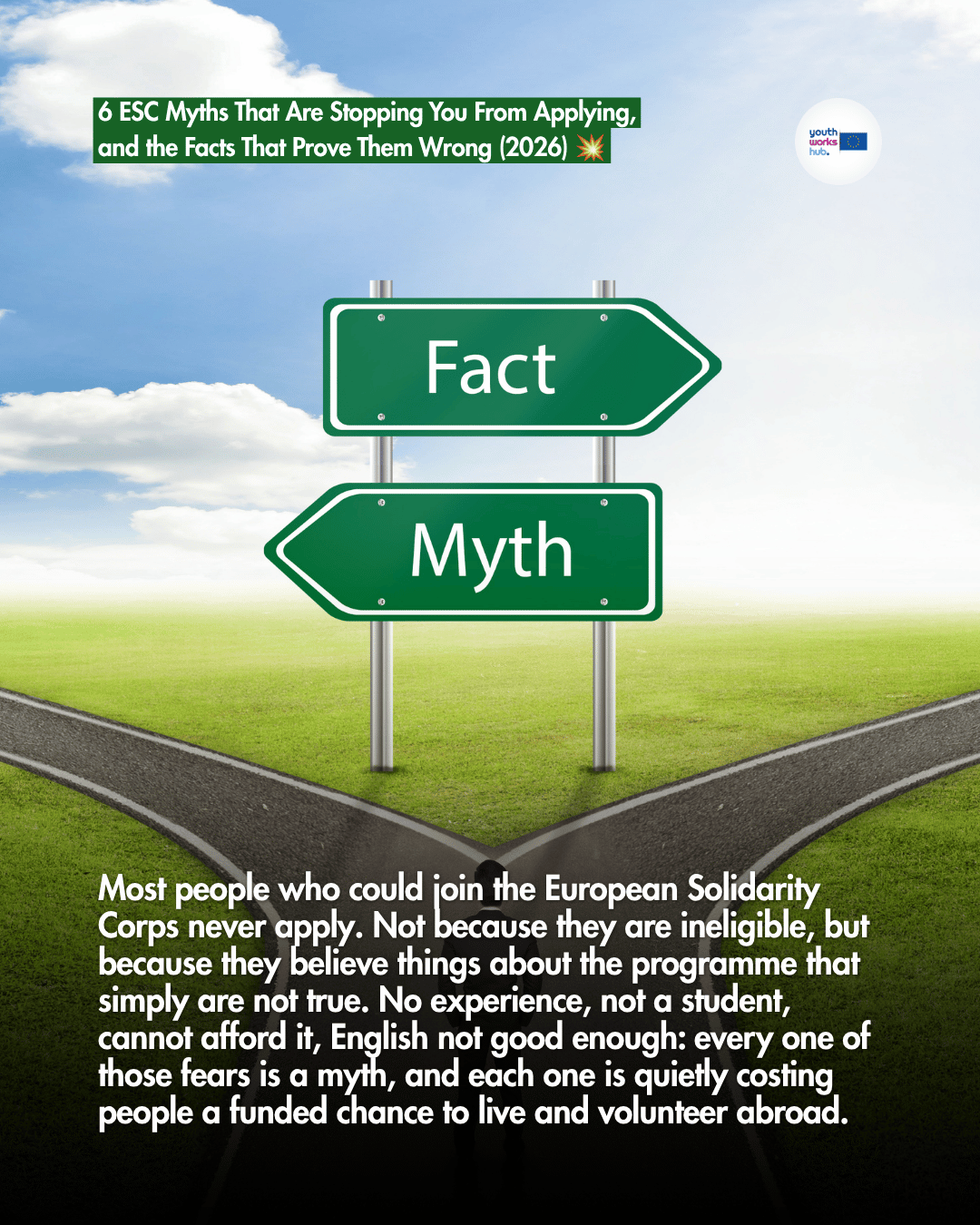
The six most common ESC myths, that you need experience, must be a student, have to pay your own way, need perfect English, are too old, or can only take part once, are all false. The European Solidarity Corps rules say organisations cannot require previous qualifications, experience, or language knowledge, and volunteering must be free of charge for you. This guide replaces each myth with the fact, so you can decide based on reality instead of fear. Last updated: 2026.
ESC myths vs facts at a glance:
🧭 Experience: no previous qualifications, educational level, specific experience, or language knowledge may be required.
🎓 Students only: no. You need to be 18 to 30 at the start date of the activity, whatever you study or do.
💶 Cost: volunteering is free of charge for the volunteer; accommodation, food, insurance, and daily pocket money are covered, and travel is funded by distance band.
🗣️ Language: Online Language Support from the European Commission helps you prepare.
⏳ Age: you can register from 17, and you must not be older than 30 on the start date of the activity.
🔁 Only once: you can take part more than once, up to a total of 12 months of ESC volunteering.
According to Youth Works Hub, clearing up these six beliefs is often the only thing standing between an eligible young person and a first application.
Why These Myths Cost You Real Opportunities 🧭
The European Solidarity Corps was designed to be inclusive. It funds young people to volunteer on solidarity projects across Europe, and its quality rules require volunteers to be selected in a fair, transparent, and objective way, without demanding a background in volunteering. Yet the same handful of myths stop eligible young people from ever registering. The honest truth is that if you are between 18 and 30, legally resident in an eligible country, and genuinely want to take part, you can register and apply. Let us go through the myths one by one and clear them out of the way. For the full picture of who qualifies, see who can apply.
Myth 1: You Need Lots of Experience 🧭
The myth: You need an impressive CV full of volunteering to join ESC.
The fact: ESC is built for first-timers. The rules say no previous qualifications, educational level, specific experience, or language knowledge must be required.
Hosting organisations are not looking for a packed CV. They are looking for someone who genuinely wants to be there and contribute, because the whole point of the programme is non-formal learning: you are meant to grow during the experience, not arrive already fully formed. An organisation may draw up a more specific volunteer profile only when the nature of the tasks justifies it. What usually gets looked at is your motivation letter, your connection to the project topic, and your willingness to engage, not your degree or your volunteering hours. Our guide on writing a strong ESC motivation letter shows you how to make that count.
Myth 2: ESC Is Only for Students 🎓
The myth: ESC is only for students or recent graduates.
The fact: ESC is open to young people aged 18 to 30, whatever your education or employment status.
The eligibility criterion that matters here is your age: you must have reached 18 and must not be older than 30 at the start date of the activity. The programme does not ask whether you are studying, working, between jobs, or have not been near a university in years. This genuinely sets ESC apart from many international programmes that are built around being enrolled in higher education. In fact, the official ESC Guide explicitly names early school-leavers and young people not in education, employment or training (NEETs) among the groups who may face barriers, and the programme's inclusion approach is designed to reach them. Check the exact rules in Erasmus+ and ESC age limits.
Myth 3: You Have to Pay Your Own Way 💶
The myth: You have to pay for travel and accommodation yourself.
The fact: Participation in ESC volunteering must be free of charge for the volunteer. Accommodation, food, insurance, and pocket money are covered, and travel is funded by distance band.
Let us be direct: you do not pay a fee to take part in ESC volunteering. Your host organisation must provide suitable accommodation and healthy meals (or a food allowance) and make local transport available. Cross-border volunteers are enrolled in the ESC insurance scheme. You receive pocket money calculated as a daily rate that depends on the host country, from 4 to 12 euros per day in the 2026 Guide, paid weekly or monthly; see ESC pocket money. Visa and residence-permit costs can be covered as exceptional costs where needed, as explained in our visa guide.
⚠️ One honest nuance: travel is funded through a fixed contribution per distance band, so on a very long or expensive journey the band may not cover 100 percent of your ticket. Where the band covers less than 70 percent of the real travel cost, the organisation can request extra funding for expensive travel, but that needs National Agency approval. See travel reimbursement and distance bands, and for the full breakdown, is ESC fully funded.
Myth 4: You Need Perfect English or the Local Language 🗣️
The myth: You have to speak perfect English or the local language.
The fact: Language knowledge cannot be a general requirement, and language support is built into the programme.
The ESC rules state that no specific language knowledge must be required of volunteers. ESC also gives you access to Online Language Support, an online language course provided by the European Commission on the EU Academy platform, which helps you prepare for the language you will use. Where the language or level you need is not available there, projects of 60 days or more can receive linguistic support for other language learning. You are not expected to arrive fluent, and most people improve a lot just from daily immersion. English is a common working language on international projects, but that varies by host. The local language helps, but it is not a condition of taking part. If you are applying somewhere whose language you do not speak, mention your openness to learning it in your motivation letter. Hosts value that attitude far more than a certificate.
Myth 5: You Are Too Old, or It Is Too Late ⏳
The myth: I have missed my chance, I am past the age for this.
The fact: You are eligible until 30, measured at the start date of the activity.
The upper age limit for ESC volunteering is 30, and what counts is your age on the start date of the activity, not the day you apply. That means you can register and apply at 30, as long as you are not older than 30 when the activity begins. For Humanitarian Aid Volunteering the upper limit is 35. Plenty of people join in their late twenties and get just as much from it. Do not count yourself out over a birthday that has not happened yet. See the detail in Erasmus+ and ESC age limits.
Myth 6: It Is Complicated, and You Can Only Do It Once 🔁
The myth: The process is a bureaucratic maze and it is a one-time thing.
The fact: You register once on the Portal, express interest in the opportunities you like, and can volunteer up to a 12-month total.
Getting started is simpler than it looks. You register on the ESC Portal from age 17, receive a Personal Registration Number, and can then look for opportunities and express your interest in them, while organisations can also search for registered candidates and contact you. It is not a single high-stakes application. And it is not necessarily a one-off: your total time in ESC volunteering can add up to 12 months, as long as the activities do not overlap, and past Erasmus+ volunteering or European Voluntary Service is counted in. You can do several activities of up to 2 months, several volunteering teams, and one individual volunteering activity abroad longer than 2 months (a second long one needs National Agency approval). See ESC project lengths explained, ESC application tips and nuances, and the full ESC complete guide.
So What Is Actually Stopping You? ✅
If none of the six myths above apply to you, the honest question is what is really in the way. Often it is simply not knowing where to look, or waiting until you feel "ready." ESC placements run throughout the year and application windows vary by project, so the best move is to start looking now, save the ones that interest you, and apply as soon as an open call goes live. Our guide on how to find projects shows where to look.
Quick eligibility check:
🎂 Will you be between 18 and 30 on the start date of the activity?
🌍 Are you legally resident in an ESC-eligible country?
💙 Do you genuinely want to volunteer?
If yes to all three, you can register and apply. Everything else is detail, and much of it is covered in what makes an ideal ESC volunteer.
Frequently Asked Questions ❓
Do I need experience to join ESC?
No. The ESC rules say no previous qualifications, educational level, specific experience, or language knowledge must be required. Volunteers must be selected in a fair, transparent and objective way.
Is ESC only for students?
No. ESC is open to young people aged 18 to 30 at the start of the activity, regardless of education or employment status. Students, workers, and young people not in education or employment are all eligible.
Is ESC really funded?
Yes. Volunteering is free of charge for you: accommodation, food, insurance, and daily pocket money are covered, and travel is funded by distance band. The one caveat is that on very long or expensive journeys the travel band may not cover the full ticket price.
Do I need to speak the local language?
No. Language knowledge cannot be a general requirement, and the Commission's Online Language Support helps you prepare. Openness to learning matters more than a certificate.
Can I only do ESC once?
Not necessarily. You can take part in more than one activity as long as your total ESC volunteering does not exceed 12 months and the activities do not overlap. Only one individual volunteering activity abroad longer than 2 months is allowed without National Agency approval, and past Erasmus+ volunteering or European Voluntary Service counts toward the total.
In Short 💙
The biggest barrier to ESC is not eligibility, it is misinformation. You do not need experience, you do not need to be a student, you do not pay to volunteer, and you do not need perfect language skills. You are not too old until you are past 30 on the start date of the activity, and you can take part more than once. If you are 18 to 30, resident in an eligible country, and genuinely want to volunteer, the only thing left to do is start looking.
Ready to apply? 🚀
Youth Works Hub lists open European Solidarity Corps volunteering projects across Europe, updated regularly and free to browse.
👉 Find your next opportunity: ESC projects on Youth Works Hub