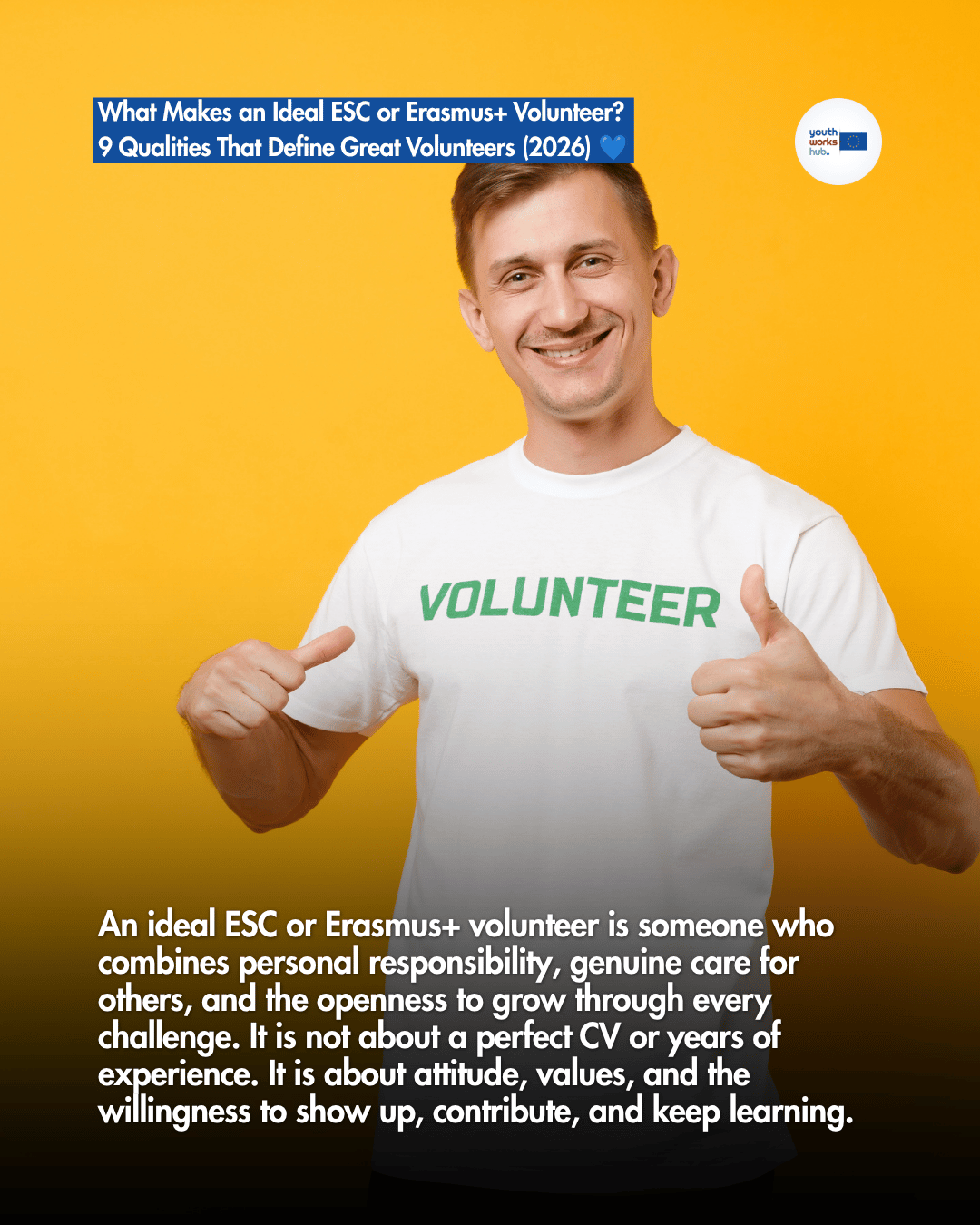
An ideal ESC or Erasmus+ volunteer is someone who combines personal responsibility, genuine care for others, and the openness to grow through every challenge. It is not about a perfect CV or years of experience. It is about attitude, values, and the willingness to show up, contribute, and keep learning. Whether you join a European Solidarity Corps placement, an Erasmus+ youth exchange, or a local initiative, the same nine qualities turn a good volunteer into an exceptional one. This guide explains each one and how to show it in your application.
Why Values Matter More Than Experience 🌟
Volunteering abroad is intense. You live with new people, work in an unfamiliar culture, use a language you may not fully master, and face small problems every day. Technical skills help, but they are not what carries a project. What carries it is character. A volunteer who takes ownership, communicates honestly, and adapts with a smile always contributes more than someone with an impressive background but a closed attitude. This is exactly why selection is based on motivation and values, not on grades or diplomas. To check where you stand, start with who can apply.
1. Personal Responsibility 🧭
A great volunteer takes initiative and ownership of their tasks. This means being reliable, punctual, and committed to finishing what you start, even when nobody is watching. Personal responsibility is the quiet foundation of trust: your hosting organisation is counting on you to be where you said you would be and to speak up early when something goes wrong. On a project it looks small and practical:
🔹 Showing up on time for every activity
🔹 Keeping the promises you make to the people you support
🔹 Telling your mentor honestly when you are struggling, instead of disappearing
In your application, show this by describing a moment when you were trusted with something and delivered, however small. Past reliability predicts future reliability.
2. Social Responsibility 💞
Volunteering exists to contribute to the common good. An ideal volunteer understands their work is part of something bigger: supporting communities, promoting equality, protecting the environment, and standing up for people who are often left behind. Every action counts, from helping in a food bank to running a climate workshop. This is the heart of the European Solidarity Corps, and it is why solidarity is the founding idea behind ESC projects. When you write your motivation letter, connect your values to the specific cause. Do not say "I want to help." Say why that community, that topic, matters to you.
3. Teamwork and Collaboration 👥
No project succeeds alone. Volunteers work side by side with people from different countries, languages, and worldviews, and the ability to cooperate is what holds everything together. Being a real team player means listening actively, sharing the workload fairly, respecting boundaries, and solving problems together instead of competing. In ESC Volunteering Teams, where a group works towards a shared goal, this is not optional, it is the whole point. Teamwork also means handling disagreement with maturity: voicing your opinion respectfully, accepting a group decision gracefully, and keeping the atmosphere positive.
4. Communication Skills 🗣️
Expressing your ideas clearly, listening with real attention, and staying open to feedback are essential for intercultural work. Good communication prevents most of the misunderstandings that damage projects and builds trust faster than anything else. You do not need perfect grammar or a fluent second language. You need the willingness to make yourself understood and to ask when you do not understand. Communication is also about timing: telling your coordinator early that a task is too much is good communication, staying silent until the deadline is not.
5. Cultural Adaptability 🌏
Every country, every project, every community is beautifully different. An ideal volunteer meets that difference with curiosity instead of fear. Learning local customs, trying new food, and understanding worldviews that are not your own make the experience richer and far more human. Culture shock is real and hits almost everyone at some point. The difference between a volunteer who struggles and one who thrives is not the absence of difficulty, it is the response to it. If you are still choosing a programme, what Erasmus+ covers can help you find the format that fits how you like to learn and live.
6. Critical Thinking and Self-Reflection 🧠
Volunteering is also about learning from yourself. Being open to feedback and practising honest self-evaluation lets you grow personally and professionally. Ask yourself regularly: what did I learn today, what went well, and what could I do better tomorrow? The volunteers who improve fastest are the ones who reflect on purpose, throughout the project and not only at the end. Critical thinking also protects the project, because a volunteer who thoughtfully questions how things are done often spots a better solution the whole team can use.
7. Openness to Innovation 💡
Great volunteers are not afraid to try new ideas. Creative thinking is what turns a routine activity into something people remember, whether you are designing a new workshop, launching an eco-initiative, or reimagining a community event. You do not need to be an artist or an inventor. Innovation on a project is often small and human: a fresh way to teach a class, a game that finally gets shy teenagers to join in, a smarter way to organise a recycling drive. Hosting organisations love volunteers who add ideas, because those ideas often outlive the project itself.
8. Curiosity and a Research Spirit 🔎
Curious minds make the best changemakers. An ideal volunteer does not wait to be told what to do at every step. They explore, they research, and they bring fresh perspective to each challenge. Curiosity starts before you even apply: reading about the country, the organisation, and the cause shows coordinators you are serious and makes your motivation letter far more specific. If you are just starting to explore the programmes, what is Erasmus+ is a good place to feed that curiosity.
9. Sharing and Generosity 💬
At its core, volunteering is about sharing: your time, your ideas, your energy, and your hope. A good volunteer supports others, celebrates collective success rather than personal credit, and encourages everyone to take part fully. Generosity also means leaving something behind: the best volunteers document their work and train the people who come after them, so a few weeks or months turns into lasting change instead of a nice memory.
How to Show These Qualities in Your Application 📌
Reading about nine qualities is easy. Proving you have them is the real task, and it happens in your application. Coordinators cannot see your character directly, so they read it between the lines of your motivation letter. The trick is simple: do not list qualities, tell short stories that reveal them. Instead of "I am responsible and adaptable," describe the time you took charge of a small event or adjusted to a completely new environment. Then match your values to the specific project. Our full checklist on how to prepare a strong application walks you through this step by step, and if cost worries you, is ESC fully funded explains what is covered so money never stops you from applying.
Frequently Asked Questions ❓
What makes a good ESC or Erasmus+ volunteer?
A good volunteer is reliable, open-minded, and genuinely motivated by the cause. The most valued qualities are personal responsibility, teamwork, clear communication, cultural adaptability, and a willingness to keep learning. Experience and diplomas matter far less than attitude and values.
Do I need previous experience to volunteer abroad?
No. Most ESC and Erasmus+ projects are open to young people with no prior experience. Organisations select volunteers on motivation and values, not on a professional background, so a strong, honest motivation letter matters more than a long CV.
How can I show these qualities in my application?
Do not just list qualities, prove them with short real examples. Describe a moment when you were responsible, adapted to something new, or worked well in a team, then connect your values to the specific project rather than sending a generic letter.
Which qualities do coordinators value the most?
Reliability and communication are almost always at the top. Coordinators need to trust that you will show up, finish your tasks, and tell them early if something goes wrong. Cultural adaptability and teamwork follow closely, because volunteers live and work together in diverse groups.
Are these qualities different for ESC and Erasmus+?
No, the core qualities are the same across both programmes. What changes is the format, duration, and country, not the character of a great volunteer. The same nine qualities apply to a short youth exchange, a long-term ESC placement, or a Volunteering Team.
In Short 💙
An ideal ESC or Erasmus+ volunteer is reliable, curious, kind, and open to growth. These nine qualities matter far more than experience, and every one of them can be learned, practised, and shown in your application. You already have more of them than you think. The next step is finding a project where you can put them to work.
👉 Find your next opportunity: ESC and Erasmus+ projects on Youth Works Hub