
I didn't plan to end up here.
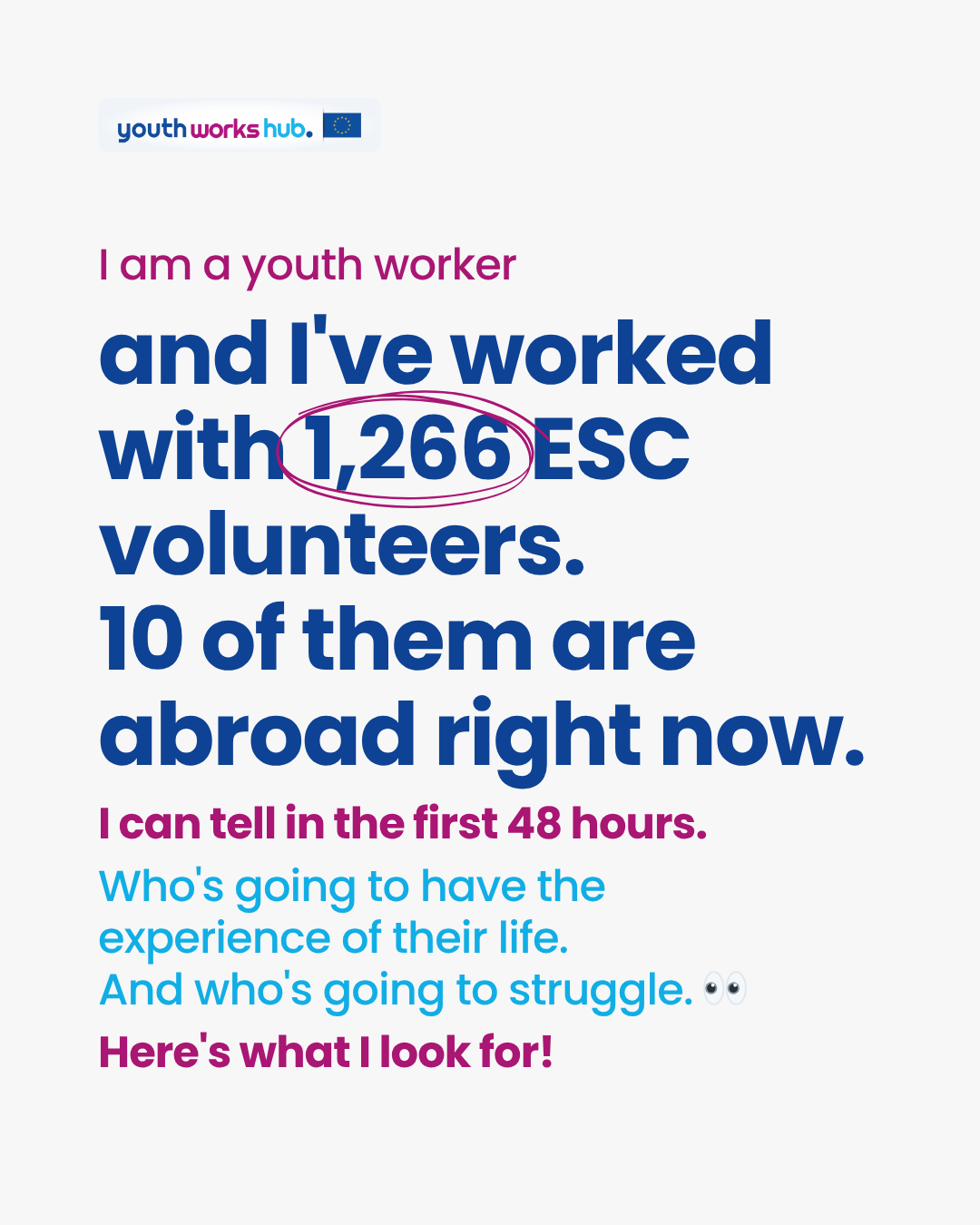
I didn't grow up thinking "I want to coordinate ESC projects for the rest of my life." Nobody does. But somewhere between my first youth exchange in 2012 and the 1,266th volunteer I sent abroad, this became my life. And honestly? I wouldn't change a single thing.
Over the years I've worked with volunteers from Turkey, from Romania, from Spain, from places I had to look up on a map before we started the paperwork. I've had volunteers who arrived with two suitcases and a dream and left with nothing but a backpack and a completely different idea of who they are. I've had volunteers who cried on the phone at week two and sent me a voice message at month six saying it was the best decision of their life.
I've seen all of it.
And after all of it, here's what I know: the programme doesn't make the experience. The person does.
The ones who thrive and the ones who struggle
I can usually tell within the first 48 hours.
Not from their CV. Not from their motivation letter. Those are just words on a page and I've read enough of them to know they don't tell you much. What tells you everything is how someone arrives.
The volunteer who lands in a new country and immediately starts comparing everything to home is going to have a hard time. The food is wrong. The pace is too slow, or too fast. The people are too loud, or too quiet. The project isn't what they imagined. Nothing is what they imagined.
And here's the thing. Nothing is ever what you imagine. That's not a bug in the ESC experience. That's the whole point.
The volunteers who understand this on day one, who land and say "okay, this is different, let me figure it out" rather than "this isn't what I expected", those are the ones who have the experience of their lives.
High expectations aren't a problem. Rigid expectations are. ESC gives you a lot, but it gives it to you on its own timeline. Not yours.
The hardest part nobody talks about
Everyone talks about the cultural shock.
The language barrier. The homesickness.
Those are real, but they're not actually the hardest part.
The hardest part is joining a team that already exists.
Most of our volunteers arrive at a project where there's already a group. People who've been working together for weeks or months. They have their inside jokes. Their routines. Their dynamic. And then a new person walks in, sometimes two or three new people at once, and everyone has to figure out how to make that work.
I've watched volunteers sit in silence at team lunch for three days straight, waiting to feel comfortable before they opened up. Comfort doesn't work that way. You don't wait for it. You create it. You lean in before you feel ready. You ask the stupid question. You mispronounce the local word and laugh at yourself. You bring something from home and share it at dinner even though you're nervous.
The volunteers who do those things, even badly, even awkwardly, end up with the best stories every single time.
One word in the local language
I always notice whether someone tries the local language. Even one word. Even badly.
I've seen volunteers with zero language background become the most connected person in the entire project by month two. Not because they became fluent. Because they tried. Every single day they tried a little more, and the locals felt that, and it opened doors that nothing else could have opened.
Because here's the truth. People don't need you to be fluent. They need you to care enough to try. That one badly pronounced word on day one tells me more about how someone's experience is going to go than anything else.
When things go wrong
And things always go wrong. Always.
Wrong accommodation. Delayed pocket money. A project activity that falls apart last minute. A miscommunication between the volunteer and the coordinator.
I want to be honest about something here. Coordinators are human. I am human. I've made mistakes. I've missed things. I've dropped the ball on communication more than once. The organisations running these projects are doing their best with limited resources and a hundred moving parts, and sometimes things fall through the cracks.
The volunteers who come to us and say "this happened, can we figure it out together" are the ones who grow the most. The ones who shut down, who decide the whole experience is ruined because one thing went wrong, miss out on everything else.
Every single problem in an ESC project can be solved through communication. I genuinely believe that. I've seen it happen over and over again. But it requires both sides to show up for the conversation.
Being resilient doesn't mean never struggling. It means staying curious and solution-oriented when you do.
Showing up for the community
This is the thing I care about most, and the thing that's hardest to teach.
ESC is not a holiday with a purpose. It's not a gap year filler. It's not a CV line. I know it gets used that way sometimes, and I understand why, but the volunteers who approach it like that always leave with less than the ones who don't.
The volunteers who leave the biggest mark are always the ones who genuinely care about the people they're working with. The kids at the after-school program. The elderly people at the care home. The refugees at the integration centre. They're not there to complete tasks. They're there because they actually give a damn.
And those volunteers? They always leave changed. And they always leave a mark on the community that lasts long after they're gone.
I've gotten messages years later from host organisations telling me about a volunteer who came and went and somehow changed the whole energy of the place. It's never the most polished volunteer. It's never the one with the best English or the most impressive background. It's always the one who showed up fully, every single day.
What I've actually learned
After 1,266 volunteers, here's the honest truth.
Nobody has it all figured out. Not the volunteer arriving with two suitcases and a dream. Not the community trying to figure out what to do with this stranger who just showed up. Not the organisation trying to coordinate everything from behind a laptop.
We're all just people trying to make something meaningful happen together. And that messiness, that imperfection, that very human chaos of it all, is exactly what makes ESC one of the most powerful experiences I've ever witnessed.
I've watched people arrive as one version of themselves and leave as someone completely different. More confident. More curious. More comfortable with discomfort. More human, somehow.
And every single time, it has nothing to do with the programme on paper. It has everything to do with how they chose to show up.
If you're thinking about applying for an ESC project, or you've already been selected and you're sitting there wondering if you're ready, I want you to know something.
You don't need to be ready. You just need to show up.
The rest takes care of itself.
Browse open ESC projects at youthworkshub.org