There's a number that doesn't get talked about enough.
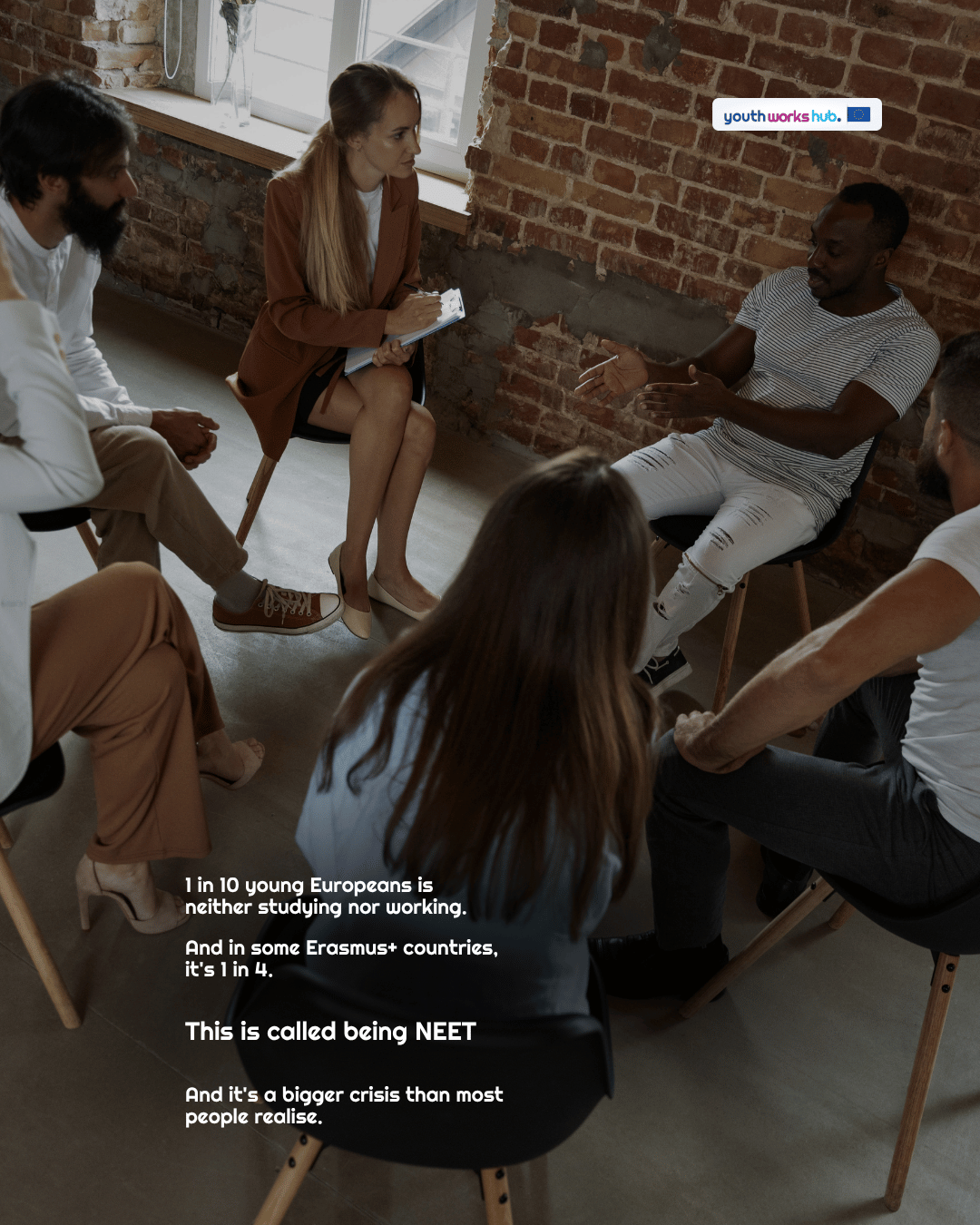
In 2024, 11% of young people aged 15–29 across the EU were NEET — not in employment, education, or training. That's roughly 1 in 10 young people across Europe sitting outside both the job market and the education system at the same time.
And when you zoom out beyond EU borders to include Erasmus+ programme countries like Turkey, North Macedonia, and Serbia, the picture gets starker. Turkey alone sits at 25.9% — meaning more than 1 in 4 young people there are disconnected from both work and learning.
These aren't just statistics. Behind every percentage point is a young person who hasn't found their path yet.
But here's what the conversation often misses: programmes like Erasmus+ and the European Solidarity Corps (ESC)aren't just cultural exchange initiatives. They are — backed by real data — one of the most effective tools Europe has for getting young people back on track.
The NEET Problem Across Erasmus+ Countries
The term NEET — Not in Employment, Education or Training — was coined to describe young people who are at risk of long-term social and economic exclusion. It's not just about unemployment. It captures a deeper disengagement: young people who aren't building skills, aren't earning, and aren't connected to any structured pathway forward.
According to Eurostat's 2024 data, NEET rates across Erasmus+ programme countries vary dramatically:
Highest rates:
- 🇹🇷 Turkey — 25.9%
- 🇲🇰 North Macedonia — 23.4%
- 🇧🇦 Bosnia-Herzegovina — 20%
- 🇷🇴 Romania — 19.4%
EU average: 11%
Lowest rates:
- 🇸🇮 Slovenia — 7.6%
- 🇳🇴 Norway — 7%
- 🇸🇪 Sweden — 5.9%
- 🇳🇱 Netherlands — 4.9%
The gap between the top and bottom is enormous — nearly 21 percentage points separating Turkey from the Netherlands. And crucially, the countries with the highest NEET rates are also among the most active participants in Erasmus+ and ESC. That's not a coincidence. It's an opportunity.
What the Research Actually Says
The European Commission's landmark Erasmus Impact Study — which surveyed over 75,000 students and alumni — produced some of the most compelling evidence to date on what international mobility actually does for young people's careers.
Here's what the data shows:
📊 Unemployment rates Former Erasmus participants have an unemployment rate 23% lower than non-participants, five years after graduation. Long-term unemployment? They're twice as unlikely to experience it.
💼 Getting hired More than 1 in 3 Erasmus students who completed a work placement abroad were hired or offered a position by their host organisation. Not just a foot in the door — an actual job offer.
🧠 Skills employers actually want 92% of employers say they actively look for personality traits that Erasmus develops: problem-solving, confidence, curiosity, tolerance, adaptability. And Erasmus participants come back with measurably stronger scores on all of these — 42% higher on average compared to peers who didn't go abroad.
🚀 Career advancement 64% of employers say they give greater professional responsibility to staff with international experience. Going abroad isn't just good for your CV — it accelerates your entire career trajectory.
But What About ESC Specifically?
The European Solidarity Corps takes this one step further — and is specifically designed with inclusion in mind.
While Erasmus+ has historically been more accessible to university students, ESC opens the door to any young person aged 18–30, regardless of their educational background. No degree required. No grades. Just motivation.
This matters enormously in the context of NEET. Because the young people most at risk — those who left school early, those from disadvantaged backgrounds, those in rural areas — are exactly the ones who benefit most from an ESC experience. And they're exactly the ones ESC is designed to reach.
What does an ESC volunteer come back with?
- Real work experience in an international setting
- A Youthpass certificate — officially recognised across Europe
- Language skills developed through full immersion
- A professional network across multiple countries
- Measurably stronger soft skills: communication, teamwork, intercultural awareness
- And perhaps most importantly: confidence
These are the exact ingredients that NEET young people are missing. Not talent. Not ambition. Just opportunity, structure, and a first real step.
The Gender Dimension
One aspect of the NEET data that rarely gets enough attention is the gender gap — and it's dramatic.
In Turkey, 15.8% of young men are NEET compared to 36.4% of young women. That's a gap of over 20 percentage points — driven largely by young women being outside the labour force entirely, often due to caregiving responsibilities or social barriers to participation.
ESC has a specific inclusion mandate. Projects are required to actively reach participants with fewer opportunities — including young women from disadvantaged backgrounds. This isn't a side note. It's built into how the programme is funded and evaluated.
The Bigger Picture
The EU has set a target: reduce the NEET rate to below 9% by 2030. As of 2024, only 11 out of 34 European countries have already met this target. Two-thirds haven't.
Erasmus+ and ESC alone won't solve the NEET crisis. Structural issues — unemployment, housing costs, inequality, educational gaps — require policy responses far beyond any single programme.
But what the data consistently shows is this: young people who participate in international mobility programmes are less likely to be unemployed, more likely to get hired faster, more likely to advance in their careers, and more likely to start their own businesses.
For a young person sitting in the NEET category right now — in Turkey, in Romania, in North Macedonia, in Greece — an ESC project is not just an adventure. It's a concrete, funded, proven pathway back into active life.
What You Can Do
If you're between 18 and 30 and currently not in employment or education, ESC volunteering could be your next step. It costs you nothing. Travel, accommodation, food, and a daily allowance are all covered.
If you work with young people — as a teacher, youth worker, or NGO coordinator — sharing information about ESC with the young people around you could genuinely change the direction of someone's life.
Browse open ESC and Erasmus+ opportunities at youthworkshub.org
Sources
- Eurostat — Statistics on NEET, 2024
- European Commission — Erasmus Impact Study (75,000 participants)
- Euronews — "Young people neither in employment nor in education: Which European countries are worst affected?" (2025)
- Education First — English Proficiency Index 2024