🔑 Key Information
Activity ⭐️ Title
Unburnable: Mental Well-being and Resilience for Human Rights Educators
🇪🇺 What is Erasmus+? Erasmus+ is the EU's programme for education, training, youth and sport, with a €26.2 billion budget for 2021–2027. It funds study abroad, internships, youth exchanges, training courses and youth worker mobility. This overview covers who is eligible, every activity type and what's funded. 👉 https://youthworkshub.org/erasmusplus
Activity 🔶 Type | 📆 Dates | 📍Location
Training Course
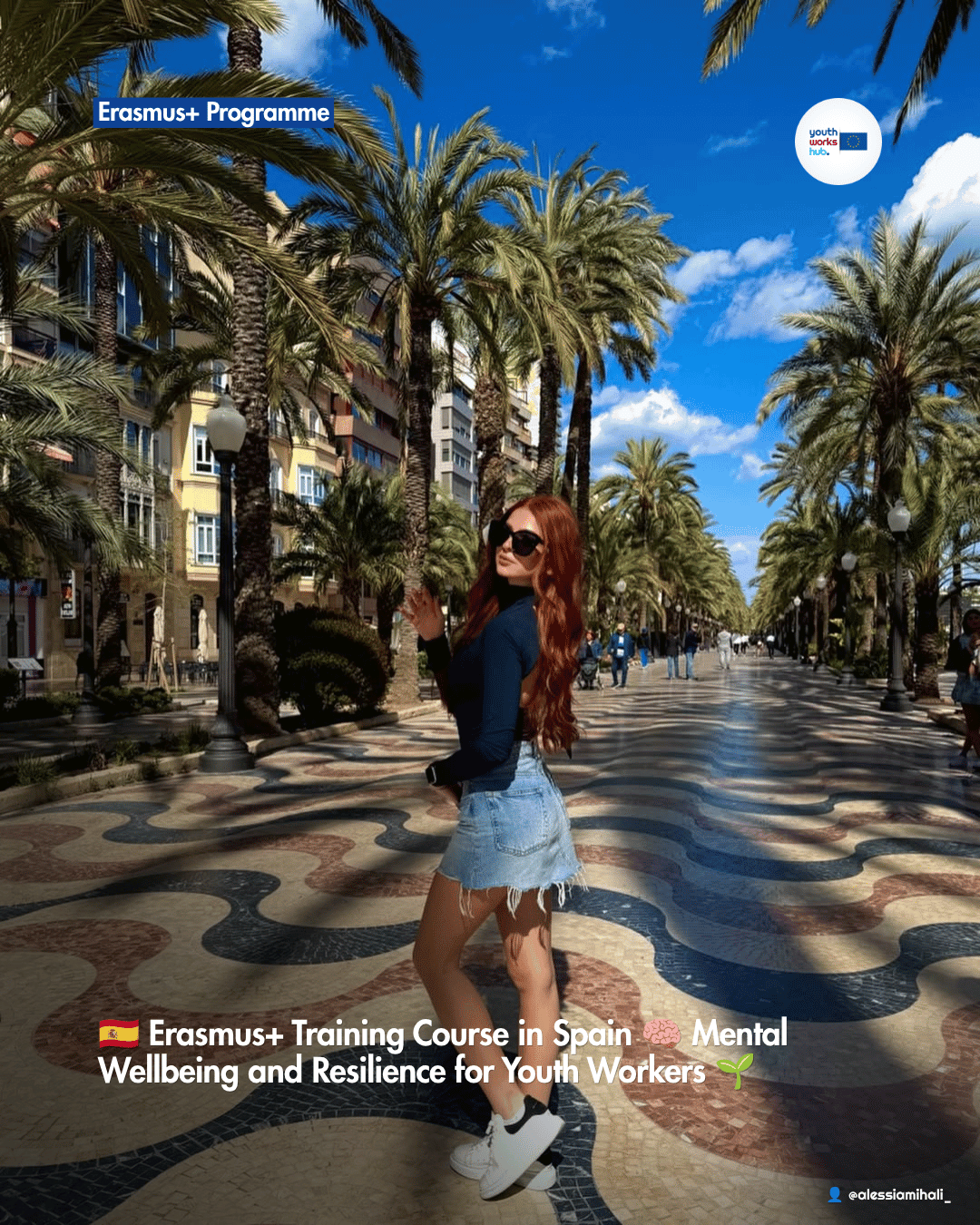
14-22 October 2026 | Coma-ruga (Tarragona), Spain
❗️What Is This Training About?
Unpredictable contexts affect human rights educators' well-being, leading to burnout. This course helps youth workers build resilience and find tools to enhance their mental health and that of the young people they support.
✅ Who can apply for Erasmus+ and ESC? Eligibility depends on activity: ages 13–30 for most Erasmus+ youth activities and 18–30 for ESC volunteering (up to 35 for humanitarian aid), plus country and residence rules. This guide covers roles, inclusion support, language needs and the profile coordinators look for. 👉 https://youthworkshub.org/whocanapply
ℹ️ Description About The Opportunity
Context
Human rights educators, activists, and youth workers across Europe navigate an increasingly unpredictable context. Shrinking civil society spaces, systemic uncertainty, and financial instability create high-stress environments that directly impact psychological well-being. This ongoing strain often leads to professional burnout, affecting both individual educators and the long-term sustainability of youth organisations and their work.
This 7-day training course offers a dedicated space for youth workers to step back, address work-related stress, build emotional resilience, and discover actionable tools to safeguard their mental well-being—and the well-being of the young people they support.
We are bringing together youth workers, trainers, and activists to step off the treadmill, address the psychological weight of our work, and build practical emotional resilience.
It is not about standard self-care; it’s about discovering collective, realistic tools to protect our well-being and keep our organisations sustainable while learning how to better support the young people we work with.
Participants' profile
The course is designed for 25 youth workers, trainers, educators, and activists involved in running human rights educational activities with young people on a regular basis.
Target Regions: Programme Countries, Eastern Partnership (EaP) and Western Balkan countries.
This mobility is specially addressed to youth workers who are feeling the strain of the field or want to proactively build resilience, are open to sharing their experiences, and are ready to bring these practices back to their local youth groups and NGOs.
The application is open to candidates from registered Erasmus+ organisations (with OID*).
* The Organisation ID (OID) serves as a unique identifier for organisations/institutions participating in Erasmus+ projects. It is essential to obtain this code from your organisation to support your participation in the programme.
Selection of participants will be conducted by the coordination team based on the submitted application form. Previous experience, the youth work background and the potential to develop concrete follow-up will be specially taken into account.
Important Note on Scope & Purpose
This training course is an educational and peer-learning programme grounded in non-formal education methodology. It is designed for preventive care, professional self-regulation, and capacity building. Please note that this programme does not constitute clinical therapy, psychotherapy, or medical treatment, nor is it intended to diagnose or treat acute mental health conditions.
The facilitators create space for reflection, stress prevention, and tool-sharing, but they are not operating as clinical mental health professionals. Participants currently experiencing severe burnout, acute trauma, or mental health crises are strongly encouraged to seek professional therapeutic support prior to or alongside participating in non-formal training activities.
📘 What is Erasmus+? (in-depth) Erasmus+ has run since 1987 and has had over 13 million participants, funding four main activities for young people. This pillar guide covers its history, funding, research-backed benefits, the full application process and an FAQ. 👉 https://youthworkshub.org/what-is-erasmus-plus
Training overview
This Training Course is
for 25 participants
from Eastern Partnership countries  , Erasmus+ Youth Programme countries , Western Balkan countries
and recommended for
Youth workers, Trainers, Youth leaders, Youth coaches
Working language(s):
English
Organiser:
Association of Human Rights Educators - AHEAD (Youth NGO)
Based in Barcelona, AHEAD supports since 2009 youth work, intercultural dialogue and human rights education as conditions to strengthen the commitment towards a culture of peace, environmental and global justice, democratic citizenship and solidarity among communities.
AHEAD holds the Erasmus+ Accreditation and the ESC Quality Label. It has a sound experience on youth workers' mobilities, youth participation activities and non-formal education tools and methodologies working on inclusion projects with young people from diverse cultural backgrounds, creating dialogue opportunities and synergies with civil society organisations and the public administration representatives.
💡 How do you prepare a strong Erasmus+ or ESC application? Read the call carefully, write specific motivation, show skills with examples, and state clear learning goals. This guide gives 10 practical tips plus the common mistakes that lead to rejection. 👉 https://youthworkshub.org/erasmus-application-tips
📥 Contact
Contact for questions:
Unburnable Team
E-Mail:
Phone: +34 XXX XX XXX
💶 Costs
Participation fee
There is an enrolment fee of 35€ that will be deducted from
the travel reimbursement after the course.
Accommodation and food
Full board and accommodation will be provided and paid for by the organisers.
Travel reimbursement
The travel costs will be reimbursed up to the Erasmus+ programme rules. Green travel is encouraged and economically supported.
The maximum travel budget limit is:
100 – 499 km: 211 EUR (285 EUR Green Travel)
500 - 1999 km: 309 EUR (417 EUR Green Travel)
2000 - 2999 km: 395 EUR (535 EUR Green Travel)
3000 - 3999 km: 580 EUR (785 EUR Green Travel)
Selected participants will receive an Infopack with further details.
The local transportation costs are to be covered by the participants as a contribution to the overall costs.
Visa costs will be fully reimbursed.
Do not book your travel until your participation has been confirmed.
📜 Certificate
Participants are entitled to receive a Youthpass certificate from the organiser, for recognition of their competence development during the activity. Read more about Youthpass:
https://youthworkshub.org/what-is-youthpass
⚠️ Important Dates
Application deadline (24h UTC): 10 September 2026
Date of selection: 16 September 2026
🎓 What is an Erasmus+ Training Course? A Training Course is a short funded course (5–10 days) for youth workers, educators and NGO staff to build skills through non-formal education. This guide explains who can join, what's covered and how it differs from a Youth Exchange. 👉 https://youthworkshub.org/trainingcourse
🔗 Official Link
🗂️ Documents
⚖️ What's the difference between ESC and Erasmus+? The ESC is for volunteering and solidarity, while Erasmus+ is broad learning mobility (study, training, youth exchanges). This guide compares age, funding, duration and application route, and includes a "choose this if…" decision guide. 👉 https://youthworkshub.org/esc-vs-erasmus
🎂 What are the age limits for Erasmus+ and ESC? Youth Exchanges are 13–30, ESC volunteering is 18–30 (35 for humanitarian aid), and training, youth worker mobility and study/traineeships have no upper age limit. This guide breaks down every activity and how age is counted (at the start date). 👉 https://youthworkshub.org/erasmus-age-limits
💶 What costs does Erasmus+ cover? For youth activities (KA152–154) it covers travel by distance band, individual support, organisational support, preparation, inclusion support up to 100% and exceptional costs. This 2026 guide details each item and what Erasmus+ does not cover. 👉 https://youthworkshub.org/what-erasmus-covers


