🔑 Key Information
Activity ⭐️ Title
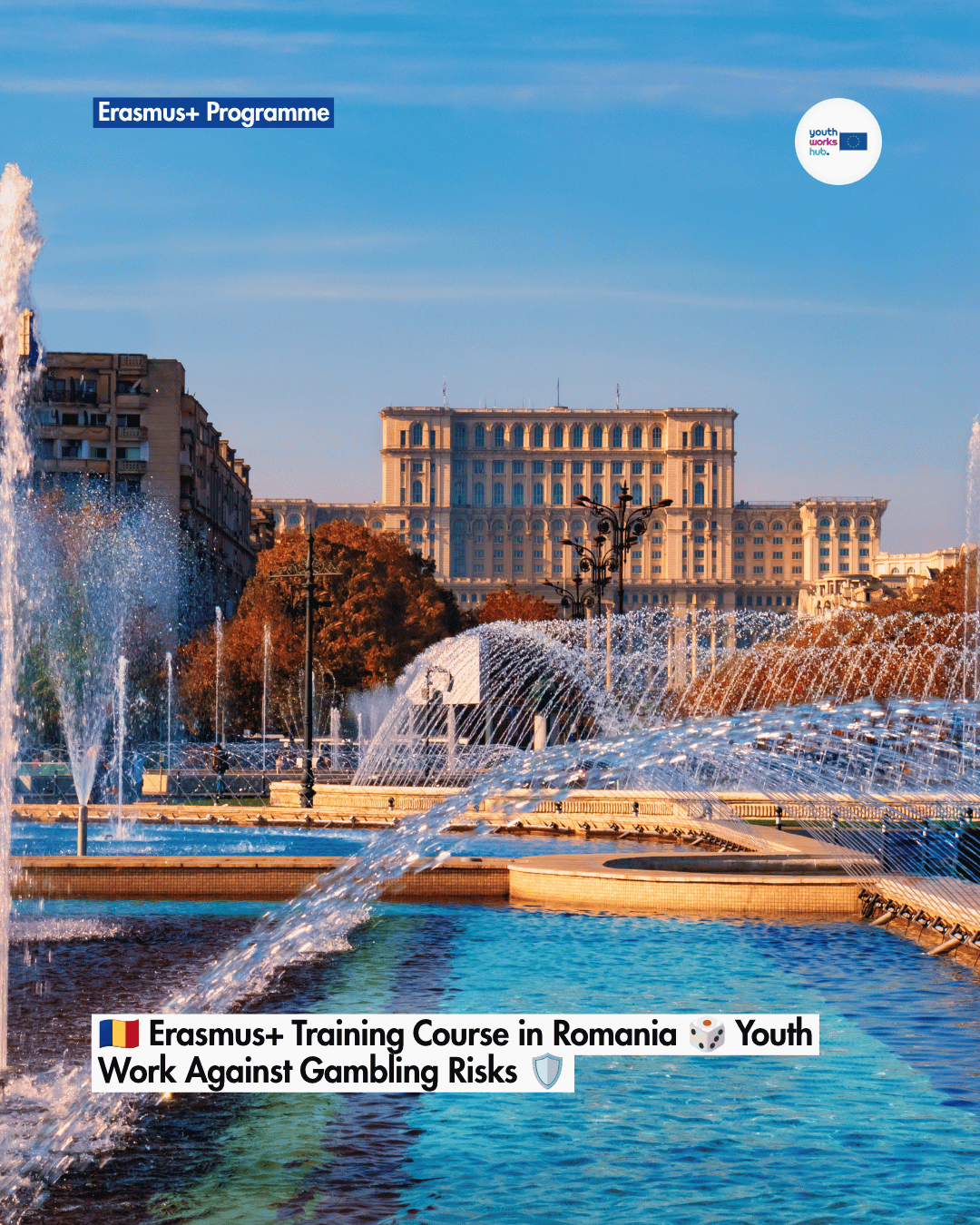
"Bet on Wellbeing: Youth Work Against Gambling Risks" - Training in Romania
Activity 🔶 Type | 📆 Dates | 📍Location
Training Course
19-25 October 2026 | Sibiu, Romania
🌍 Erasmus+ explained — the complete beginner's guide to Europe's largest youth programme.Millions of young people have taken part in Erasmus+ since its launch, but many still don't fully understand what the programme actually includes, who it's for, or how to get involved. This in-depth guide breaks down everything: the different types of mobility, funding opportunities, eligibility criteria, and what you can realistically expect from participating. If you've ever wondered whether Erasmus+ is right for you, this guide gives you all the answers in one place. 👉 https://youthworkshub.org/15096/
❗️What Is This Training About?
Bet on Wellbeing: 7-day Erasmus+ course for youth workers on tools to prevent gambling risks and foster safer conversations. Sibiu, 19-25 Oct 2026. Apply: https://forms.gle/dn7dwBtCz8kX52aUA
🏘️ How Erasmus+ youth projects create lasting change in local communities. The impact of Erasmus+ goes far beyond the individuals who participate. Local communities, host organisations, and even entire neighbourhoods are shaped by the projects that take place within them. This article explores the broader social impact of Erasmus+ youth exchanges — from building intercultural understanding to empowering grassroots organisations — and makes a compelling case for why these projects matter beyond the personal level. 👉 https://youthworkshub.org/3595/
ℹ️ Description About The Opportunity
Bet on Wellbeing: Youth Work Against Gambling Risks is a 7-day Erasmus+ KA153-YOU training course taking place in Sibiu, Romania, from 19 to 25 October 2026. It will bring together 30 participants from Romania, Spain, Italy, Türkiye, Greece and Croatia.
Gambling risks do not always begin with a visible crisis. Young people may first encounter them through sports betting, online advertisements, influencers, gaming-related mechanisms, financial pressure, stress or the need to belong. Youth workers often meet these situations early, yet may lack the confidence, language and practical methods needed to respond without judgement.
The training aims to strengthen participants’ capacity to recognise early signs of gambling-related harm, understand cognitive biases and persuasive online design, facilitate safer conversations about money, emotions and risk, and identify the boundaries between youth work, coaching and professional or therapeutic intervention.
The programme will explore:
• gambling pathways and early warning signs;
• digital advertising, influencers and persuasive design;
• peer pressure, emotions and impulsive decisions;
• financial consequences and the psychology of chasing losses;
• neuropsychological mechanisms related to gambling;
• safe communication with young people and families;
• coaching tools, professional boundaries and referral pathways;
• non-formal prevention activities for local communities.
This offer is specifically intended for people working in youth work and non-formal learning, including youth workers, trainers, facilitators, volunteers, educators, project coordinators, social workers, school counsellors, psychologists and teachers whose roles involve direct work with young people.
Applicants should be at least 18 years old, have at least six months of relevant experience, possess a working level of English, be available for the entire programme and be ready to act as multipliers after the mobility. We especially welcome applicants working with young people experiencing financial vulnerability, exclusion, risky online behaviours or other fewer-opportunity contexts.
By the end of the training, participants will have a set of practical, ready-to-use non-formal education methods and greater confidence in addressing gambling-related risks without moralising or assuming a therapeutic role. After the mobility, each national team will adapt and test at least five methods with young people in its community and contribute to the project’s dissemination activities and shared resources.
Participants’ learning outcomes will be recognised through Youthpass. Accommodation, meals and programme costs are covered through Erasmus+ funding.
Training overview
This Training Course is
for 30 participants
from Croatia, Greece, Italy, Romania, Spain, Türkiye
and recommended for
Youth workers, Youth leaders, Volunteering mentors, Youth coaches
Accessibility info:
This activity and venue place are accessible to people with disabilities.
Working language(s):
English
Organiser:
Asociatia Educatie pentru Viata Reala (Others)
AEVR stands as a pivotal and dynamic NGO in Romania, focusing on financial and entrepreneurship education for individuals aspiring to cultivate a healthier rapport with money and lead lives of prosperity and significance. Our strategic vision centers on forging innovative paths within financial education and investments. Our aim is twofold: not just generating financial returns, but also cultivating returns on invested time and human capital. By fostering sustainable thinking, we empower individuals to envision their financial futures with longevity in mind.
To successfully navigate the everyday challenges of life, young people need a number of skills. In the 9 years of activity of the NGO, we have gathered many proofs that financial education is an essential aspect of real life education. Moreover, it is an effective tool for building a prosperous future by gaining financial autonomy and accumulating wealth.
Since 2016 we have managed to increase the activity of the association and today more then 4000 person had financila coaching session. The main activity of the association is the development and implementation of training programs for financial education and
entrepreneurship for young people and adults. We organise training programs for adolescents and adults both in Bucharest
and in the countryside. For example, in Bacau County, a training program was organised for institutionalised young people,
to help them understand the two ways of being active on the labour market: employee or employer.
We want to empower adults and young people in Romania through the power of information, to help them make inspired and
informed decisions. That is why we have taken on the mission of contributing with our experience, perspective and our
positive intention to build a
better version of the society we belong to, a responsibly sustainable one.
The strategic partnerships with Romanian students associations and social services associations keep AEVR in touch with
the needs of youth, students associations and adult beneficiaries. In 2021 we delivered financial workshops to more than
100 students.
Our area of expertise:
Information: AEVR provides general assistance for the establishment and functioning of business and structures of the
social economy. AEVR addresses all those who intend to establish business and provides access to various management
instruments in their early settlement. Also AEVR is raising awareness among young people and adults about the benefits of
a healthy financial education.
Consultancy: we have developed specialised consultancy services for the establishment and functioning of businesses and
structures of the social economy.
Education and training programs: We have successfully trained more than 200 young people over the last 2 years in
financial education, entrepreneurship and how to pay your debts.
Research – we constantly evaluate the impact of our programs and the dynamic of different aspects of the financial life and the impact of it in the family or individual welfare.
At the moment the association has 15 financial coaches and 5 full-time employees. The number of beneficiaries differs depending on the activities we implement, but annually we carry out activities with over 6000 people with financial vulnerabilities and more than 600 social service beneficiaries
Co-organiser(s):
- Spain: Federación de Asociaciones Juveniles de Gijón – CMX (Youth NGO)
- Italy: Coconut Italia (Youth NGO)
- Türkiye: Pangea Gençlik Derneği (Youth NGO)
✅ 10 practical tips to write a stronger Erasmus+ or ESC application and actually get selected. With growing competition for spots in Erasmus+ and ESC projects, a well-crafted application can genuinely make or break your chances. This guide shares 10 concrete, actionable tips based on what selection committees actually look for — covering everything from how to frame your motivation to the common mistakes that get applications rejected. If you're serious about getting selected, take the time to read this before you hit submit. 👉 https://youthworkshub.org/8396/
📥 Contact
Contact for questions:
Silvia Misu
E-Mail:
Phone: +40 729 473 975
💶 Costs
Participation fee
All costs are covered by Erasmus +
Accommodation and food
We’ve secured all your stay and meals at Hotel Bliss Sibiu, so you can focus entirely on the course:
Accommodation
– Comfortable double-rooms, each with its own private bathroom and free Wi-Fi.
– Towels, linens and daily housekeeping included.
Full board catering
– Buffet-style breakfast, lunch and dinner prepared with locally sourced, seasonal ingredients (always at least one vegetarian/vegan option).
– Mid-morning and afternoon coffee breaks with snacks.
– Filtered tap water available throughout the day.
Cost to participants: The project is financed by the Erasmus+ Programme of the European Union, thus all the activities, accommodation and food are 100% covered by the EU grant. The travel costs will be reimbursed to the participants after the course, according to travel distance.
Travel reimbursement
Round-trip travel costs to and from Sibiu will be reimbursed up to the following maximum amount per participant:
• Romania: up to EUR 285
• Spain: up to EUR 395
• Italy: up to EUR 309
• Türkiye: up to EUR 309
• Greece: up to EUR 309
• Croatia: up to EUR 309
For selected participants travelling from Türkiye, eligible visa and entry-related costs may additionally be reimbursed up to EUR 100 per participant, subject to prior approval and the submission of supporting documents.
These amounts represent the maximum reimbursement ceilings and are not automatic flat-rate payments. The reimbursed amount cannot exceed the participant’s eligible travel costs or the maximum amount allocated for their country.
All travel routes and ticket prices must be approved in writing by the organisers or the relevant sending organisation before purchase. Participants must keep and submit all tickets, invoices, boarding passes and proofs of payment. Economy-class tickets and the most reasonable and cost-efficient routes should be selected. Sustainable means of transport are strongly encouraged whenever feasible.
Participants can check the distance between their place of departure and Sibiu using the official Erasmus+ Distance Calculator.
📜 Certificate
Participants are entitled to receive a Youthpass certificate from the organiser, for recognition of their competence development during the activity. Read more about Youthpass:
https://youthworkshub.org/15122
⚠️ Important Dates
Application deadline (24h UTC): 31 July 2026
Date of selection: 31 August 2026
🔗 Official Link
Infopack: https://canva.link/8x1zwri3g8p2an9
😄 How every Erasmus+ group chat starts vs. how it ends — a journey in messages. If you've ever been part of an Erasmus+ project group chat, you already know the energy: the awkward introductions, the overenthusiastic emojis, the plans that never happen, and the inside jokes that follow you for years. This article captures the evolution of every Erasmus+ group dynamic with humour and honesty — and if you haven't experienced it yet, consider this your preview of what's coming. 👉 https://youthworkshub.org/15112/
📖 The real story behind every Erasmus+ and ESC journey — what happens before, during, and after.Every Erasmus+ and ESC project has an official timeline: application, preparation, mobility, evaluation. But the real story is much richer than that. This article takes you through what genuinely happens at each stage of a project's life — the doubts, the breakthroughs, the unexpected friendships, and the quiet moments that change everything. A deeply human look at what these programmes mean beyond the paperwork. 👉 https://youthworkshub.org/15180/
🚨 How to spot a real Erasmus+ or ESC project — and protect yourself from fake offers. As the popularity of Erasmus+ and ESC grows, so does the number of fraudulent offers mimicking legitimate projects. Fake calls, scam organisations, and misleading listings can be difficult to identify — especially for first-time applicants. This guide gives you the specific red flags to watch for, the verification steps you should always take, and the key differences between genuine EU-funded projects and imitations. Stay informed, stay safe. 👉 https://youthworkshub.org/15135/
⚠️ Important Notice
1️⃣ Source of Information
This announcement has been prepared based on the information provided by the source.
2️⃣ No Affiliation
YouthWorks Hub is not the organiser, partner, or representative of the projects listed. All applications must be submitted directly to the project coordinator or hosting organisation through the original link, email, etc.
3️⃣ Content May Change
The project coordinator is solely responsible for the accuracy and details of the opportunity. Deadlines, eligible countries, activity dates, and other details may change, or the announcement may be withdrawn entirely, at any time after publication. Always check the original link before applying.
4️⃣ Funding
All funding, travel reimbursements, and allowances are determined and provided by the project coordinator or National Agency. YouthWorks Hub is not responsible for any payments or financial matters.
5️⃣ External Links
Listings may contain links to third-party websites, forms, or documents (e.g. the ESC Portal, infopacks, application forms). YouthWorks Hub is not responsible for the content, accuracy, or security of these external sources.
💡 Final Note: All listings are shared for informational purposes only. Please always verify details directly through the official project coordinator or programme website before applying.