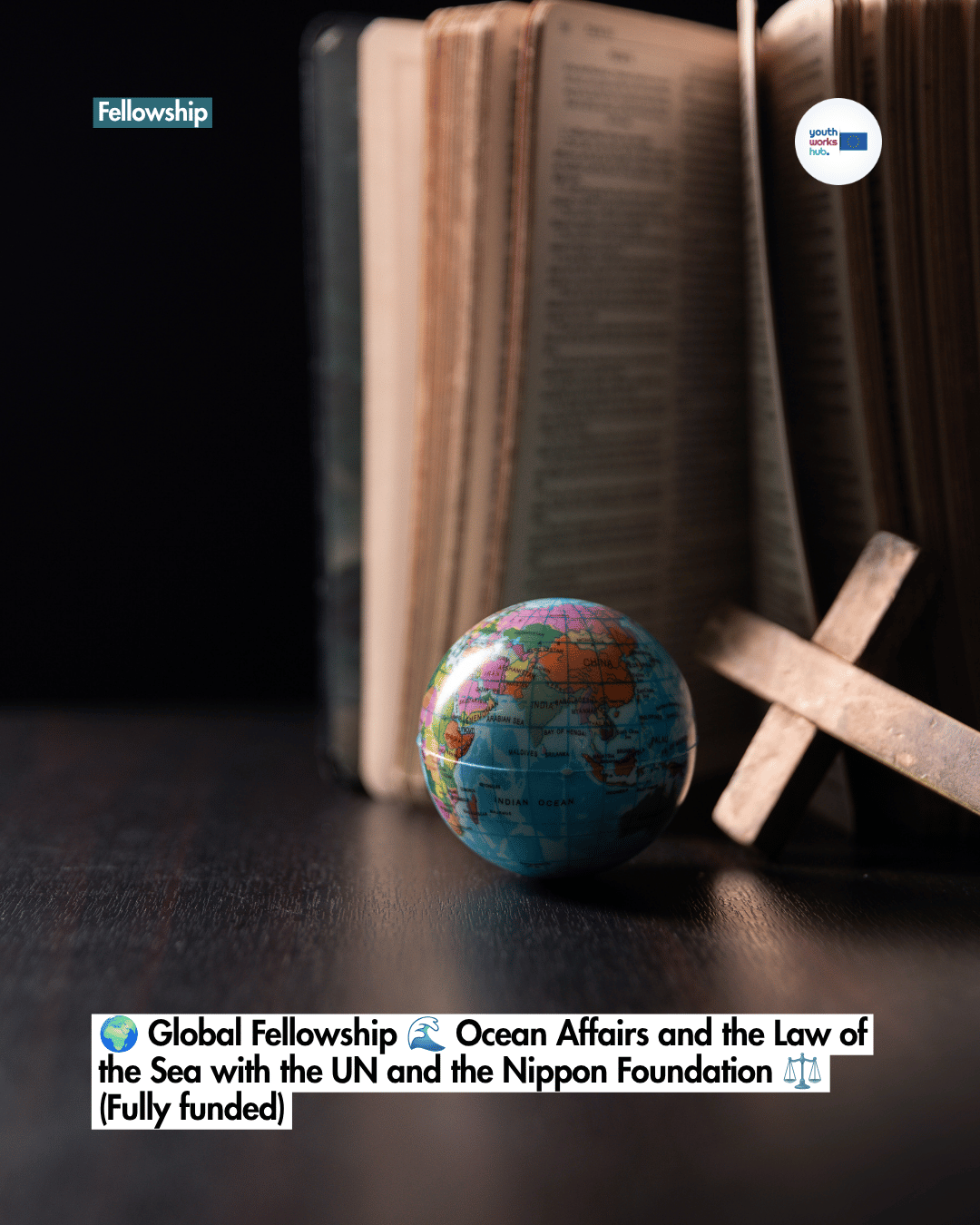
Are you a government official or mid-level professional from a developing State ready to become an expert in ocean policy and the law of the sea? The United Nations – Nippon Foundation Fellowship (OALOS) offers advanced, fully funded training and research on ocean affairs and the law of the sea, based at the United Nations in New York and at a leading academic host institution.
About the Fellowship
The United Nations – Nippon Foundation Ocean Affairs and the Law of the Sea Fellowship provides government officials and other mid-level professionals from developing States with advanced training on ocean affairs and the law of the sea, as well as related disciplines including marine science in support of management frameworks. Fellows learn about international legal frameworks, key issues and best practices in ocean affairs, become familiar with the work of the United Nations, and develop professional skills. Fellows also conduct individual research, under academic supervision, and develop a written thesis on a topic they select.
Upon completion, Fellows are expected to return to their home countries and use their in-depth knowledge and experience to assist in formulating comprehensive ocean policy and in implementing the legal regime set out in the United Nations Convention on the Law of the Sea (UNCLOS) and related instruments, including through designing, implementing and evaluating specific improvement projects.
Fellowship Structure
⏳ The 9-month Fellowship Programme is composed of two consecutive phases, plus an alumni phase.
🗽 Phase One: a 3-month Research and Training placement, normally between March/April and June, undertaken at the Division for Ocean Affairs and the Law of the Sea, Office of Legal Affairs (DOALOS), at United Nations Headquarters in New York.
🎓 Phase Two: a 6-month Advanced Academic Research and Study placement, normally between July and December, undertaken at one of the prestigious participating host institutions under the guidance of subject-matter experts in the Fellow's chosen field.
🤝 Phase Three: becoming an Alumnus of the Programme and a member of the Alumni Network, a global platform that serves the evolving capacity and networking needs of Alumni as they progress through their careers.
Inside Phase One
📑 Reporting: by the end of the First Phase, Fellows provide a detailed draft annotated table of contents of their thesis and a one-page abstract, present their research to an audience of Fellows and DOALOS staff, and complete an ocean governance matrix to map legal, policy, political, diplomatic and institutional frameworks across ocean sectors.
⚖️ Law of the sea and ocean affairs training: Fellows gain an in-depth understanding of the UNCLOS regime and related agreements, covering the delineation of maritime zones, sustainable fisheries, biodiversity beyond national jurisdiction (BBNJ), maritime security, the human dimension of ocean affairs, sustainable ocean-based economies, ocean governance, oceans and climate change, and the implementation of SDG 14. They also learn about the bodies established under UNCLOS (the Commission on the Limits of the Continental Shelf, the International Seabed Authority and the International Tribunal for the Law of the Sea).
🧑🏫 Professional skills development: training in report writing, presentation skills, research skills (including UN documents), negotiation and leadership, and strategic communication, taught by UN staff and external professionals.
🏛️ Observing UN intergovernmental meetings: Fellows observe relevant UN oceans meetings, which may include the BBNJ Intergovernmental Conference, the Informal Consultations of States Parties to the UN Fish Stocks Agreement, the UN Open-ended Informal Consultative Process on Oceans and the Law of the Sea, the Regular Process for Global Reporting and Assessment of the State of the Marine Environment, and the Meeting of States Parties to UNCLOS.
The Curriculum
📚 The training is delivered through lectures, seminars, group exercises and discussions over 12 to 16 weeks, by DOALOS experts together with external experts and practitioners, and covers twelve modules: the Maritime Domain; International Law and UNCLOS; Maritime Zones, Jurisdiction and Maritime Boundary Delimitation; the Continental Shelf; Conservation and Sustainable Uses of Marine Resources; the Marine Environment; Maritime Security; Dispute Settlement Mechanisms; United Nations Intergovernmental Processes; Oceans and Sustainable Development; Ocean Governance and Implementation Tools; and Professional Skills. Field trips to interact with the various maritime sectors are arranged on an ad hoc basis.
Phase Two and Deliverables
📝 In Phase Two, Fellows conduct further individual academic research on their proposed topic and finalize their thesis under an assigned Academic Supervisor, and may contribute to the host institution through guest lectures, seminars, research and writing where this does not interfere with their Fellowship obligations.
📦 The deliverables of the Programme are a written thesis of around 100 pages, a presentation of the research, and an ocean governance matrix, alongside a number of assignments completed during Phase One.
Reporting Requirements
📄 Fellows complete an academic research paper (thesis), provide a detailed draft table of contents and a one-page abstract, and present their thesis in a session of no more than 30 minutes followed by a 30-minute question and answer session.
🗂️ Fellows undertake a national/regional ocean policy and law inventory for their State or region during their tenure at DOALOS. The final research paper must be edited to the standard of an academic journal publication with proper referencing, and Fellows also submit a final fellowship report of no more than 20 pages evaluating the programme and explaining how it will help them assist their States.
🗽 Also open in 🇺🇸 the United States: Internship in 🇺🇸 the United States – Social Development Research at the UN → https://youthworkshub.org/20830
Who Can Apply
🌍 Government officials and other mid-level professionals from developing States, who wish to obtain the knowledge needed to help their countries and regions formulate comprehensive ocean policies and implement the legal regime set out in UNCLOS and related instruments.
🌊 Riding the same ocean current? You might also like: 🌍 Creative Arts Fellowship for Young Environmentalists – Protect the Ocean → https://youthworkshub.org/20457
Fellowship Conditions
💶 The Fellowship covers conditions relating to travel, stipend payments, visas, medical clearance, insurance and housing, as detailed on the official Fellowship Conditions page.
How to Apply
This is a highly competitive United Nations fellowship for professionals from developing States. Consult the official fellowship website for the current call for applications, eligibility conditions and full requirements, and review the profiles and theses of previous Fellows in the research database before applying.
Deadline
📅 As soon as possible!
Links
🔗 Official fellowship page: https://www.un.org/oceancapacity/content/unnf-fellowship
🔗 Fellowship conditions: https://www.un.org/oceancapacity/content/fellowship-conditions
🔗 Research database of previous Fellows: https://www.un.org/oceancapacity/content/research-database