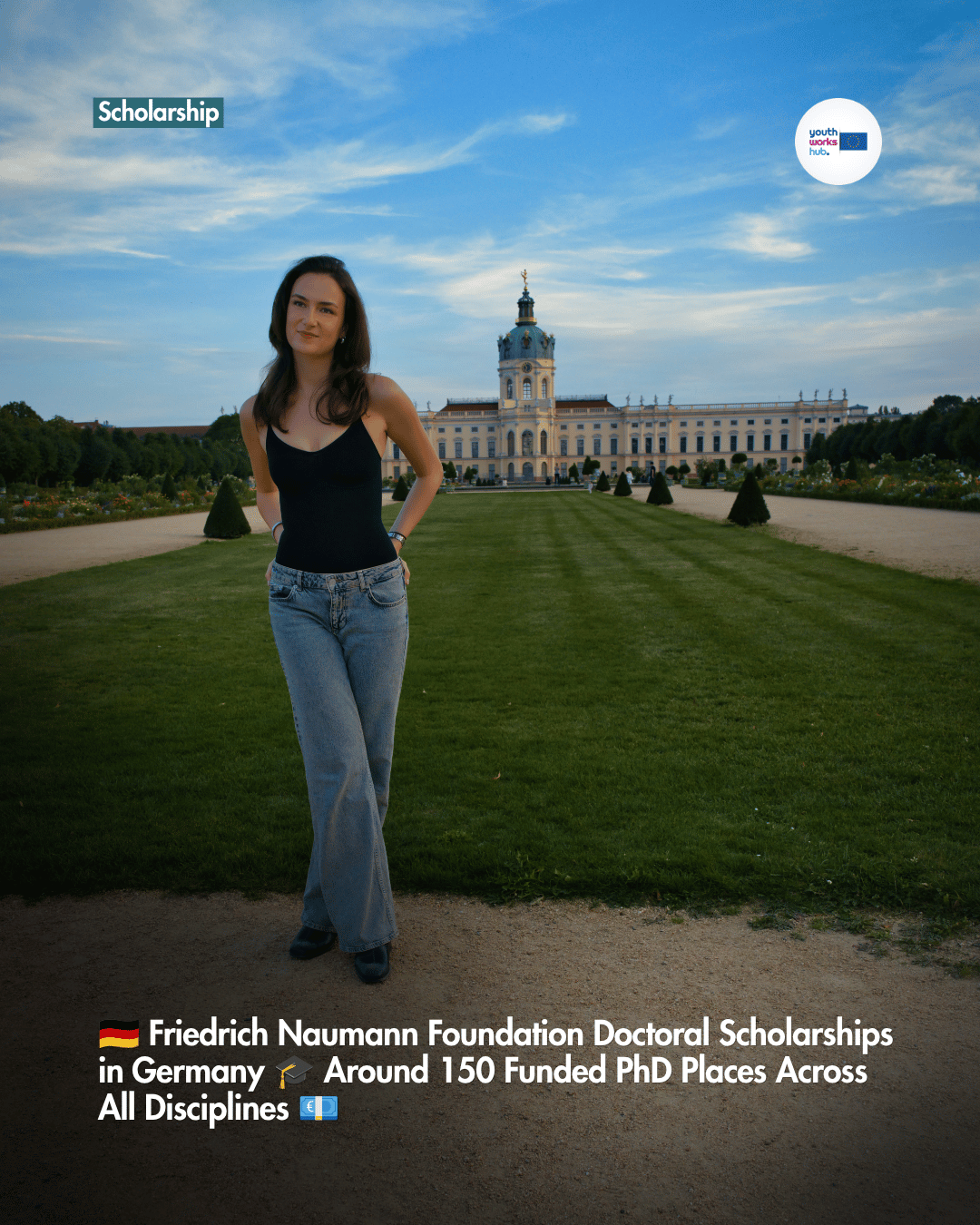
Doing a PhD in Germany is a huge undertaking, and funding is the difference between focusing on your research and worrying about rent. The Friedrich Naumann Foundation for Freedom runs a doctoral scholarship that funds roughly 150 PhD candidates a year across every discipline, pairs the money with a network built on liberal values, and — like its student counterpart — asks for civic engagement rather than party membership. At Youth Works Hub we follow funded research routes across Europe, and this one has a concrete deadline coming up, so here is exactly who qualifies, what is excluded, what it pays and how the selection runs.
About the Foundation and the Doctoral Scholarship
🕊️ The Friedrich Naumann Foundation for Freedom (FNF) is Germany's liberal political foundation, close to the FDP, and its scholarship programme is part of Germany's official talent-support system (Begabtenförderung).
🔬 Each year the foundation funds around 150 doctoral candidates across all disciplines.
🤝 As with the student scholarship, the foundation seeks alignment with liberal values and civic engagement; party membership is not required.
📅 Applications are online only, in two annual windows — 1–30 April and 1–31 October (closing 23:59 on the last day). The next deadline is 31 October 2026.
Who the Doctoral Scholarship Is For
🎓 You must have been admitted to a doctoral programme and have a convincing research project.
📚 The scholarship is open across all disciplines, subject to the exclusions below.
What Is Excluded
The doctoral track has clear boundaries. The following are not funded:
🚫 Doctorates in human medicine and dentistry.
🚫 Postdoctoral research.
🚫 Postgraduate courses.
🚫 Doctorates in their final phase.
🚫 Doctorates conducted abroad.
🚫 Project-based funding.
⚖️ For those with a legal background, funding applies if you are starting the doctorate after your Referendariat or after completing it — a specific timing condition worth checking against your own situation.
What It Pays
💶 For non-EU doctoral scholars, the reported ceiling is up to €1,200 per month, plus a €100 per month research allowance. (Germany's general FAQ cites €1,350 + €100, and another figure of €1,050 + €100 for a specific track; for non-EU applicants the €1,200 base is the figure to work from, and you should confirm your exact rate with the foundation.)
👨👩👧 Family and child components and a health insurance contribution are included, though the precise amounts are not fully verified and should be confirmed directly.
💼 Earnings above roughly €520 per month are offset against the scholarship, so check the current rule before taking paid work.
🔁 The scholarship does not have to be repaid.
How Long the Funding Lasts
📆 Funding runs for an initial one year, then a two-year continuation (a standard total of three years), with an exceptional additional year possible.
The Non-Financial Side
🌐 Doctoral scholars join the foundation's seminars, events, networking and mentoring around liberal values and civic engagement. Participation in this non-material programme expects German at B2 level.
Eligibility Fine Print
📌 No age limit.
📌 German at B2 level for the foundation's non-material programme.
📌 A non-EU residence rule: you should not have lived in Germany for more than 15 months before the scholarship begins (study or research time is an exception).
📌 Selection weighs grades, references, leadership, community engagement and alignment with liberal values.
📚 Weighing several funded routes abroad before you commit? This scholarship in another country is worth a look: the Glendon Chase McCormick Award at Dalhousie University in 🇨🇦 Canada → https://youthworkshub.org/21037
The Selection Process
The doctoral track runs in four stages:
1️⃣ Online application in the 1–30 April or 1–31 October window (by 23:59 on the closing day).
2️⃣ Document pre-screening.
3️⃣ A compulsory personal interview / selection-seminar conversation, done by video for international applicants abroad.
4️⃣ The decision, within three weeks of the selection conference. Interview invitations go out by 8 February or 8 August.
The Documents You Will Need
📄 Everything is uploaded online as PDFs (each up to 5 MB).
📎 Two letters of reference via a personal portal link (email submissions are rejected). For doctoral applicants these should be one from your supervisor and one from a subject specialist; English is accepted.
🎓 Planning ahead or supporting a younger student too? This international undergraduate award is a strong option: the Lester B. Pearson Award for International Undergraduates at the University of Toronto in 🇨🇦 Canada → https://youthworkshub.org/21038
Frequently Asked Questions
❓ How many doctoral scholarships are there? Around 150 a year, across all disciplines.
❓ Which doctorates are excluded? Human medicine and dentistry, postdoctoral research, postgraduate courses, doctorates in their final phase, doctorates abroad, and project-based funding.
❓ What does it pay? Up to €1,200/month for non-EU scholars plus a €100/month research allowance, with family, child and health-insurance components on top.
❓ How long is it? One year initially, then two more (three years standard), with an exceptional extra year possible.
❓ Do I need to be admitted to a PhD already? Yes, with a convincing research project.
❓ Do I need German? B2 level, for the foundation's seminars and events.
❓ Is there an age limit? No.
Deadline
⏳ 31 October 2026 (closes at 23:59 on the final day; the other window runs 1–30 April). Youth Works Hub keeps funded PhD routes like this in one place so you can prepare your research project and references before the window closes.
Link
🔗 Official scholarships page: https://www.freiheit.org/scholarships-friedrich-naumann-foundation-freedom
📩 Enquiries: stipendien-bewerbung@freiheit.org · +49 30 2099-3702