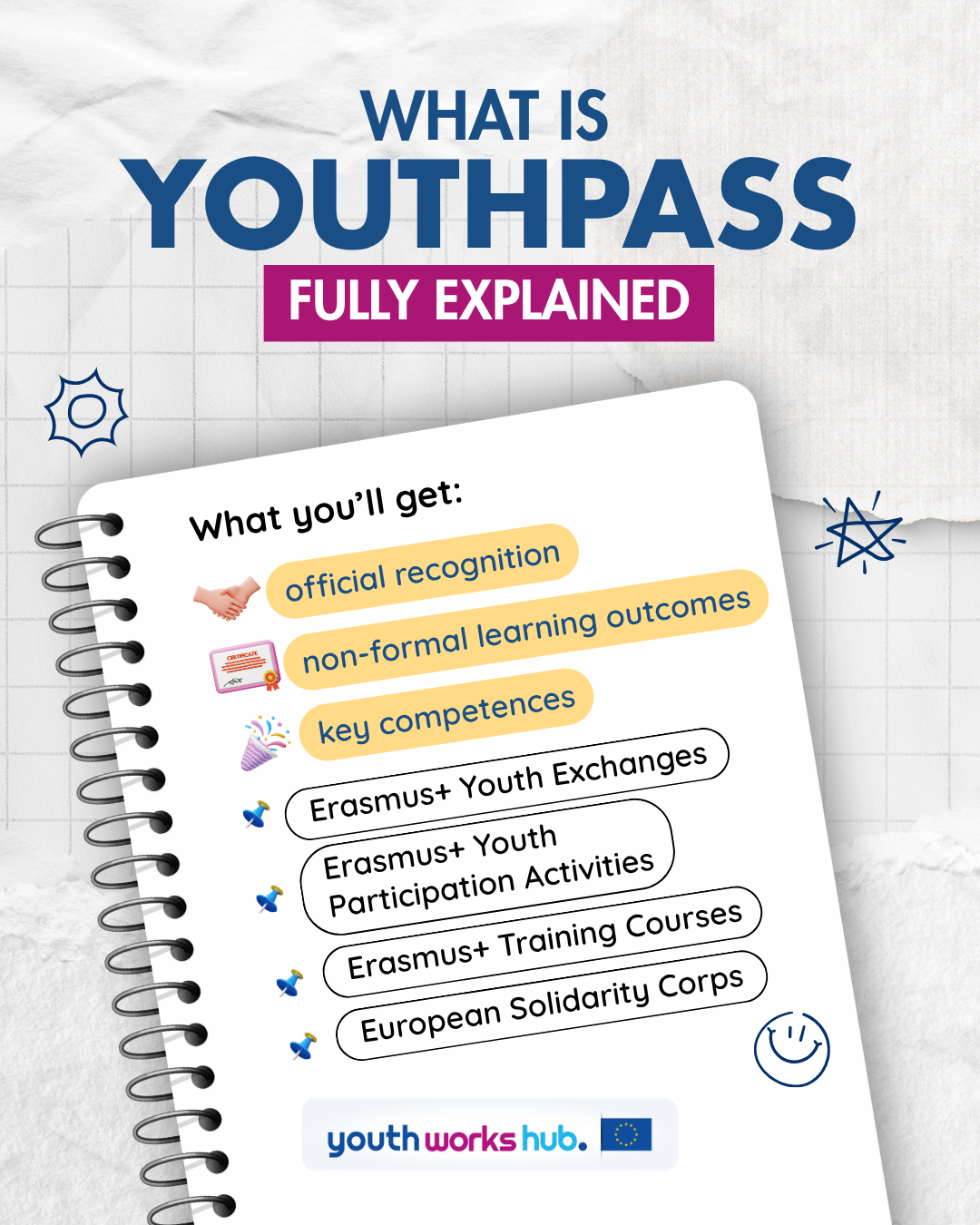
What Is YouthPass? The Official Erasmus+ & ESC Certificate — Fully Explained
YouthPass is the official recognition certificate for Erasmus+ and European Solidarity Corps participants. It documents what you actually learned — not in a classroom, but through real international experience. Here’s everything you need to know.
If you have completed an Erasmus+ Youth Exchange, a Training Course, a Youth Participation Activity, or an ESC volunteering project, you are entitled to a YouthPass certificate. Many participants finish their project not knowing this — or not knowing how to use it. This guide covers exactly what YouthPass is, what it contains, how to get it, and why it matters for your CV, your career, and your future applications.
What Is YouthPass — and What Makes It Different from Other Certificates?
The YouthPass certificate is not a diploma, a degree, or a formal academic qualification. It is something different — and in many ways, more honest. It is a document that records what you actually did, what you reflected on, and what you learned through direct experience in an international youth project.
Most certificates document what a course taught you. The YouthPass certificate documents what you developed — through participation, through challenge, through working alongside people from other countries on a shared project. That distinction matters, and it is what makes YouthPass a genuinely useful document for employers and organisations who understand non-formal education.
YouthPass was developed by the European Commission specifically to address the gap between formal qualifications and the skills young people develop through youth work, volunteering, and international mobility. It is part of the EU’s broader commitment to recognising non-formal and informal learning as equally valid pathways of development.
What Skills Does a YouthPass Certificate Document? — The 8 Key Competences
The YouthPass certificate is structured around the European Union’s eight key competences for lifelong learning. These are the broad competence areas that the EU has identified as essential for personal development, employment, and active citizenship. Your YouthPass documents your development across these competences based on your specific experience in the project.
Who Gets a YouthPass Certificate? — Full Eligibility List
If you have taken part in any of the following EU-funded youth programme activities, you are entitled to receive a YouthPass certificate. This is not optional — it is a right guaranteed to all participants by the European Commission.
✓ Erasmus+ Youth Exchanges — short-term international projects bringing together young people from multiple countries
✓ Erasmus+ Training Courses — professional development for youth workers, educators, and project coordinators
✓ Erasmus+ Youth Participation Activities — projects focused on democratic participation and active citizenship
✓ European Solidarity Corps (ESC) Individual Volunteering — long-term or short-term volunteering placements abroad
✓ ESC Volunteering Teams — group solidarity projects in another country
✓ ESC Solidarity Projects — locally initiated solidarity activities
If you have completed any of these activities and have not yet received or requested your YouthPass certificate, contact your host organisation. You are entitled to it — and it is worth having.
How to Get Your YouthPass Certificate — Step by Step
Getting your YouthPass certificate is straightforward. The process is guided by your host organisation and takes place at the end of your project. Here is exactly what happens:
How YouthPass Helps Your Career — CV, LinkedIn, and Job Applications
The YouthPass certificate is designed to be used. Not filed away. Not forgotten. It was built specifically to bridge the gap between the skills young people develop through Erasmus+ and ESC, and the language that employers, universities, and scholarship committees understand.
“It’s not just a paper — it’s your story of growth. Youthpass makes your real-life learning visible.”
How to use YouthPass in your career
Employers across Europe — particularly in sectors like education, youth work, international organisations, NGOs, public administration, and the creative industries — are increasingly familiar with YouthPass and understand what it represents. It is an EU-recognised document, and its contents describe real, verifiable competences.
YouthPass and Non-formal Learning — Why the Reflection Process Matters
One of the most underrated aspects of the YouthPass certificate process is that it requires genuine reflection. This is not bureaucratic box-ticking. The act of sitting down at the end of a project and asking yourself — what did I actually learn? what challenged me? what can I do now that I couldn’t before? — is itself a significant part of the learning.
Non-formal learning — the kind that happens in youth exchanges, volunteering projects, and training courses — is often invisible to the learner while it is happening. You are too busy living the experience to catalogue what it is doing to you. The YouthPass reflection process creates a structured moment to look back, name what happened, and convert experience into articulated competence.
YouthPass for Youth Workers and Project Coordinators
YouthPass is not only for young participants. Youth workers who take part in Erasmus+ Training Courses, Seminars, or other eligible professional development activities also receive a YouthPass certificate documenting their own learning outcomes and competence development.
For youth workers, the YouthPass certificate is particularly valuable as a professional development record — demonstrating continued investment in non-formal education methodology, intercultural competence, and youth work practice. It can be added to professional portfolios, used in job applications within the youth sector, and included in accreditation applications for youth organisations.
Is YouthPass Free? — And Is It Really Recognised?
Yes. The YouthPass certificate is completely free for all eligible participants. It is part of the Erasmus+ and ESC programmes, which are funded by the European Union. There is no cost to participants, no registration fee, and no third-party charge involved.
As for recognition: YouthPass is an official EU document. It carries the branding of the Erasmus+ or European Solidarity Corps programme. It is listed in Europass. It is referenced in official EU communications on non-formal learning recognition. It is not a private certificate from a training company — it is an instrument of the European Commission’s youth policy.
Recognition varies by employer, institution, and country — as it does with all certificates. But within the European youth work sector, NGOs, public institutions, and education providers, YouthPass is well understood and valued. And as non-formal learning recognition continues to grow as a priority across EU member states, that recognition is expanding.
Frequently Asked Questions About YouthPass
Want to earn your YouthPass? Start with an Erasmus+ or ESC project.
Youth Works Hub lists open Erasmus+ Youth Exchange and ESC volunteering opportunities across Europe — updated regularly, free to browse.
Browse Open Opportunities →Related posts:
 The Untold Truths of Erasmus+ 🔍 What They Don’t Put in the Brochure
 🌍 13 New Opportunities in Europe — EU Fully Funded ESC & Erasmus+ 🚀
 🇩🇪 ESC Volunteering in Germany 🔬 Science-Oriented Kindergarten Experience in Leipzig 🌍
 ❤️ The First Erasmus Couple and the First Erasmus Baby — A Love Story That Started in 1987