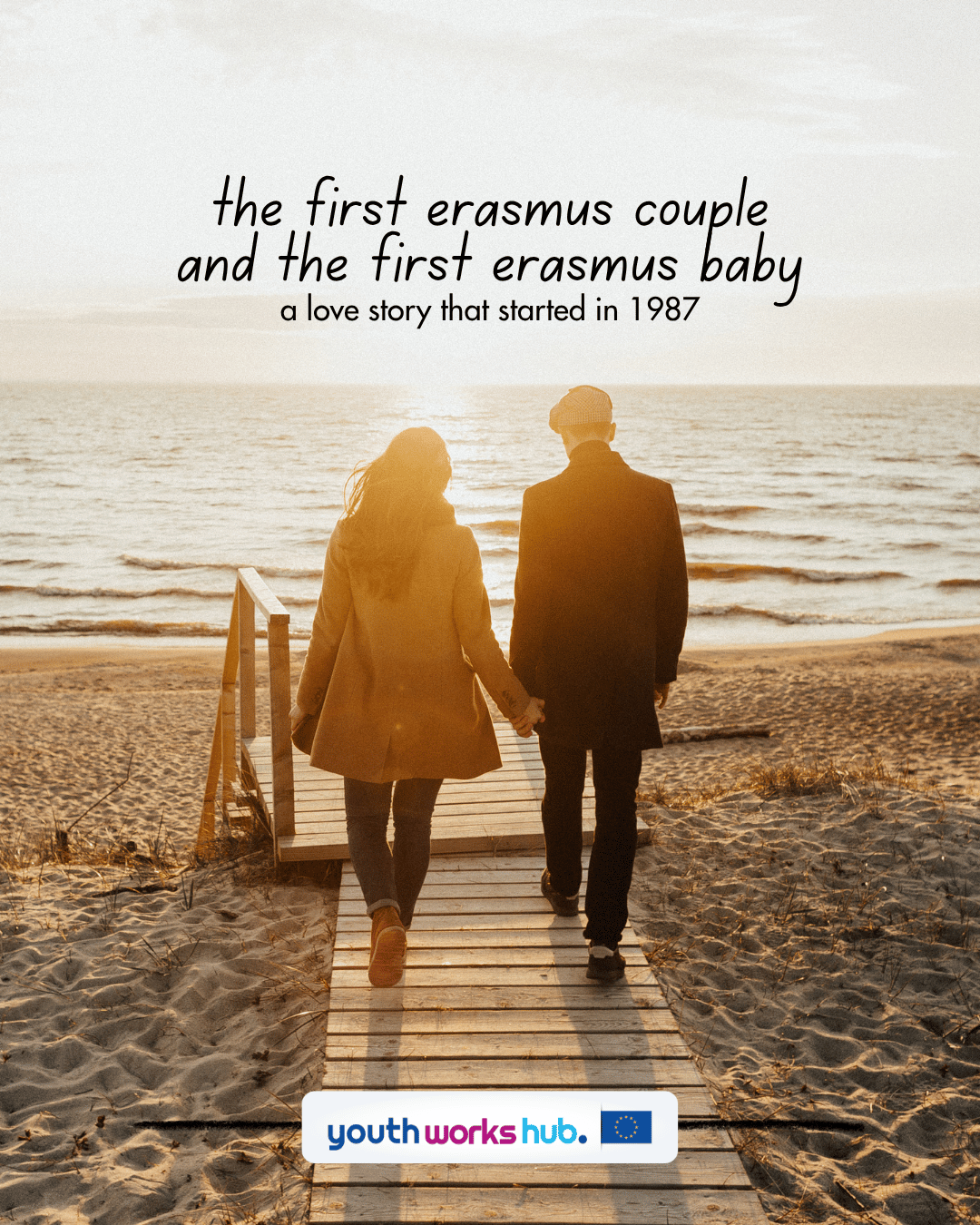
The First Erasmus Couple and the First Erasmus Baby — A Love Story That Started in 1987
It was 1987. The Erasmus Programme had just launched. A French student named Pascal arrived in Sligo, Ireland — and had no idea his life was about to change forever.
In 1987, the Erasmus Programme launched for the very first time. Only 3,200 students from 11 countries took part in that inaugural year — a number that seems impossibly small compared to the 15+ million participants the programme has supported since. One of those 3,200 was a young French student named Pascal. He arrived in Sligo, on the west coast of Ireland, excited to improve his English, experience a new culture, and make the most of a year abroad. He had no idea that the Erasmus exchange would give him something far more meaningful than academic credits.
It would give him love — and in doing so, would make him and his partner the most famous couple in the history of European education.
What Was the Erasmus Programme in 1987 — and Why Did It Only Have 3,200 Students?
The Erasmus Programme — which today operates under the name Erasmus+ — was officially launched by the European Commission on 15 June 1987. Its original purpose was to allow university students from member states of the European Community to study abroad at a partner institution for a period, receiving academic credits that would count towards their degree at home.
The name “Erasmus” is both an acronym — European Region Action Scheme for the Mobility of University Students — and a reference to the Dutch philosopher and humanist Desiderius Erasmus of Rotterdam, who himself lived and studied across different European countries in the 15th and 16th centuries.
How Pascal and Siobhán Met — The Story of the First Erasmus Couple
Pascal arrived in Sligo, a coastal town in the west of Ireland, at the start of the 1987 academic year. It was his first time living outside France, his first real immersion in English, and his first extended experience of a culture substantially different from his own. He was one of the 3,200 who took that leap in the very first year.
During his first week, he met an Irish student named Siobhán. Her warmth. Her laugh. Her presence. Something clicked — not dramatically, not with any fanfare, but with the quiet certainty that sometimes announces the most important things.
What began as a classroom acquaintance became study walks along the Irish coastline, long conversations that stretched past any reasonable hour, and a shared daily life that neither of them had planned for. Slowly, and without either of them quite noticing when it became inevitable, something beautiful was growing between them.
“Erasmus brought us together. We just continued the journey.” — Pascal, first Erasmus couple
Long-Distance Love Before the Age of Smartphones — How One Erasmus Year Turned Into a Lifetime
When Pascal’s Erasmus year ended, he returned to France. This was 1988. There were no smartphones, no WhatsApp, no cheap Ryanair flights to keep cross-border relationships alive with the ease we take for granted today. Long-distance love in the late 1980s meant handwritten letters, expensive international phone calls, and long stretches of silence between visits.
But love found a way. Pascal and Siobhán kept their connection alive across the distance. They travelled back and forth, navigating the logistics of international romance before any of the tools that make it easy today existed.
What Is an Erasmus Baby? The Story Behind the First Erasmus Babies
The term “Erasmus baby” refers to a child born to parents who met through the Erasmus Programme. It has become a popular and affectionate way to describe one of the more unexpected outcomes of European academic mobility — the fact that, when you put young people from different countries together in a new environment for months at a time, some of them fall in love and start families.
Pascal and Siobhán’s children are widely referred to across European media as the first Erasmus babies. This distinction — being the children of the couple who met in the very first cohort of the very first year of the programme — has made their family a recurring reference point in coverage of Erasmus’s legacy.
Why the First Erasmus Love Story Still Matters in 2025
Pascal and Siobhán’s story is often told as a romantic anecdote — a charming footnote to the history of European integration. And it is that. But it’s also something more.
Their story is evidence of what happens when you create the conditions for people from different countries to actually live alongside each other — not just visit, not just exchange pleasantries at a conference, but share daily life for an extended period. Study together. Walk the same coastline. Talk long past midnight.
That kind of proximity changes things. It changes how you see the person in front of you, and how you understand the country they come from. Sometimes it changes your whole life. Erasmus was designed to integrate Europe through education. In doing so, it also integrated people — individual people, with their own specific love stories, families, and futures.
Erasmus isn’t only about education. It’s about people. Moments. Chance encounters. And sometimes — love that lasts a lifetime.
Erasmus+ Today — From 3,200 Students to 15 Million Participants
The programme that began with 3,200 students in 11 countries has grown into one of the largest educational mobility programmes in the world. Today, Erasmus+ supports not just university students but also:
If you are between 18 and 30 and interested in volunteering abroad through the European Solidarity Corps — the successor to the European Voluntary Service and now part of the broader Erasmus+ family — Youth Works Hub lists open opportunities across Europe, updated regularly.
And if you are a young person looking for an Erasmus+ Youth Exchange — the week-long international projects that bring together young people from multiple countries for non-formal learning and cultural exchange — those are listed there too.
Frequently Asked Questions About the First Erasmus Couple and Erasmus Babies
The world is big. But the right people always find each other. ❤️
Find your Erasmus+ Youth Exchange or ESC volunteering opportunity at Youth Works Hub — updated regularly, free to browse.
Browse Opportunities →