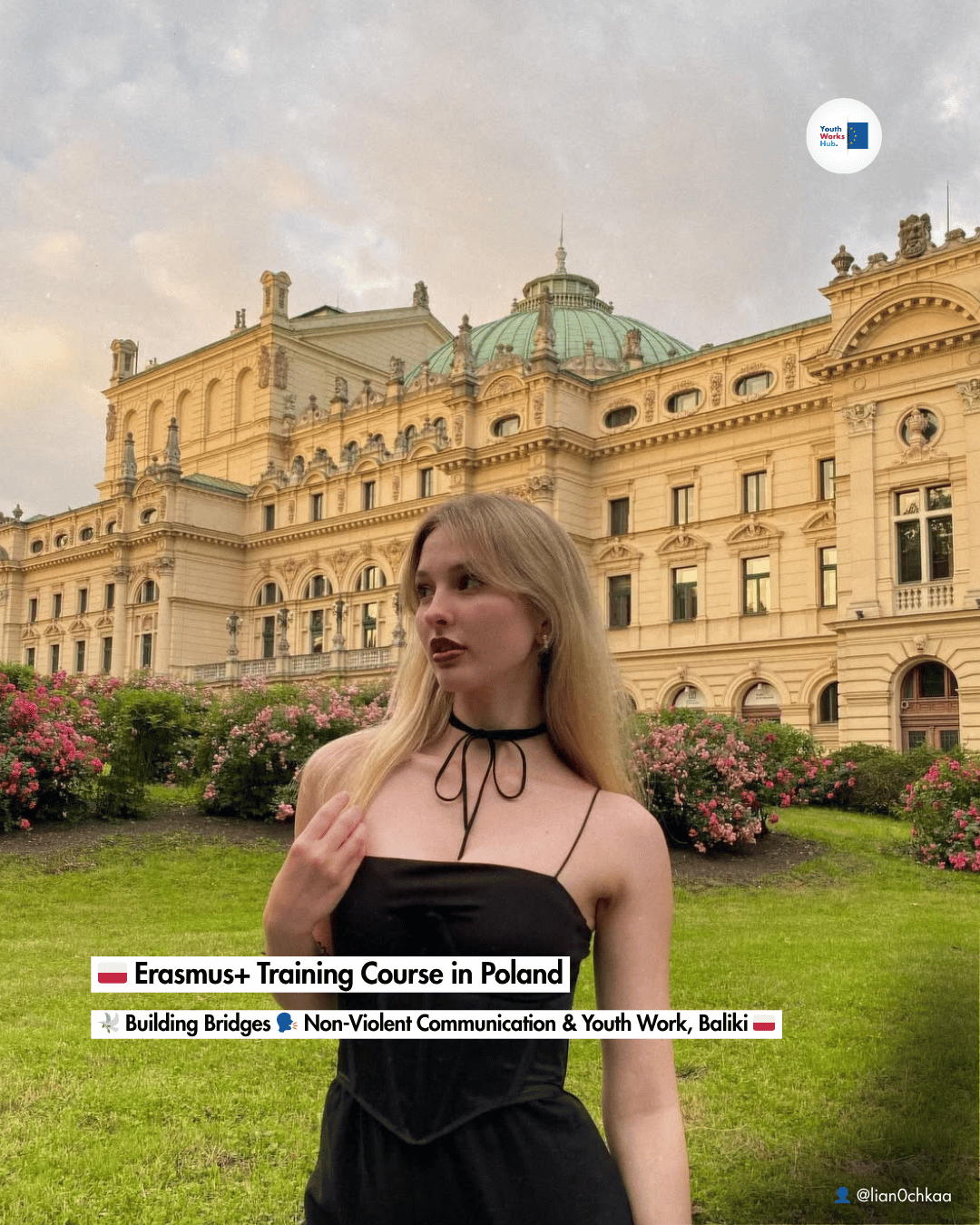
🇵🇱 Erasmus+ Training Course in Poland 🕊️ Building Bridges 🗣️ Non-Violent Communication & Youth Work, Baliki 🇵🇱
Building Bridges is a fully-funded Erasmus+ Training Course (KA153-YOU) for youth workers, educators, youth leaders, trainers, and volunteers from six countries — gathering in the secluded natural setting of Baliki, Poland, to explore the principles and transformative power of Non-Violent Communication (NVC). Over seven intensive days, 23 participants will develop practical tools for empathetic listening, conflict resolution, and peaceful communication — skills that will directly strengthen their daily work with young people across Europe.
🌍 Did You Know? Baliki is located near Łomża in the Podlaskie region of northeastern Poland — one of the country’s most unspoiled natural areas, home to ancient forests, pristine rivers, and some of Europe’s last remaining primeval wilderness. The venue sits directly beside a forest and river, completely cut off from urban noise and internet connection — making it an ideal environment for deep reflection, authentic human connection, and genuine learning.
What Is This Project About?
🕊️ Building Bridges is built around one central mission: creating peaceful, empathetic, and honest communication among youth workers — and equipping them to bring those same skills into their work with young people
🗣️ The project is rooted in Non-Violent Communication (NVC) — a communication framework developed by Marshall Rosenberg that focuses on honest self-expression, empathetic listening, identifying needs, and resolving conflict without aggression or blame
🌍 Through international cooperation and experiential learning, the project creates a safe space for sharing personal stories, exploring diverse perspectives, and building authentic connections across cultures
🔄 The project runs across four stages: preparation with national groups before departure; the training itself in Poland; online dissemination (each participant shares their experience on social media); and a local dissemination event where participants apply what they’ve learned in their own community
🌍 Did You Know? Non-Violent Communication (NVC) was developed by American psychologist Marshall Rosenberg in the 1960s and has since been used in schools, conflict zones, prisons, and community organisations across more than 60 countries. Its core insight — that most conflict arises from unmet needs rather than malicious intent — has transformed how educators, social workers, and youth workers approach difficult conversations and interpersonal tension.
What Will You Learn & Do?
🕊️ Learn practical tools of Non-Violent Communication and how to apply them directly in youth work contexts
👂 Improve your active listening and empathetic communication skills — building the ability to truly hear and understand others even in tense or difficult situations
⚖️ Develop concrete skills and strategies for conflict resolution — learning to de-escalate, mediate, and find common ground
🌍 Increase your capacity to work effectively and confidently with diverse groups of young people across cultural, social, and linguistic boundaries
🛠️ Gain a rich toolkit of new methods, exercises, and approaches to bring directly into your daily youth work after the training
🧠 Dive into experiential learning — sharing personal stories, participating in workshops, and engaging in guided self-exploration in a supportive international group
⚡ Prepare and lead energisers for the group — each participant takes an active role in keeping the energy and connection alive throughout the week
🏢 Present your organisation to other participants — bring leaflets or materials and share what your organisation does
📬 Bring one postcard from your country — these will be exchanged and given to other participants as a tangible memory of the intercultural connections made during the week
🌱 Commit to dissemination: after returning home, each participant organises a local activity in their community related to NVC and the project’s themes
Our Approach & Values
🔓 Openness: Authenticity, self-development, self-expression, mutual respect, and acceptance are at the heart of how we work
💡 Sharing: Experiential learning driven by participants’ own stories — this is not a lecture-based training
🤝 Teamwork: Cooperation, mutual support, and shared learning through collaborative work in a multicultural environment
✅ Integrity: Honest, respectful, and responsible communication — encouraging authenticity, trust, and ethical behaviour in all interactions
🕊️ Non-Violent Communication: The unifying thread woven through every session, activity, and interaction throughout the week
Who Can Apply?
🎂 Youth workers, youth leaders, trainers, educators, or volunteers working with young people — aged 20 to 30 — residing in one of the six partner countries
🌍 Have experience or interest in youth work and non-formal education
🗣️ Motivated to develop communication, active listening, and interpersonal skills
🤝 Open-minded and genuinely willing to engage in an international and intercultural learning environment
💪 Committed to full active participation in all training activities — unexcused absences are not permitted
🌱 Willing to share acquired knowledge and organise a local dissemination activity in your community after the project ends
📱 Willing to share your experience and project outcomes on your personal social media as part of the dissemination process
Accommodation, Food & Travel
🏡 Venue: Baliki — address: Ptaki 121, 18-414 Ptaki, Poland — a peaceful, secluded retreat surrounded by forest and a river in the Podlaskie region
🛏️ Shared rooms of 2–3–4 people, same gender but different countries — to strengthen intercultural connections from day one
🍽️ Three meals per day provided, catered to dietary preferences — inform the organisers of any dietary requirements in your application
📵 Important: the venue has no internet or mobile data connection — this is intentional and part of the immersive learning experience; bring everything you need in advance
🛒 The nearest shop is approximately 3 km away — bring any snacks, drinks, or personal items you may need for the week
🚗 A car is available at the venue for emergency use only
✈️ Fly to Warsaw Airport — confirm your route with the organisers BEFORE buying tickets by sending your travel plan to: filippoenquiries@outlook.com by 15 March 2026
🚌 On arrival in Łomża at 20:00 on 15 May, a private bus will transfer participants to the Baliki hotel — details sent by email and WhatsApp; departure bus from Baliki to Łomża at 08:00 on 22 May
💶 Travel reimbursed up to country-specific limits (standard / green travel): Poland €26 | Italy €289/€397 | Latvia €191/€265 | Greece €289/€397 | Romania €289/€397 | Finland €289 | Türkiye €289 — note that €20 is deducted from all reimbursements to cover the private bus transfer
🌿 Green travel (bus, carpooling, or train only) is eligible for higher reimbursement rates — participants choosing green travel must fill out additional statements
⚠️ Only economy/class II tickets are eligible — taxis and cars are NOT reimbursable; do not book through travel agencies; reimbursement is sent to the sending organisation, not individual participants
📄 Keep ALL travel documents — original tickets, boarding passes, invoices, and payment confirmations — these are mandatory for reimbursement; missing documents cannot be reimbursed
💰 No participation fee — fully funded by Erasmus+
What to Prepare & Bring
🪪 Valid ID or passport — mandatory
💻 Bring a laptop if possible — it will be helpful during workshops
📬 One postcard from your country — to be exchanged with other participants as a memento of the intercultural connections made
📷 A camera if you have one — photo documentation is warmly encouraged
⚡ Prepare some energisers you could lead for the group during the project
🏢 Prepare a short presentation about your organisation — bring leaflets or printed materials to share
🛒 Bring any snacks, personal drinks, or items you may need for the week — the nearest shop is 3 km away
Key Information
Eligible Countries
🇵🇱 Poland, 🇮🇹 Italy, 🇱🇻 Latvia, 🇬🇷 Greece, 🇷🇴 Romania, 🇫🇮 Finland
Application Link
⚠️ Important Notice
1️⃣ Source of Information
This announcement has been prepared based on the information provided by the opportunity organiser.
2️⃣ Responsibility for Content
The organiser is solely responsible for the accuracy, details, and updates of the opportunity content.
3️⃣ Right to Modify or Withdraw
Organisations reserve the right to make changes after publication — including eligibility criteria, conditions, or deadlines — or to withdraw the announcement entirely.
4️⃣ Disclaimer of Liability
YouthWorks Hub is not responsible for any such changes, updates, or cancellations made by the organiser.
💡 Final Note:
All listings are shared for informational purposes only. Please always verify details directly through the official organiser or programme website before applying.

 🇨🇿 Erasmus+ Training Course in Czechia 🤖 AI Unlocked 🌍 Artificial Intelligence and Digital Literacy in Youth Work, Kolín 🇨🇿
 🇷🇴 ESC Volunteering in Romania ☀️ Short Term Summer Fun Vol.5 🏕️ Summer Camps for Disadvantaged Children, Cristuru Secuiesc 🇷🇴
 🇫🇷 ESC Volunteering in France 🌻 Youth & Intercultural Exchange Volunteer 🌍 Culture, Language & Rural Community, Ribérac 🇫🇷
 🇩🇪 Erasmus+ Training Course in Germany 💧 Water Matters 🌿 Water Sustainability, Environmental Education & Youth Work, Stuttgart 🇩🇪