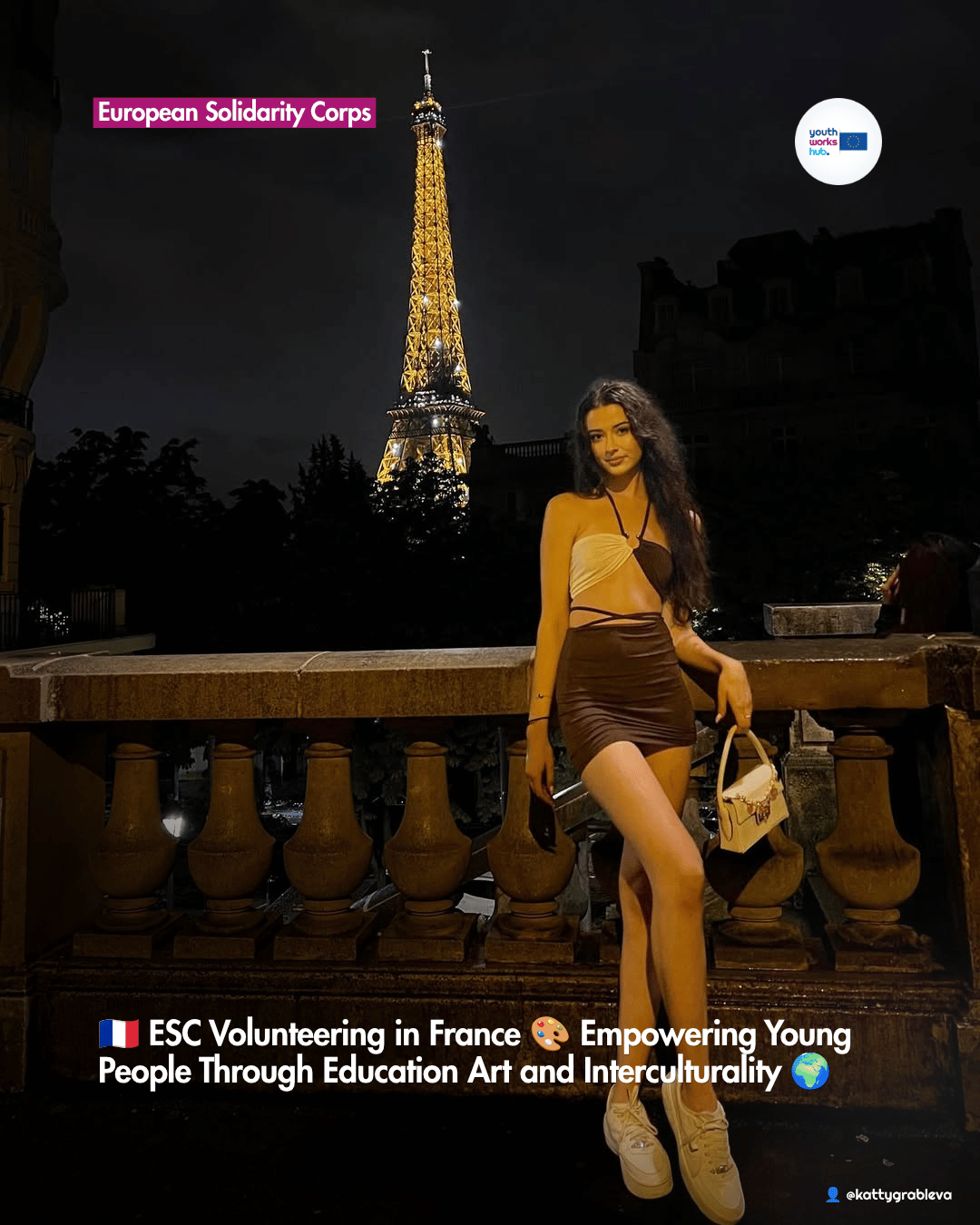
At Youth Works Hub, we love sharing the real journeys of our community. Aldona, 22, from Lithuania, spent five days at a Non-Formal Education Training Course in France with 40 young people from 10 countries. Non-formal learning is learning which takes place outside formal education and training through learning activities and with some form of learning support, and it has a participative and learner-centred approach. A training course is one of the forms of Professional Development Activities supporting the professional development of youth workers. Here is her story, in her own words.
Last updated: November 2026.
By Aldona, 22 – Lithuania 🇱🇹
When I first saw the announcement for a Non-Formal Education Training Course in France 🇫🇷, I knew it was something special. 🌍✨
A few weeks later, I arrived at a cozy training venue surrounded by 40 incredible young people from 🇵🇹 Portugal, 🇫🇷France, 🇮🇹 Italy, 🇹🇷 Türkiye, 🇧🇬 Bulgaria, 🇫🇮 Finland, 🇩🇰 Denmark, 🇩🇪 Germany, 🇸🇪 Sweden, and 🇱🇹 Lithuania — each of us curious, open-minded, and ready to learn together.
For five unforgettable days, we explored what it really means to learn beyond classrooms. 💡💬
🎓 What Is Non-Formal Education?
Before this experience, I believed learning only happened in schools or universities.
But during this Erasmus+ project, I discovered something entirely new — a world where education means freedom, creativity, and self-expression. 🎨✨
We learned through games, storytelling, debates, and outdoor challenges.
One day, we built a “bridge of trust” blindfolded 🤝; another day, we created theatre plays to address real-world issues like inclusion and mental health. 🎭🌱
Every task had a hidden purpose — teamwork, empathy, leadership, communication.
By the end, I realized that non-formal education teaches you not only about the world, but also about yourself. 🌍💙
🌍 A Week of Connection, Culture & Growth
Our group felt like a big European family. 👨👩👧👦
Mornings began with energizers full of laughter and music 🎶☀️, and nights were filled with intercultural eveningswhere we shared food, songs, and traditions.
I proudly presented Lithuanian pink soup 🇱🇹💜, while tasting French cheese 🇫🇷, Italian pasta 🇮🇹, Turkish baklava 🇹🇷, and Finnish chocolate 🇫🇮🍫.
Every night reminded us that diversity is our greatest strength — we spoke different languages, yet understood each other perfectly through smiles, energy, and curiosity. 💬💫
🌱 Lessons That Stay Forever
These five days changed the way I see learning and life.
I discovered that:
⭐ True learning happens when you feel safe and inspired.
⭐ Mistakes are steps, not failures.
⭐ The best classrooms have no walls.
When I came back to Vilnius 🇱🇹, I started helping my local youth center organize creative workshops using non-formal tools I learned in France. It felt like the beginning of something bigger — a ripple effect of learning, friendship, and inspiration. 💙
💬 Aldona’s Message to You
If you ever see an Erasmus+ opportunity, take it. Don’t think twice.
Pack your courage, curiosity, and openness. ✨
Because somewhere in Europe, there’s a project waiting to change your life — just like this one changed mine. 🌍💙
In a training course in a Mobility project for Youth Workers, participants must be minimum 16 years old, and the duration is from 2 to 60 days, excluding travel days. A youth worker is a professional or volunteer who supports the personal, social and educational development of young people. Our guide on mobility of youth workers explains the strand behind these courses, and Youthpass covers how learning in these projects is recognised.
Thank you, Aldona, for sharing your story 💙 Have your own Erasmus+ or ESC story? Send it to Youth Works Hub and we will feature it here, so other young people can see what is possible.
More stories from our community: Yasemin's Youth Exchange in Braga · Lorenzo's Youth Exchange in Portugal · Serena's Erasmus+ and DiscoverEU story
👉 Erasmus+ projects: youthworkshub.org/?tab=erasmus-projects