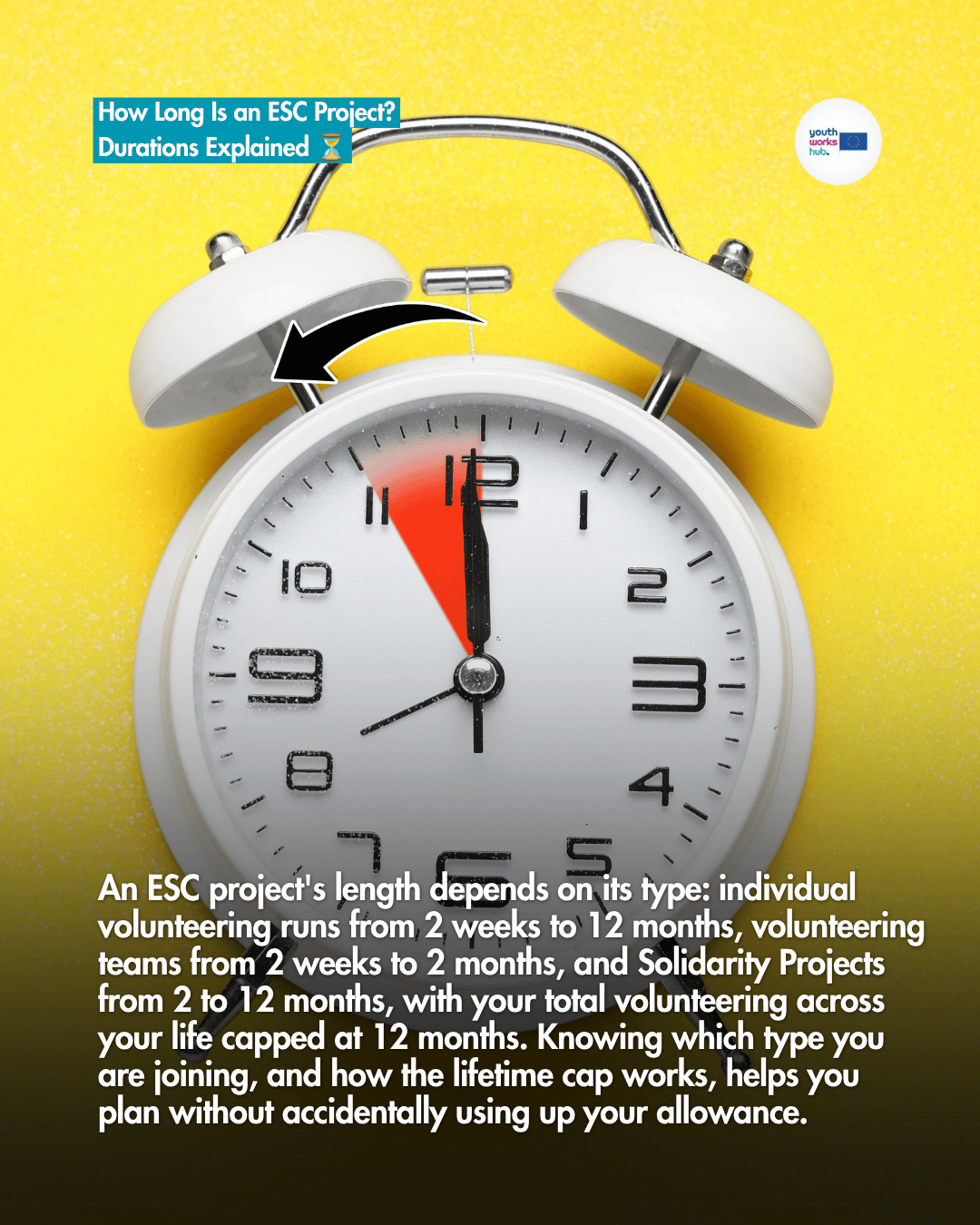
In the European Solidarity Corps (ESC), Individual Volunteering is a solidarity activity of a duration of 2 weeks to 12 months, excluding travel time. Volunteering is a full-time unpaid activity that has a duration of up to 12 months. In terms of activity duration, individual volunteering can be short term, with participation lasting between 14 and 59 days, excluding travel days, or long term, with participation lasting between 60 and 366 days, excluding travel days. A Solidarity Project is a non-profit solidarity activity initiated, developed and implemented by young people themselves for a period from 2 to 12 months. Our guide on what the European Solidarity Corps is introduces the programme, and the complete guide to ESC volunteering walks through every stage of a volunteering activity.
Last updated: October 2026.
How long is European Solidarity Corps Individual Volunteering?
In the European Solidarity Corps, Individual Volunteering has a duration of 2 weeks to 12 months, excluding travel time.
🕐 Short and long term: In terms of activity duration, individual volunteering can be short term, with participation lasting between 14 and 59 days, excluding travel days, or long term, with participation lasting between 60 and 366 days, excluding travel days.
🌍 Cross-border or in-country: Volunteering may take place in a country other than the country of residence of the participant (cross-border) or in the country of residence of the participant (in-country).
🏢 Daily work: Individual Volunteering provides young people with the opportunity to contribute to the daily work of organisations in solidarity activities to the ultimate benefit of the communities within which the activities are carried out.
Our guide on what ESC volunteering is explains how a volunteering activity is organised, and the agreement you sign before starting covers the document that fixes your dates.
How long are European Solidarity Corps Volunteering Teams activities?
Volunteering Teams in the European Solidarity Corps are from 2 weeks to 2 months, excluding travel time.
⏳ In days: Up to 59 days, excluding travel days.
Our guide on what ESC Volunteering Teams are explains how a team is put together before departure.
How long is a European Solidarity Corps Solidarity Project?
A Solidarity Project is a non-profit solidarity activity initiated, developed and implemented by young people themselves for a period from 2 to 12 months.
👨👩👧 Minimum five young persons: A Solidarity Project gives a group of minimum five young persons the chance to express solidarity by taking responsibility and committing themselves to bring positive change in their local community.
🧑🤝🧑 No maximum number: There is no maximum number of the group's members.
🏡 In your own country: The activities will take place in the country of residence of the applicant, facilitating in particular the participation of young people who may encounter difficulties to engage in transnational activities.
🧩 Stages: A Solidarity Project will typically consist of the following stages: planning, preparation, implementation of the activities, and follow-up, including the evaluation of the activities as well as the sharing of project's results.
📅 Timetable: The phases should be clearly structured with the help of a project's timetable.
Our guide on what ESC Solidarity Projects are covers how a group of young people starts one.
Do travel days count towards the duration?
No. In the European Solidarity Corps, Individual Volunteering has a duration of 2 weeks to 12 months, excluding travel time, and Volunteering Teams are from 2 weeks to 2 months, excluding travel time.
📏 Short term and long term: Short term volunteering is participation in volunteering activities lasting up to 59 days, excluding travel days, and long term volunteering is participation in volunteering activities lasting 60 days or longer, excluding travel days.
🧮 Multiple activities: A volunteer can take part in multiple individual cross-border volunteering activities lasting up to 2 months, and up to 2 months is up to 59 days, excluding travel days. The total amount of time spent by a young person in European Solidarity Corps volunteering activities must not exceed 12 months and the activities carried out must not overlap.
Our guide on how flights are booked and reimbursed covers the journey itself, and how Erasmus+ and ESC travel reimbursement works shows how the amount is worked out.
How many hours a week does European Solidarity Corps volunteering take?
Volunteering in the European Solidarity Corps is a full-time unpaid activity that has a duration of up to 12 months.
⏰ Hours per week: At least 30 and not more than 38 hours per week.
💶 Free of charge: Participation in volunteering activities must be free of charge for the volunteer.
Our guide on whether ESC is fully funded sets out what is paid and what is not, and how much pocket money you get on ESC covers the personal allowance.
Is there a limit on how much time you can spend in total?
The total amount of time spent by a young person in European Solidarity Corps volunteering activities must not exceed 12 months and the activities carried out must not overlap. Activities carried out under Erasmus+ volunteering or European Voluntary Service will count towards the total of 12 months allowed.
🧍 A single long activity: A volunteer can take part in a single individual cross-border volunteering activity longer than 2 months.
🔎 A second long activity: A second individual cross-border volunteering activity longer than 2 months is allowed only if the National Agency approves it, either for young people with fewer opportunities or in other duly justified cases.
🧩 Multiple activities: A volunteer can take part in multiple individual cross-border volunteering activities lasting up to 2 months.
👥 Teams: A volunteer can take part in multiple volunteering teams activities.
🏠 In-country activities: A volunteer can take part in multiple in-country volunteering activities.
✅ Solidarity Projects: Solidarity Projects are not included in the 12-month time limit.
Our guide on doing ESC more than once works through the combinations, and the difference between ESC and Erasmus+ compares the two programmes side by side.
Frequently asked questions
What is the shortest European Solidarity Corps volunteering activity?
Individual Volunteering is from 2 weeks to 12 months and Volunteering Teams are from 2 weeks to 2 months, both excluding travel time. In terms of activity duration, individual volunteering can be short term, with participation lasting between 14 and 59 days, excluding travel days, or long term, with participation lasting between 60 and 366 days, excluding travel days. Our guide on how a team volunteers together describes the shorter team format.
What is the longest European Solidarity Corps volunteering activity?
Individual Volunteering has a duration of 2 weeks to 12 months, excluding travel time. Long term volunteering is participation in volunteering activities lasting 60 days or longer, excluding travel days. Our guide on your first steps as an ESC volunteer covers what happens once you arrive.
Where is the line between short term and long term volunteering?
Short term volunteering is participation in volunteering activities lasting up to 59 days, excluding travel days. Long term volunteering is participation in volunteering activities lasting 60 days or longer, excluding travel days. Our guide on how to choose the right project explains what to compare before you apply.
Can you do a second long European Solidarity Corps project?
A second individual cross-border volunteering activity longer than 2 months is allowed only if the National Agency approves it, either for young people with fewer opportunities or in other duly justified cases. Our guide on doing ESC more than once works through the combinations.
Does a group project of your own count towards your volunteering total?
No, Solidarity Projects are not included in the 12-month time limit. The total amount of time spent by a young person in European Solidarity Corps volunteering activities must not exceed 12 months and the activities carried out must not overlap. Activities carried out under Erasmus+ volunteering or European Voluntary Service will count towards the total of 12 months allowed. Our guide on Solidarity Projectsexplains how young people run a project of their own.
Count your days before you apply
Read the dates on an opportunity before you send anything, because the length of the activity decides how much of your year it takes. Our guide on how to find Erasmus+ and ESC projects shows where open calls are published. The related pages below from Youth Works Hub cover each part of this guide in more detail.
Related pages: the complete guide to ESC volunteering · projects young people run themselves · how a team volunteers together · doing ESC more than once · how to find Erasmus+ and ESC projects
👉 ESC projects: youthworkshub.org/category/esc-projects