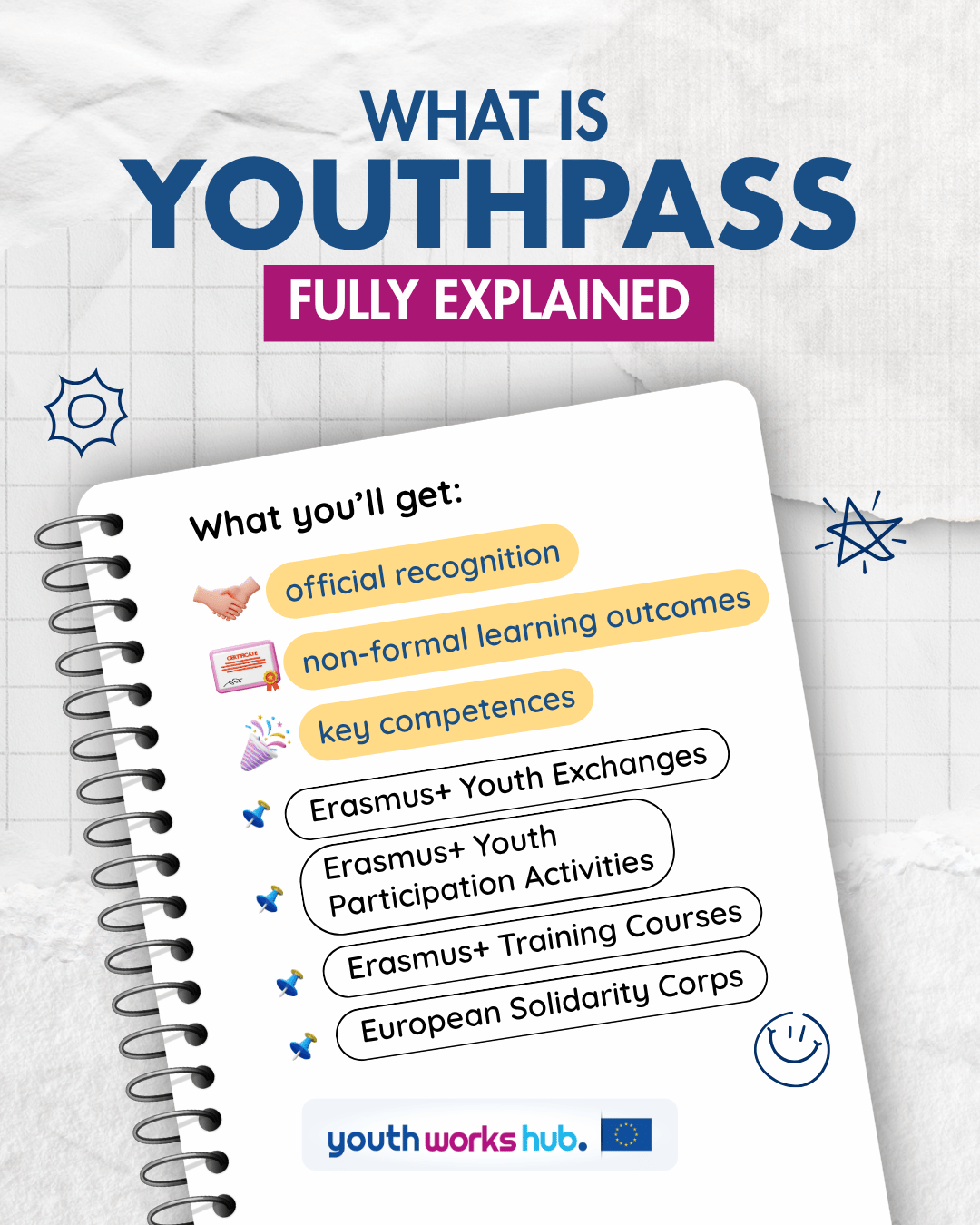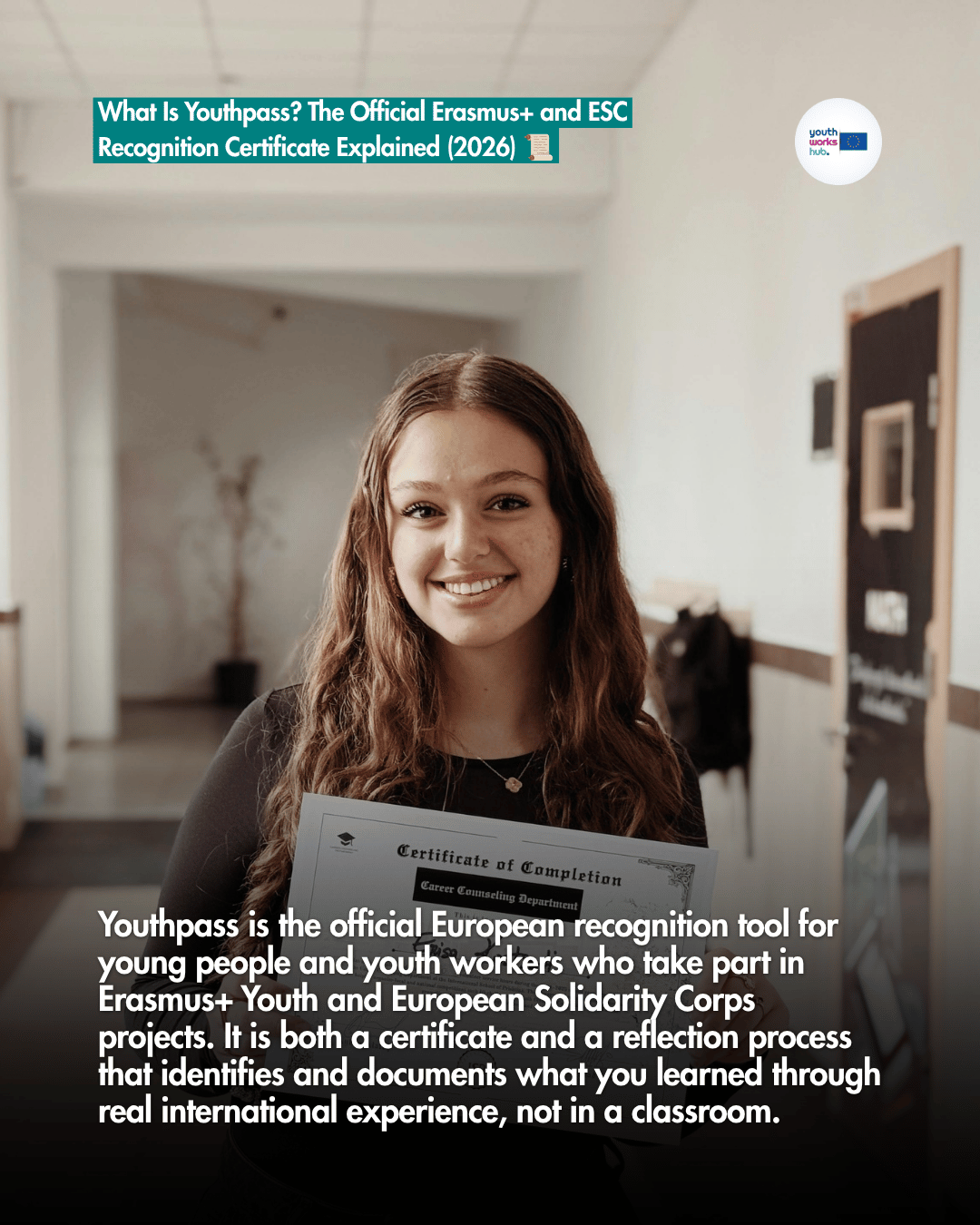
Youthpass is the official European recognition tool for young people and youth workers who take part in Erasmus+ Youth and European Solidarity Corps projects. It is both a certificate and a reflection process that identifies and documents what you learned through real international experience, not in a classroom. Every participant in an eligible activity is entitled to one, it is generated on the official youthpass.eu platform by your organisation, and there is no cost to you. This guide explains exactly what Youthpass is, which competences it records, who is eligible, how the process works, and how to actually use it.
What Is Youthpass? A Tool and a Process, Not Just a Certificate 🌍
Most people think of Youthpass as a piece of paper you get at the end. It is more than that. Officially, Youthpass is a European recognition instrument for identifying and documenting learning outcomes acquired in youth projects, and it works as a tool, a process, and a strategy all at once. The certificate is the visible result. The real value is the guided reflection that runs through your whole project, where you stop and ask what you actually learned and how you grew.
It was created to close the gap between formal qualifications and the very real skills young people build through youth work, volunteering, and international mobility. Youthpass makes that non-formal and informal learning visible, both to you and to employers, universities, and organisations who understand it. It is developed and maintained by the SALTO Training and Cooperation Resource Centre in the name of the European Commission, and it has run across the EU youth programmes since 2007, now within Erasmus+ and the European Solidarity Corps 2021 to 2027.
Who Creates and Issues It, and Is There a Cost? 🧾
You do not create your Youthpass entirely alone, and you do not pay for it:
🔹 Your organisation issues it. The organisation that holds the grant (your host or coordinating organisation) is responsible for generating your certificate on the official youthpass.eu platform
🔹 You shape the content. You describe your project and your learning outcomes in your own words, guided by a support person
🔹 There is no cost to participants. Youthpass is part of the EU-funded programmes, and no fee is charged to you
🔹 It is voluntary to claim. You are entitled to it, but you receive it if you want it, which is exactly why so many participants finish a project without ever asking for theirs
If your project has ended and nobody mentioned Youthpass, contact your host organisation and ask. You have the right to it.
Which Erasmus+ Youth and ESC Activities Are Eligible? ✅
If you took part in any of these EU-funded activities, you are entitled to a Youthpass certificate:
🔹 Erasmus+ Training Courses and other mobility of youth workers
🔹 Erasmus+ Youth Participation Activities
🔹 European Solidarity Corps volunteering, individual and short-term
Youthpass also supports the documentation of learning in the DiscoverEU Inclusion Action. In short, if it is an eligible Erasmus+ Youth or ESC activity, Youthpass belongs to it.
The 8 Key Competences for Lifelong Learning (2018 Framework) 🧠
For most youth activities, your learning is described against the EU's eight key competences for lifelong learning, in the current framework from the 2018 Council Recommendation. These are the up to date official names:
🔹 Literacy competence
🔹 Multilingual competence
🔹 Mathematical competence and competence in science, technology and engineering
🔹 Digital competence
🔹 Personal, social and learning to learn competence
🔹 Citizenship competence
🔹 Entrepreneurship competence
🔹 Cultural awareness and expression competence
You do not have to show progress in all eight. You describe the competences your specific project actually developed, in your own words. Note that many older blogs and PDFs still list the outdated 2006 names (like "communication in the mother tongue" or "sense of initiative"). The list above is the current one.
A Different Framework for Youth Workers: The ETS Model 🛠️
Here is a nuance most guides miss. When the participant is a youth worker rather than a young participant, for example on a Training Course or another mobility of youth workers activity, Youthpass does not use the 8 key competences. It uses the ETS Competence Model for Youth Workers (the European Training Strategy model), which describes the competences specific to youth work practice. So the framework behind your certificate depends on the type of activity you took part in.
How the Youthpass Process Works: Before, During, After ⏳
Youthpass is not a form you fill in on the last day. The reflection runs through the whole project life cycle:
🔹 Before: you are told you can receive a Youthpass and encouraged to pay attention to your learning from the start
🔹 During: the project builds in regular moments to reflect on what you are experiencing and learning
🔹 After: you write down your learning outcomes and the certificate is generated on youthpass.eu
The point is the reflection itself. Sitting down and asking "what did I learn, what challenged me, what can I do now that I could not before" turns a lived experience into something you can actually describe later.
The Role of the Support Person or Mentor 🤝
You do not do the reflection in a vacuum. A support person, often your mentor or a facilitator from your organisation, guides the process. They help you notice your learning, put it into words, and describe your competences honestly for the certificate. A good support person is the difference between a vague certificate and one that genuinely captures your growth. This is one of the qualities of a well-run project, and it connects closely to what makes an ideal ESC volunteer.
What the Youthpass Certificate Actually Contains 📄
A Youthpass certificate is generally built from these parts, though the exact order and detail vary by activity type:
🔹 Confirmation of participation plus the main facts of your project and background on the EU youth programmes
🔹 A project description, covering the organisations involved, the aims, the activities, and the results
🔹 Your self-assessed learning outcomes, described against the 8 key competences (or the ETS model for youth workers)
Certificates are available in more than a dozen European languages, and once issued they do not expire.
Youthpass, Europass, and Recognising Non-formal Learning 🔗
Youthpass is an official EU document, and it connects to Europass, the EU's official CV and credentials platform, where you can store and share it in your Europass Library. It sits within the EU's wider work on validating non-formal and informal learning, and EU recommendations specifically name Youthpass as a transparency tool to promote. Recognition still varies by employer, institution, and country, as it does with any certificate, so the honest picture is this: Youthpass is well understood within the European youth sector, NGOs, and public institutions, and it is most powerful when you can clearly describe the competences it documents.
Common Misconceptions: It Is Not a Diploma 💡
A few things are worth being clear about:
🔹 It is not a formal qualification. Youthpass confirms participation and documents competences, but it is not a diploma or degree and gives no formal rights
🔹 It is not an attendance sheet. The competence descriptions come from genuine reflection, not a tick box
🔹 It is not automatic. Your organisation has to create it and you have to claim it, which is why many participants never receive one
🔹 It is not only for young participants. Youth workers receive Youthpass too, documenting their professional development
Understanding these points is part of understanding the whole programme, which you can explore in what is Erasmus+and who can apply.
Frequently Asked Questions ❓
What is Youthpass in simple terms?
Youthpass is the official recognition tool of the Erasmus+ Youth and European Solidarity Corps programmes. It is both a certificate and a reflection process that documents the competences you developed through your project, based on real experience rather than classroom study. It is issued digitally and there is no cost to you.
Who is entitled to a Youthpass certificate?
All participants in eligible Erasmus+ Youth activities (Youth Exchanges, Training Courses and other youth-worker mobility, Youth Participation Activities) and European Solidarity Corps activities (volunteering, Volunteering Teams, Solidarity Projects) are entitled to a Youthpass. Claiming it is voluntary.
What skills does Youthpass document?
For most activities, your learning is described against the EU's eight key competences for lifelong learning from the 2018 framework. For youth-worker activities, Youthpass uses the ETS Competence Model for Youth Workers instead.
How do I get my Youthpass certificate?
Your host or coordinating organisation creates the certificate on the official youthpass.eu platform. You reflect on your learning with a support person, describe your competences in your own words, and the organisation issues it digitally. If your project has ended and you have not received one, contact your organisation.
Is Youthpass the same as a diploma?
No. Youthpass documents non-formal and informal learning and confirms participation, but it is not a formal qualification and does not replace a degree. It complements formal education by making experience-based competences visible.
Does Youthpass expire?
No. Once your Youthpass certificate is issued, it does not have an expiry date and stays valid permanently.
In Short 💙
Youthpass is the official way the EU makes your Erasmus+ and ESC learning visible. It is a certificate and, more importantly, a reflection process that helps you name the competences you built through real experience. It is free to you, issued by your organisation, structured around the 2018 key competences (or the ETS model for youth workers), and it does not expire. Claim it, and learn to describe what it holds, because that is what turns an amazing experience into something others can see.
👉 Find your next opportunity: ESC and Erasmus+ projects on Youth Works Hub