🔑 Key Information
Activity ⭐️ Title
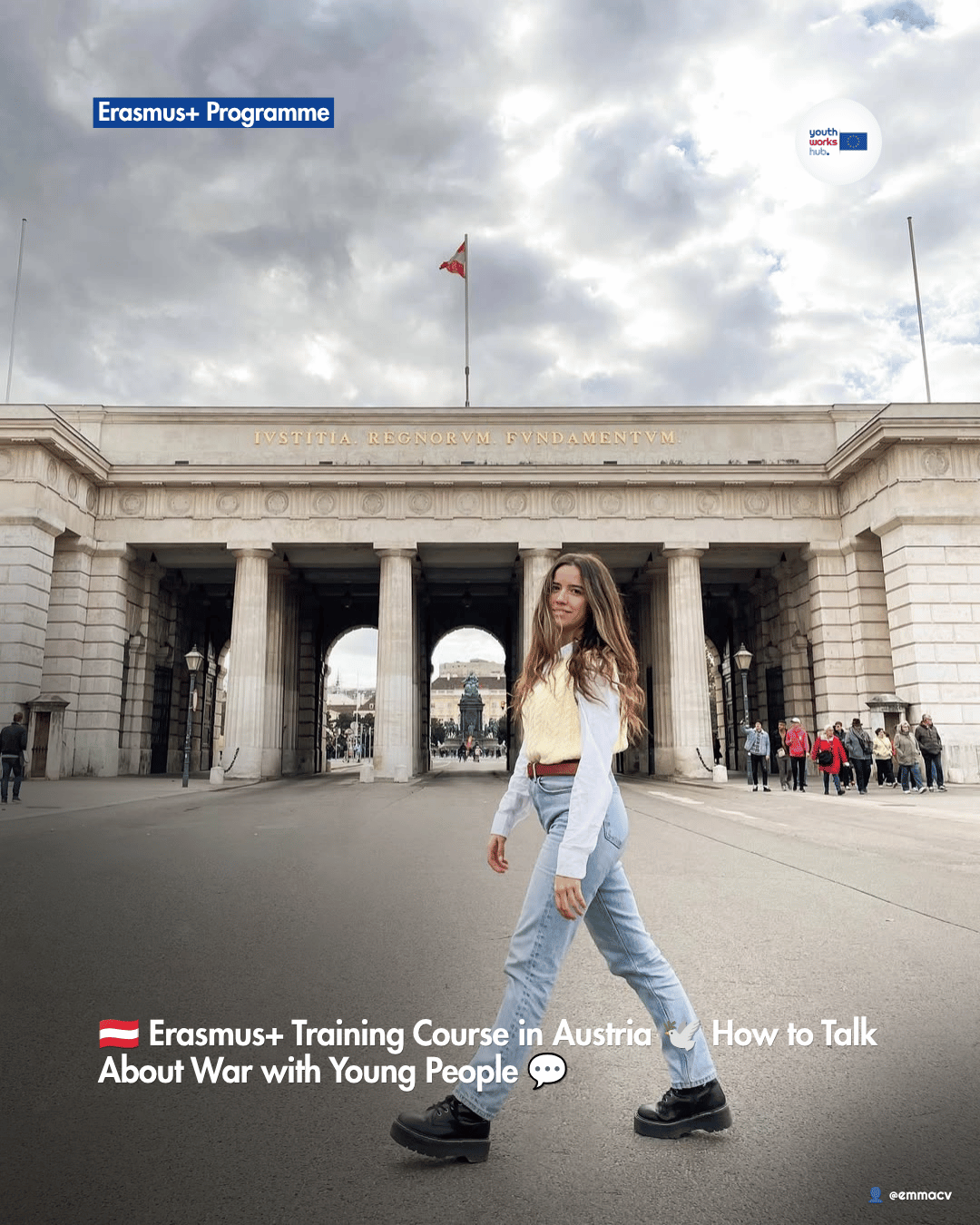
How to talk about war
Activity 🔶 Type | 📆 Dates | 📍Location
Training Course
6-11 December 2026 | Vienna, Austria
🌍 Erasmus+ explained — the complete beginner's guide to Europe's largest youth programme.Millions of young people have taken part in Erasmus+ since its launch, but many still don't fully understand what the programme actually includes, who it's for, or how to get involved. This in-depth guide breaks down everything: the different types of mobility, funding opportunities, eligibility criteria, and what you can realistically expect from participating. If you've ever wondered whether Erasmus+ is right for you, this guide gives you all the answers in one place. 👉 https://youthworkshub.org/15096/
❗️What Is This Training About?
The aim of the training is to develop the competences of youth workers to help them to engage young people in meaningful, informed, and sensitive conversations about wars and armed conflicts.
🏘️ How Erasmus+ youth projects create lasting change in local communities. The impact of Erasmus+ goes far beyond the individuals who participate. Local communities, host organisations, and even entire neighbourhoods are shaped by the projects that take place within them. This article explores the broader social impact of Erasmus+ youth exchanges — from building intercultural understanding to empowering grassroots organisations — and makes a compelling case for why these projects matter beyond the personal level. 👉 https://youthworkshub.org/3595/
ℹ️ Description About The Opportunity
Aim of the training course
The aim of the training is to develop the competences of youth workers to help them to engage young people in meaningful, informed, and sensitive conversations about wars and armed conflicts. The training neither aims to inform about nor discuss the details and/or history of any specific war.
The training will combine elements of:
- self-reflection (how do youth workers tackle the topic)
- building youth workers’ confidence in facilitating discussions about war and armed conflicts with young people
- exchanging experiences of dealing with difficult conversations with young people on war related topics
- equipping youth workers with methods and practical tools to help discuss difficult topics with young people
- opportunities in Erasmus+ and European Solidarity Corps possibilities for youth workers and young people on the topic
- if feasible, a study visit to a Viennese organisation will be incorporated
Methodology of the training course:
The methodology of the training course is based on the principles and methods of non-formal education and experiential learning. This means, that we will not “just talk”, we will work in small groups, try out methods that will engage the mind, emotions and the body, use reflection, educational games, simulations and peer learning as tools. Dialogue is at the core of the training, based on principles of non-violence and supportive communication.
Participants profile:
- Youth workers who deal with difficult discussions with their target groups related to the topic of war/armed conflicts
- Youth leaders, and others involved in non-formal education or youth engagement who are working directly with young people on daily basis in relation to these topics
- Youth workers who work or who have experience working with young people with refugee and migrant background
- Openness to listen and to share own experiences and opinions, readiness to challenge own attitudes and behaviours
- Commitment to participate in all elements of the programme
- Ability to work in English (as the working language of the training will be English)
- Age: 18+
This training has the potential to be intense and emotionally challenging. It might bring up difficult experiences from participants. Before registering, evaluate for yourself whether you feel emotionally prepared and sufficiently supported to take part at this moment. Please also keep in mind that it is not a therapeutic setting and is not suitable for processing personal trauma or receiving individual counselling or crisis support.
Duration of the training course
- The residential training will take place in Vienna from 6 to 11 December 2026 (Arrivals and Welcome evening on 6 December, full working days 7–10 December and departure on 11 December 2026 after breakfast)
- 1-hour online kick-off meeting prior to the training course as well as 1-hour online check-in meeting after the training course. The dates and time will still be communicated to the selected participants
Team
- The training is organised within the Strategic Partnership for Inclusion by OeAD-GmbH (Austrian National Agency, Aleksandra Vedernjak, Sebastian Harrer), Haridus-Ja Noorteamet – HARNO (Estonian National Agency, Mirjam Kodi) and SALTO Eastern Europe and Caucasus Resource Centre (Tomasz Szopa).
- The trainers are Yuliya Ielfimova (trainer and consultant on human rights education, conflict transformation, peacebuilding, trauma-informed youth work, youth worker) and Manina Ott (freelance trainer and organisational developer, focusing on diversity and anti-discrimination, especially within the field of (forced) migration).
Link
This is the training's third edition. Previous trainings on the same topic took place in Estonia in 2025 and in Poland in 2022. Please find some testimonials about last year's edition here: https://beyondb.eu/peace-work-how-to-talk-about-war/
Training overview
This Training Course is
for 25 participants
from Erasmus+ Youth Programme countries  , Partner Countries Neighbouring the EU
and recommended for
Youth workers, Youth leaders
Accessibility info:
This activity and venue place are accessible to people with disabilities.
Working language(s):
English
Organiser:
OeAD - Austria's agency for education and internationalisation (National Agency)
✅ 10 practical tips to write a stronger Erasmus+ or ESC application and actually get selected. With growing competition for spots in Erasmus+ and ESC projects, a well-crafted application can genuinely make or break your chances. This guide shares 10 concrete, actionable tips based on what selection committees actually look for — covering everything from how to frame your motivation to the common mistakes that get applications rejected. If you're serious about getting selected, take the time to read this before you hit submit. 👉 https://youthworkshub.org/8396/
📥 Contact
Contact for questions:
Sebastian Harrer
E-Mail:
Phone: +43 1 53408-719
💶 Costs
Participation fee
This project is financed by the participating National Agencies (NAs) of the Erasmus+ Programme. If there is a participation fee at all, it varies from country to country. Please contact your National Agency or regional SALTO Resource Centre to learn more about the participation fee for participants from your country.
Accommodation and food
- We aim to make this training course as accessible as possible and can offer additional support, if needed. Please get in touch in advance so we can find a way on how to proceed
- If you need a visa in order to participate, please include this in the application
- Participants will be accommodated in single rooms
- We provide a full board (breakfast/lunch/dinner, coffee breaks) during the activity. Please include any dietary needs in the application forms
Travel reimbursement
If you would like to know details of travel reimbursement of selected participants, please contact your National Agency or regional SALTO Resource Centre.
📜 Certificate
Participants are entitled to receive a Youthpass certificate from the organiser, for recognition of their competence development during the activity. Read more about Youthpass:
⚠️ Important Dates
Application deadline (24h UTC): 6 September 2026
Date of selection: 27 September 2026
🔗 Official Link
https://www.salto-youth.net/tools/european-training-calendar/training/how-to-talk-about-war.15090/
⚠️ Important Notice
Youth Works Hub is not the organiser, partner, or representative of the listed projects. This listing is shared for information only, based on details from the source. Deadlines, eligible countries, dates, and other details may change or be withdrawn at any time, and all funding, reimbursements, and allowances are set by the project coordinator or National Agency. Applications go directly to the coordinator or hosting organisation through the official link. Listings may include third-party links (ESC Portal, infopacks, forms) that Youth Works Hub does not control. Always verify the details on the official project page before applying.