🔑 Key Information
Activity ⭐️ Title
Space That Holds Training Course
Activity 🔶 Type | 📆 Dates | 📍Location
Training Course
7-12 September 2026 | Gánt, Hungary
🌍 Erasmus+ explained — the complete beginner's guide to Europe's largest youth programme.Millions of young people have taken part in Erasmus+ since its launch, but many still don't fully understand what the programme actually includes, who it's for, or how to get involved. This in-depth guide breaks down everything: the different types of mobility, funding opportunities, eligibility criteria, and what you can realistically expect from participating. If you've ever wondered whether Erasmus+ is right for you, this guide gives you all the answers in one place. 👉 https://youthworkshub.org/15096/
❗️What Is This Training About?
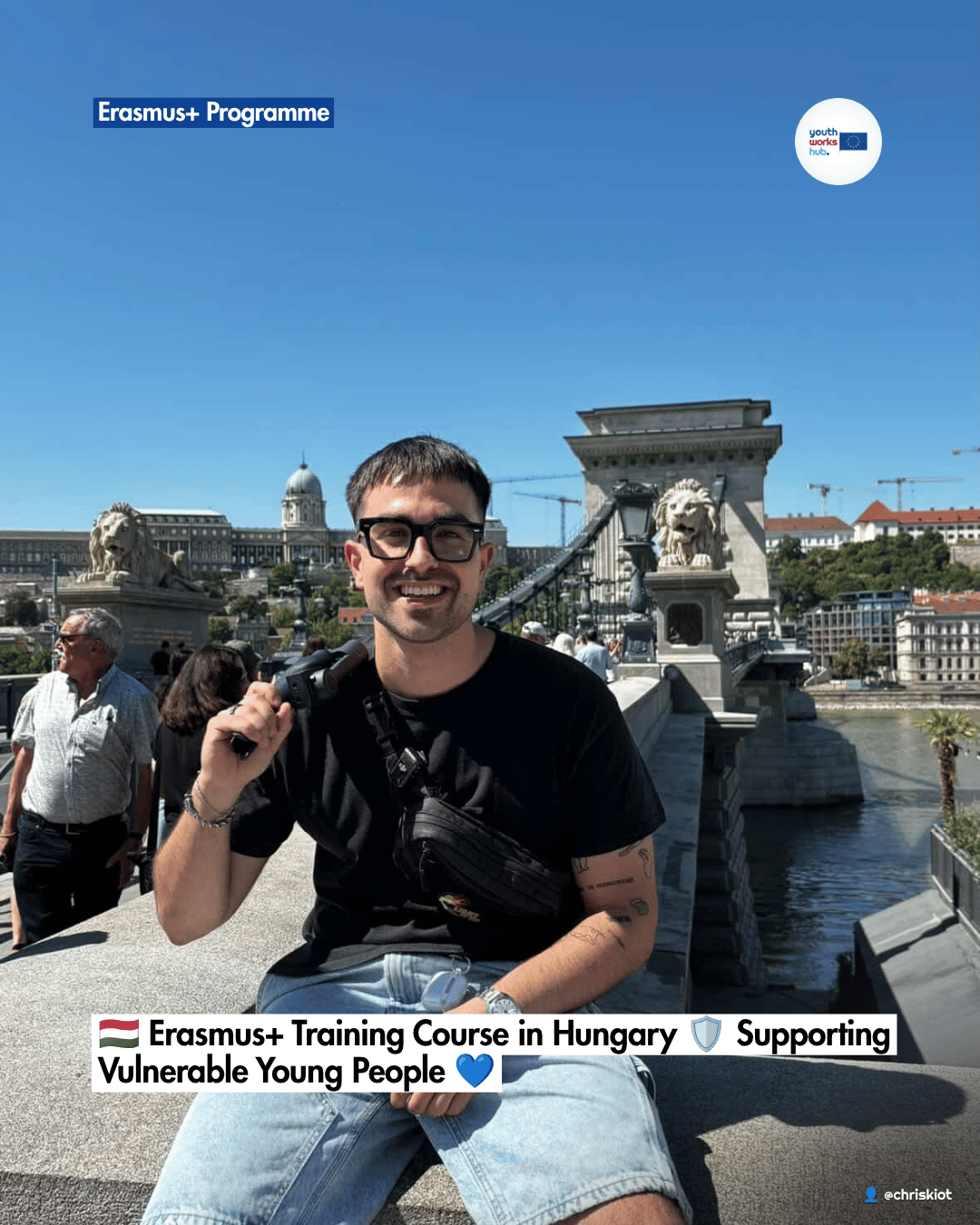
Develop practical skills to support young people facing complex challenges. This training combines safeguarding, trauma-informed, and solution-focused approaches to promote safety, wellbeing, participation, and resilience.
🏘️ How Erasmus+ youth projects create lasting change in local communities. The impact of Erasmus+ goes far beyond the individuals who participate. Local communities, host organisations, and even entire neighbourhoods are shaped by the projects that take place within them. This article explores the broader social impact of Erasmus+ youth exchanges — from building intercultural understanding to empowering grassroots organisations — and makes a compelling case for why these projects matter beyond the personal level. 👉 https://youthworkshub.org/3595/
ℹ️ Description About The Opportunity
This training course is designed for experienced youth workers, educators, trainers, and other helping professionals who work with young people experiencing increased vulnerability and complex life challenges.
The course focuses on strengthening participants' capacity to create safer, more inclusive, and supportive environments by integrating three complementary approaches: safeguarding, trauma-informed practice, and solution-focused approaches.
We define highly vulnerable young people as those facing at least two significant life challenges, with at least one being chronic, systemic, or particularly difficult to overcome. These challenges may include poverty, abuse, discrimination, family instability, mental health difficulties, neglect, violence, or social exclusion. Supporting these young people requires approaches that recognise the impact of adversity while promoting safety, empowerment, participation, and positive development.
Throughout the training, participants will explore:
the principles of safeguarding and child protection;
risk assessment and creating safer organisational practices;
codes of conduct and ethical decision-making;
trauma-informed approaches and the impact of adverse childhood experiences (ACEs);
psychological first aid and responding to distress;
solution-focused approaches that build on strengths, resilience, and young people's existing resources.
The programme combines theory with practical tools, reflection, experiential learning, and peer exchange, enabling participants to transfer their learning directly into their everyday practice.
The final two days of the programme will take place as part of the Source Conference in Hatvan, where participants will join workshops and learning sessions alongside youth workers, trainers, educators, and other professionals from across Europe. The conference offers an inspiring space for sharing experiences, exchanging good practices, exploring current challenges in youth work, and building new international partnerships. Participants will engage with topics such as youth participation, inclusion, wellbeing, experiential learning, and innovative approaches to supporting young people in diverse contexts.
For more information please check the Infopack
Training overview
This Training Course is
for 24 participants
from Erasmus+ Youth Programme countries 
and recommended for
Youth workers, Youth leaders, Volunteering mentors
Working language(s):
English
Organiser:
Élményakadémia KHE (Youth NGO)
Élményakadémia was founded in 2005 by 12 young volunteers, who - based on their personal experiences - believed that non-formal education is an essential tool for the development of youth. Our mission is to inspire, empower and support youth to take responsibility for their lives and their communities. Our target groups are teenagers, young adults, and volunteers or professionals who are working with them. We put special emphasis to reach and involve youth workers and trainers escorting such programmes and eager to refresh themselves with new competencies; and youth with fewer opportunities: those dropping out of the school system, unemployed, living in geographically and socially disadvantaged regions.
The objective of the organization is to provide opportunities for various non-formal educational activities to develop social and personal skills, resulting in altered attitudes and behaviour. Our main thematic focuses are: personal and social participation of youth and inclusion. We foresee reaching them by running experience-based non-formal educational activities resulting in the development of transversal competencies.
✅ 10 practical tips to write a stronger Erasmus+ or ESC application and actually get selected. With growing competition for spots in Erasmus+ and ESC projects, a well-crafted application can genuinely make or break your chances. This guide shares 10 concrete, actionable tips based on what selection committees actually look for — covering everything from how to frame your motivation to the common mistakes that get applications rejected. If you're serious about getting selected, take the time to read this before you hit submit. 👉 https://youthworkshub.org/8396/
📥 Contact
Contact for questions:
Zsófi Rácz
E-Mail:
Phone: +36703319921
💶 Costs
Participation fee
The contribution fee can be paid during the registration on the arrival day. If your financial situation is limited and would like to ask for an exemption, please email us at zsofi.racz@elmenyakademia.hu
Contribution fee: 30,00 EUR
Accommodation and food
Accommodation & Venue
Location: Gánt, Hungary
Venue: Fecskepalota
You will be provided:
shared rooms with bunkbeds (3-4 people)
3 meals per day + snacks
indoor common rooms & nature around the venue
Dinner is the first meal on arrival day.
Breakfast is the last meal on departure day.
Travel reimbursement
Travel costs will be reimbursed according to programme rules.
Please keep in mind that only direct travel costs between your home location and the venue of the event can be reimbursed. Private travelling, detours or holiday-related trips cannot be financed through the grant, and taxi or first-class tickets are unfortunately not eligible for reimbursement. Travel costs can only be covered for the cheapest reasonable means of transport, and we kindly ask you to consider eco-friendly travel options whenever possible.
The allocated travel budget is calculated according to the European Commission’s official Distance Calculator.
https://erasmus-plus.ec.europa.eu/resources-and-tools/distance-calculator
After checking the distance between your place of residence and the venue, you can determine the maximum amount available for your travel. The travel budget categories are as follows: for distances between 10–99 km the maximum is 28 EUR per person, and 56 EUR in case of green travel; for 100–499 km the maximum is 211 EUR per person, or 285 EUR for green travel; for 500–1999 km the maximum is 309 EUR per person, or 417 EUR for green travel; for 2000–2999 km the maximum is 395 EUR per person, or 535 EUR for green travel; for 3000–3999 km the maximum is 580 EUR per person, or 785 EUR for green travel. For distances between 4000–7999 km the maximum budget is 1188 EUR per person, and for 8000 km or more it is 1735 EUR per person. Travel costs will be reimbursed up to 100% as long as they remain within the allocated budget.
You are entitled to reimbursement only if you provide all original proof of travel: invoices or bills, the tickets themselves, and, in case of flights, the boarding passes as well. Please note that without both the receipt and the corresponding ticket, we are not able to reimburse any expenses. Before booking your travel, please send your planned itinerary to Zsofi Racz at zsofi.racz@elmenyakademia.hu for approval. Reimbursement will be made via bank transfer to your sending organisation once all required travel documents have been received; they will then transfer the amount to the participants.
Green travel refers to low-emission and shared forms of transportation such as travelling by bus, train, or car sharing (with at least two or more passengers in the same car). If you plan to travel using green options, please inform us in advance so that the appropriate budget category can be applied.
📜 Certificate
Participants are entitled to receive a Youthpass certificate from the organiser, for recognition of their competence development during the activity. Read more about Youthpass:
https://youthworkshub.org/15122
⚠️ Important Dates
Application deadline (24h UTC): 3 August 2026
Date of selection: 10 August 2026
🔗 Official Link
😄 How every Erasmus+ group chat starts vs. how it ends — a journey in messages. If you've ever been part of an Erasmus+ project group chat, you already know the energy: the awkward introductions, the overenthusiastic emojis, the plans that never happen, and the inside jokes that follow you for years. This article captures the evolution of every Erasmus+ group dynamic with humour and honesty — and if you haven't experienced it yet, consider this your preview of what's coming. 👉 https://youthworkshub.org/15112/
📖 The real story behind every Erasmus+ and ESC journey — what happens before, during, and after.Every Erasmus+ and ESC project has an official timeline: application, preparation, mobility, evaluation. But the real story is much richer than that. This article takes you through what genuinely happens at each stage of a project's life — the doubts, the breakthroughs, the unexpected friendships, and the quiet moments that change everything. A deeply human look at what these programmes mean beyond the paperwork. 👉 https://youthworkshub.org/15180/
🚨 How to spot a real Erasmus+ or ESC project — and protect yourself from fake offers. As the popularity of Erasmus+ and ESC grows, so does the number of fraudulent offers mimicking legitimate projects. Fake calls, scam organisations, and misleading listings can be difficult to identify — especially for first-time applicants. This guide gives you the specific red flags to watch for, the verification steps you should always take, and the key differences between genuine EU-funded projects and imitations. Stay informed, stay safe. 👉 https://youthworkshub.org/15135/
⚠️ Important Notice
1️⃣ Source of Information
This announcement has been prepared based on the information provided by the source.
2️⃣ No Affiliation
YouthWorks Hub is not the organiser, partner, or representative of the projects listed. All applications must be submitted directly to the project coordinator or hosting organisation through the original link, email, etc.
3️⃣ Content May Change
The project coordinator is solely responsible for the accuracy and details of the opportunity. Deadlines, eligible countries, activity dates, and other details may change, or the announcement may be withdrawn entirely, at any time after publication. Always check the original link before applying.
4️⃣ Funding
All funding, travel reimbursements, and allowances are determined and provided by the project coordinator or National Agency. YouthWorks Hub is not responsible for any payments or financial matters.
5️⃣ External Links
Listings may contain links to third-party websites, forms, or documents (e.g. the ESC Portal, infopacks, application forms). YouthWorks Hub is not responsible for the content, accuracy, or security of these external sources.
💡 Final Note: All listings are shared for informational purposes only. Please always verify details directly through the official project coordinator or programme website before applying.