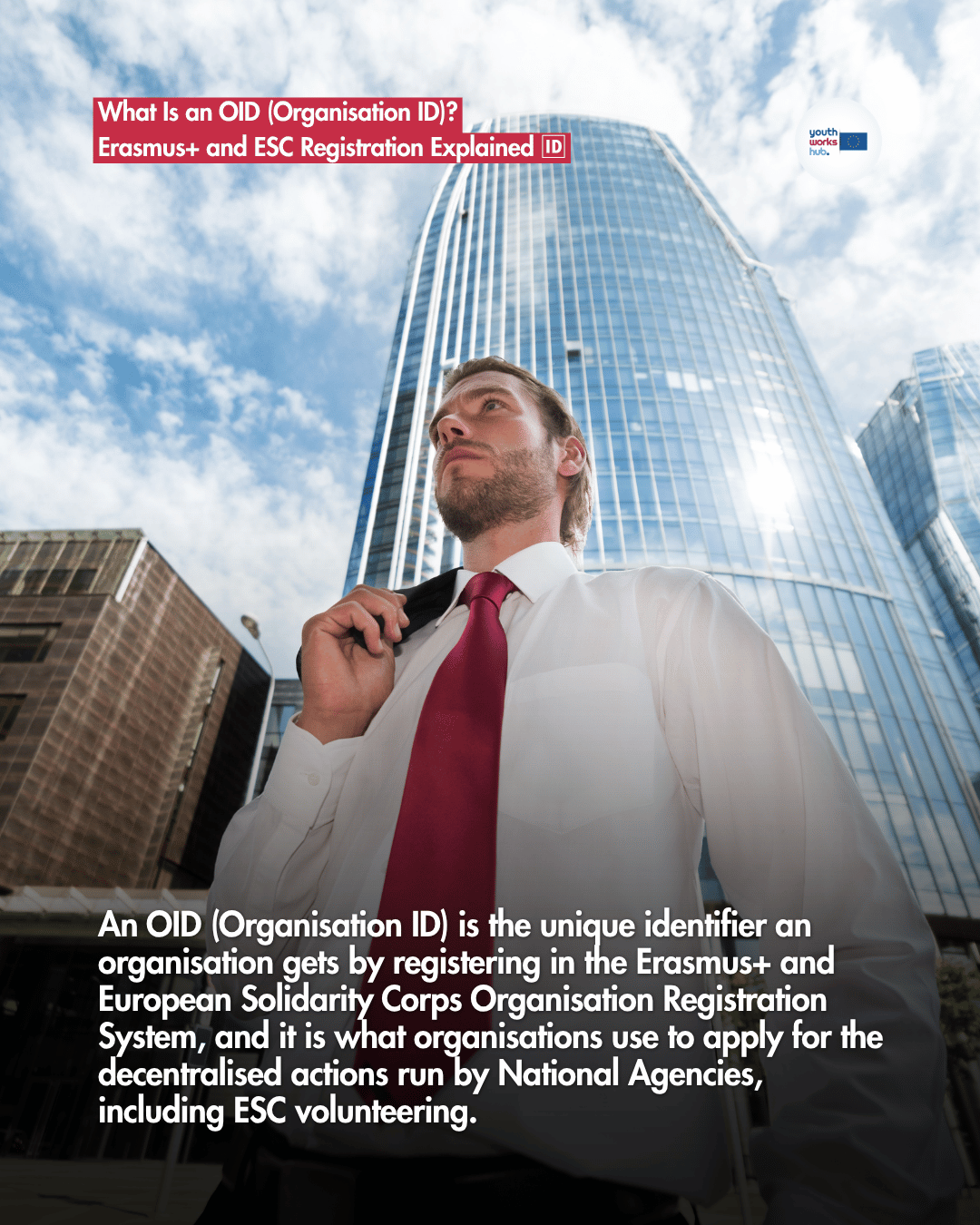

Once the registration is completed, the organisation or group will obtain an Organisation ID (OID) if applications are submitted to the National Agency, and a participant identification code (PIC) if applications are submitted to the Education and Culture Executive Agency (EACEA), and this code is an identifier and is necessary for the submission of applications. Organisations and groups of young people involved in any application must be registered and provide their basic legal and financial data in either the Erasmus+ and European Solidarity Corps platform for projects submitted to National Agencies or in the Participant Register Portal for projects submitted at the Education and Culture Executive Agency (EACEA). To submit a European Solidarity Corps project application, applicants must follow four steps, and registration is step 1. Our guide on how to apply for Erasmus+ or ESC walks through all four steps, and what Erasmus+ is introduces the programme that shares this registration system.
Last updated: October 2026.
Who needs an OID?
For actions managed by National Agencies, organisations and groups of young people involved in the application must register through the Organisation Registration system for Erasmus+ and European Solidarity Corps and receive an Organisation ID (OID). Organisations and groups of young people that have already obtained such an identification code do not need to register again. Individuals are not entitled to submit project proposals in the framework of the European Solidarity Corps, except for individuals applying on behalf of a group of at least five young people wishing to carry out a Solidarity Project. In the case of Solidarity Projects, groups of young people are assimilated to organisations in the European Solidarity Corps Guide. Our guide on who can apply to Erasmus+ and the European Solidarity Corps goes through the conditions case by case, and projects young people run themselves explains how a group of at least five young people starts one.
OID or PIC: which one do you need?
Once the registration is completed, the organisation or group will obtain an Organisation ID (OID) if applications are submitted to the National Agencies, and a participant identification code (PIC) if applications are submitted to EACEA. For actions managed by the European Education and Culture Executive Agency, the legal representative of the applicant must carry out the registration in the Electronic Submission System of the EU Funding & Tenders Portal. The applicant needs to register only once through the European Commission's Participant Register, and after the registration is processed the applicant will obtain a PIC, a 9-digit unique identifier necessary for the submission of applications. Organisations and groups of young people that have already participated in Erasmus+ and European Solidarity Corps actions and hold a PIC do not need to register again, and for them an organisation ID was automatically assigned and can be found by using the search on the Erasmus+ and European Solidarity Corps platform. Our guide on what National Agencies are explains the national offices on the OID side of this split, and the 2026 EU project roadmap shows which call each application belongs to.
How do you get an OID, step by step?
For actions managed by the National Agencies, the person representing an organisation or a group of young people must carry out the following steps to register in the Organisation Registration System (ORS) of Erasmus+ and European Solidarity Corps.
🔐 Create an EU Login account: create an EU Login account unless the person representing the organisation or the entities which do not have legal personality already has an account, and new EU Login accounts can be created via webgate.ec.europa.eu/cas.
🏛️ Access the Organisation Registration system: the person representing the organisation or group must access the Organisation Registration system for Erasmus+ and European Solidarity Corps at webgate.ec.europa.eu/erasmus-esc and register on behalf of the organisation or group they represent.
🆔 Register only once: the organisation or group of young people should register only once, and once the registration is processed the organisation or group of young people will obtain an Organisation ID (OID).
🧾 Group registration form in the European Solidarity Corps: to be registered, the group of young people has to submit a registration form using the provided template which confirms the agreement of the members to form the group.
📄 Upload the Identification Form: as part of the registration process, applicants must upload an Identification Form, which can be downloaded from the European Commission's website, to ORS, and three types of the identification form are available, depending on the type of applicant (natural persons, private companies or public law bodies).
✅ Validation by the National Agencies: the identification form is subject to a privacy statement and to a subsequent validation by the National Agencies.
Our guide on how to apply for Erasmus+ or ESC takes the application itself step by step, and how to write a strong Erasmus+ application covers what the form asks for.
What extra step do groups of young people have to take in the European Solidarity Corps in 2026?
In the European Solidarity Corps, specifically for groups of young people, as of 2026, the formation of the group needs to be evidenced by a registration form signed between the group members. The signatures on the registration form may have to be officially authenticated, if required by the granting authority, to ensure legal certainty. Existing groups which are already registered in ORS also need to upload the signed agreement in their ORS profile to be eligible to apply as informal group of young people for European Solidarity Corps actions under the Call 2026 and onwards. In the European Solidarity Corps, to be registered, the group of young people has to submit a registration form using the provided template which confirms the agreement of the members to form the group. Our guide on projects young people run themselves explains how a group starts one, and how to find partners for an Erasmus+ project helps if the group wants an organisation alongside it.
What does the OID do when you fill in the application form?
Entering the OID into the application form will automatically fill in all the information provided by the organisation at registration stage and display it in the form. The four steps of a European Solidarity Corps application are registration, the check of compliance with the criteria for the relevant Action, the check of the financial conditions, which is only applicable to requests for funding and not relevant for Quality Label, and filling in and submitting the application form. All the contractual and financial provisions that apply to awarded grants are presented in model grant agreements, which are made available for projects implemented by the Executive Agency (EACEA) in the EU Funding & Tenders Portal and for projects implemented by the National Agencies on the website of the relevant National Agency. In case of discrepancies with the information presented in the European Solidarity Corps Guide, provisions of the grant agreements prevail over those of Part E of the European Solidarity Corps Guide. Our guide on how to apply for Erasmus+ or ESC sets out the form itself, the 2026 EU project roadmap shows when each call closes, and what the ESC Quality Label is explains the application that asks for no funding. Our guide on Cooperation Partnerships in Erasmus+ explains that action in full, and Small-scale Partnerships covers its smaller-scale counterpart.
What can go wrong with an OID?
Multiple registrations for an OID by the same entity and the use of multiple OIDs by the same entity may qualify as misrepresentation under the EU Financial Regulation and lead to the entity's rejection from the affected award procedures by the National Agency. Applicants must have explicit consent to use another organisation's OID in an application form. Such proof can be requested in case of disagreements, and applicants may be disqualified if they are not able to present it. Our guide on how to write a strong Erasmus+ application covers the parts assessors read, and the top reasons Erasmus+ applications fail lists what sinks a file before assessors read it.
Frequently asked questions
Do you need a new OID for every application?
No, the organisation or group of young people should register only once. Once the registration is processed, the organisation or group of young people will obtain an Organisation ID (OID). Our guide on how to apply for Erasmus+ or ESC explains the four steps of an application.
Is an OID the same as a PIC?
No, the organisation or group will obtain an Organisation ID (OID) if applications are submitted to the National Agencies, and a participant identification code (PIC) if applications are submitted to EACEA. The PIC is a 9-digit unique identifier necessary for the submission of applications. Our guide on what National Agencies are explains the offices that receive applications made with an OID.
Where do you check or change your OID?
Organisations can check their OID or change information linked to it through the Organisation Registration system for Erasmus+ and European Solidarity Corps. Organisations and groups of young people that have already participated in Erasmus+ and European Solidarity Corps actions and hold a PIC do not need to register again, and for them an organisation ID was automatically assigned and can be found by using the search on the Erasmus+ and European Solidarity Corps platform. Our guide on the 2026 EU project roadmap shows which call each application belongs to.
Can one person get an OID and apply alone?
No, individuals are not entitled to submit project proposals in the framework of the European Solidarity Corps, except for individuals applying on behalf of a group of at least five young people wishing to carry out a Solidarity Project. Our guide on projects young people run themselves explains how a group starts one.
What document do you have to upload when you register?
As part of the registration process, applicants must upload an Identification Form, which can be downloaded from the European Commission's website, to ORS. Three types of the identification form are available, depending on the type of applicant (natural persons, private companies or public law bodies), and the identification form is subject to a privacy statement and to a subsequent validation by the National Agencies. Our guide on who can apply to Erasmus+ and the European Solidarity Corps goes through the conditions case by case.
Where do you register if your application goes to EACEA instead of a National Agency?
For actions managed by the European Education and Culture Executive Agency, the legal representative of the applicant must carry out the registration in the Electronic Submission System of the EU Funding & Tenders Portal. The applicant needs to register only once through the European Commission's Participant Register, and after the registration is processed the applicant will obtain a PIC. Our guide on how to write a strong Erasmus+ application covers what the form asks for.
What should you do next?
Our guide on how to apply for Erasmus+ or ESC explains the four steps of an application. The related pages below from Youth Works Hub cover each part of this guide in more detail.
Related pages: how to apply for Erasmus+ or ESC · projects young people run themselves · the EU project roadmap · what National Agencies are · how to write a strong Erasmus+ application · what the ESC Quality Label is
👉 ESC projects: youthworkshub.org/category/esc-projects
👉 Erasmus+ projects: youthworkshub.org/category/erasmus-projects