🔑 Key Information
Activity ⭐️ Title
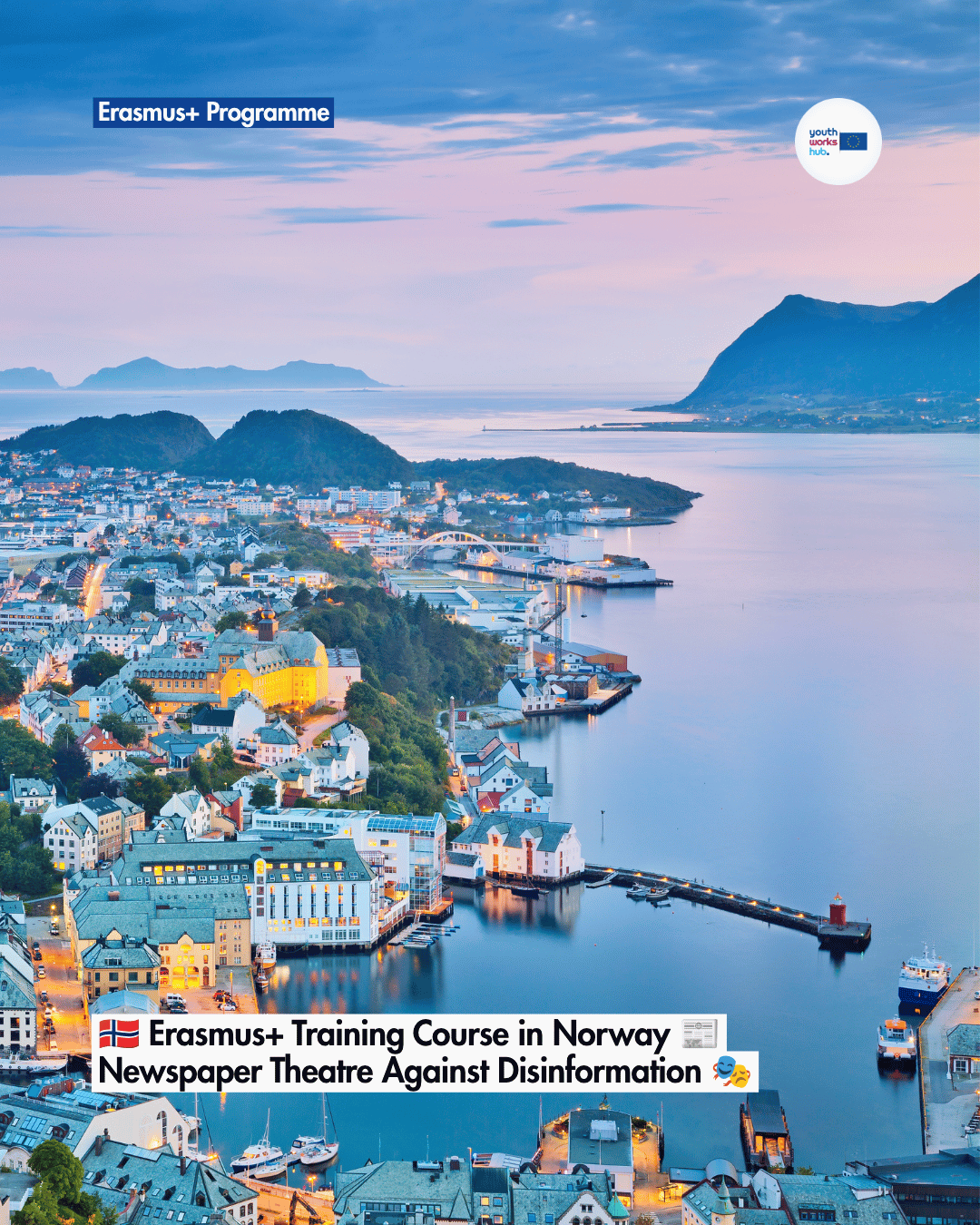
“Newspaper Theatre Training Course”
Activity 🔶 Type | 📆 Dates | 📍Location
Training Course
22-31 October 2026 | Balestrand, Norway
🌍 Erasmus+ explained — the complete beginner's guide to Europe's largest youth programme.Millions of young people have taken part in Erasmus+ since its launch, but many still don't fully understand what the programme actually includes, who it's for, or how to get involved. This in-depth guide breaks down everything: the different types of mobility, funding opportunities, eligibility criteria, and what you can realistically expect from participating. If you've ever wondered whether Erasmus+ is right for you, this guide gives you all the answers in one place. 👉 https://youthworkshub.org/15096/
❗️What Is This Training About?
The main goal of the training is to build the capacity of youth workers to use the Newspaper Theatre method to challenge disinformation and promote media literacy around various human rights issues among young people.
🏘️ How Erasmus+ youth projects create lasting change in local communities. The impact of Erasmus+ goes far beyond the individuals who participate. Local communities, host organisations, and even entire neighbourhoods are shaped by the projects that take place within them. This article explores the broader social impact of Erasmus+ youth exchanges — from building intercultural understanding to empowering grassroots organisations — and makes a compelling case for why these projects matter beyond the personal level. 👉 https://youthworkshub.org/3595/
ℹ️ Description About The Opportunity
Important: Please read this call and the information included carefully. Check adequately if you fit the profile of the participants we are looking for, before deciding to apply.
The Newspaper Theatre Method is part of a larger set of methods called Theatre of the Oppressed. This is a type of theatre methodology developed by Augusto Boal in the 1960s in Brazil. Augusto Boal experimented with theatre to give voice to the oppressed, to empower them to fight the oppression in their lives.
Under the umbrella of Theatre of the Oppressed, we find the following methods: Image Theatre, Forum Theatre, Invisible Theatre, Legislative Theatre, Newspaper Theatre and Rainbow of Desire. In this particular training, we will only focus on the Newspaper Theatre method!
Newspaper Theatre
As a distinct method, Newspaper Theatre is focused on the stimulation of critical thinking and consumption of media content, in order to push engagement and interest towards the issues raised through the performance, always linked with a type of oppression.
The core sources of information which are used in the preparatory process are newspapers or media materials (articles, advertisements, etc.). These can be used as inspiration or provide the main material for the artistic outcome. The topics raised by the media materials are examined from alternative perspectives through Newspaper Theatre, to bring them to the relevant audiences in a different light and angles and to trigger critical reflections.
The main goal of the training is to build the capacity of youth workers to use the Newspaper Theatre method to challenge disinformation and promote media literacy around various human rights issues among young people.
Methodology of the training course
The learning process will be very practical and hands-on, infused with specific games, exercises, and activities from the Theatre of the Oppressed methodology from the books published by Augusto Boal, as well as other experienced practitioners in the field over the last few decades. One of the main manuals, which is focused on Newspaper Theatre, will be used mainly in the process, is published by one of the trainers and will be provided as a hard copy to all participants. The learning process will be based on the total involvement of participants who will be active protagonists of their learning and live an educational experience centred on their own experiences.
The learning process will be guided and facilitated by an experienced team with a long history and practice in working with Theatre of the Oppressed methods:
- Andreea-Loredana Tudorache has been working with Theatre of the Oppressed since 2005, trained numerous practitioners around the world and authored several manuals on these methods. (http://trainers.salto-youth.net/AndreeaLoredanaTudorache )
- Elena Stevkovska has been a youth worker and Theatre of the Oppressed facilitator and trainer since 2021 (https://www.salto-youth.net/tools/toy/elena-stevkovska.6009/ )
Do you resonate with this course and want to be part of it? Any interested applicant must check all the following requirements:
- Active members or close collaborators of active Youth Organisations (staff or active members, paid or not) who are working regularly with young people. It is obligatory that the organisation has a valid OID number at the moment of applying!
- Enthusiastic youth workers who are motivated to work with the Newspaper Theatre method with young people on diverse oppression and human rights issues.
- Significant interest in Theatre of the Oppressed methods or theatre as a tool for social change (it doesn’t mean previous experience).
- Good command of the English language (to be able to engage actively and meaningfully in the discussions during the course).
- People older than 18 years and with a legal residence (proven by documents) in the country they are currently residing in.
- People with residence in one of the Erasmus + Program Countries (EU Member States and third countries associated with the Programme that do not need a visa for Norway)
Important:
- The criteria mentioned are not optional or negotiable. We will not respond to any inquiries aiming to challenge these criteria stated previously.
- If you are not part of an organisation as an active member, or cannot communicate actively in English, do not apply!
- If you lie in the application process, are selected, and we discover the lie, we reserve the right to cancel your participation in the project and not reimburse any costs incurred until that moment.
- Previous experience: We welcome participants with little or no experience in Theatre of the Oppressed, as well as people who have previous experience in other methods from this methodological umbrella. The process is designed for beginners in working with Newspaper Theatre, regardless of their previous experience with other Theatre of the Oppressed methods.
Training overview
This Training Course is
for 24 participants
from Erasmus+ Youth Programme countries 
and recommended for
Youth workers, Trainers, Youth leaders
Working language(s):
English
Organiser:
Creative Connections (Youth NGO)
✅ 10 practical tips to write a stronger Erasmus+ or ESC application and actually get selected. With growing competition for spots in Erasmus+ and ESC projects, a well-crafted application can genuinely make or break your chances. This guide shares 10 concrete, actionable tips based on what selection committees actually look for — covering everything from how to frame your motivation to the common mistakes that get applications rejected. If you're serious about getting selected, take the time to read this before you hit submit. 👉 https://youthworkshub.org/8396/
📥 Contact
Contact for questions:
Elena Stevkovska
E-Mail:
Phone: /
💶 Costs
Participation fee
There is no participation fee!
Accommodation and food
Board and lodging for the training course are fully covered by the local organisers during the period mentioned. Participants will be accommodated in dorm-style rooms of 2 to 5 beds (bunk beds). Rooms are simple and without any luxury. Food will be served as a buffet, and it will cater for all dietary needs.
Travel reimbursement
Each participant is free to choose the preferred way of travelling. Due to the organisers' policies, we strongly encourage the use of green travel. If flights are used for more than 50% of the total travel distance (round-trip), the maximum budget allocated will be from the Non-Green travel category!
Use this website (https://erasmus-plus.ec.europa.eu/resources-and-tools/distance-calculator ) to find out your distance. This is the official website to be used in order to determine the distance (no other website that calculates distances can be used as evidence).
Write at the START, your location, from where you will start your travel and at the END, Balestrand, Norway. You will get a km number as a result, which will correspond to the financial support which you may get for your travel costs. It doesn’t matter in which other cities (or how many) you transfer on the way - the distance is calculated using only the starting and end cities.
The individual maximum budget allowance for travel, per person, is the following:
- 10 – 99 km 56 EUR (Green Travel)/ 28 EUR (Non-Green Travel)
- 100 – 499 km 285 EUR (Green Travel)/ 211 EUR (Non-Green Travel)
- 500 – 1999 km 417 EUR (Green Travel)/ 309 EUR (Non-Green Travel)
- 2000 – 2999 km 535 EUR (Green Travel)/ 395 EUR (Non-Green Travel)
- 3000 – 3999 km 785 EUR (Green Travel)/ 580 EUR (Non-Green Travel)
- 4000 – 7999 km 1188 EUR (Green Travel) 1188 EUR (Non-Green Travel)
- 8000 km or more 1735 EUR (Green Travel)/ 1735 EUR (Non-Green Travel)
📜 Certificate
Participants are entitled to receive a Youthpass certificate from the organiser, for recognition of their competence development during the activity. Read more about Youthpass:
https://youthworkshub.org/15122
⚠️ Important Dates
Application deadline (24h UTC): 11 August 2026
Date of selection: 15 August 2026
🔗 Official Link
🗂️ Documents
Newspaper Theatre_Call for Pax-compressed.pdf
😄 How every Erasmus+ group chat starts vs. how it ends — a journey in messages. If you've ever been part of an Erasmus+ project group chat, you already know the energy: the awkward introductions, the overenthusiastic emojis, the plans that never happen, and the inside jokes that follow you for years. This article captures the evolution of every Erasmus+ group dynamic with humour and honesty — and if you haven't experienced it yet, consider this your preview of what's coming. 👉 https://youthworkshub.org/15112/
📖 The real story behind every Erasmus+ and ESC journey — what happens before, during, and after.Every Erasmus+ and ESC project has an official timeline: application, preparation, mobility, evaluation. But the real story is much richer than that. This article takes you through what genuinely happens at each stage of a project's life — the doubts, the breakthroughs, the unexpected friendships, and the quiet moments that change everything. A deeply human look at what these programmes mean beyond the paperwork. 👉 https://youthworkshub.org/15180/
🚨 How to spot a real Erasmus+ or ESC project — and protect yourself from fake offers. As the popularity of Erasmus+ and ESC grows, so does the number of fraudulent offers mimicking legitimate projects. Fake calls, scam organisations, and misleading listings can be difficult to identify — especially for first-time applicants. This guide gives you the specific red flags to watch for, the verification steps you should always take, and the key differences between genuine EU-funded projects and imitations. Stay informed, stay safe. 👉 https://youthworkshub.org/15135/
⚠️ Important Notice
1️⃣ Source of Information
This announcement has been prepared based on the information provided by the source.
2️⃣ No Affiliation
YouthWorks Hub is not the organiser, partner, or representative of the projects listed. All applications must be submitted directly to the project coordinator or hosting organisation through the original link, email, etc.
3️⃣ Content May Change
The project coordinator is solely responsible for the accuracy and details of the opportunity. Deadlines, eligible countries, activity dates, and other details may change, or the announcement may be withdrawn entirely, at any time after publication. Always check the original link before applying.
4️⃣ Funding
All funding, travel reimbursements, and allowances are determined and provided by the project coordinator or National Agency. YouthWorks Hub is not responsible for any payments or financial matters.
5️⃣ External Links
Listings may contain links to third-party websites, forms, or documents (e.g. the ESC Portal, infopacks, application forms). YouthWorks Hub is not responsible for the content, accuracy, or security of these external sources.
💡 Final Note: All listings are shared for informational purposes only. Please always verify details directly through the official project coordinator or programme website before applying.