🔑 Key Information
Activity ⭐️ Title
I have autism, so what - Training for youth workers
Activity 🔶 Type | 📆 Dates | 📍Location
Training Course
26-29 October 2026 | Ankaran, Slovenia
🌍 Erasmus+ explained — the complete beginner's guide to Europe's largest youth programme.Millions of young people have taken part in Erasmus+ since its launch, but many still don't fully understand what the programme actually includes, who it's for, or how to get involved. This in-depth guide breaks down everything: the different types of mobility, funding opportunities, eligibility criteria, and what you can realistically expect from participating. If you've ever wondered whether Erasmus+ is right for you, this guide gives you all the answers in one place. 👉 https://youthworkshub.org/15096/
❗️What Is This Training About?
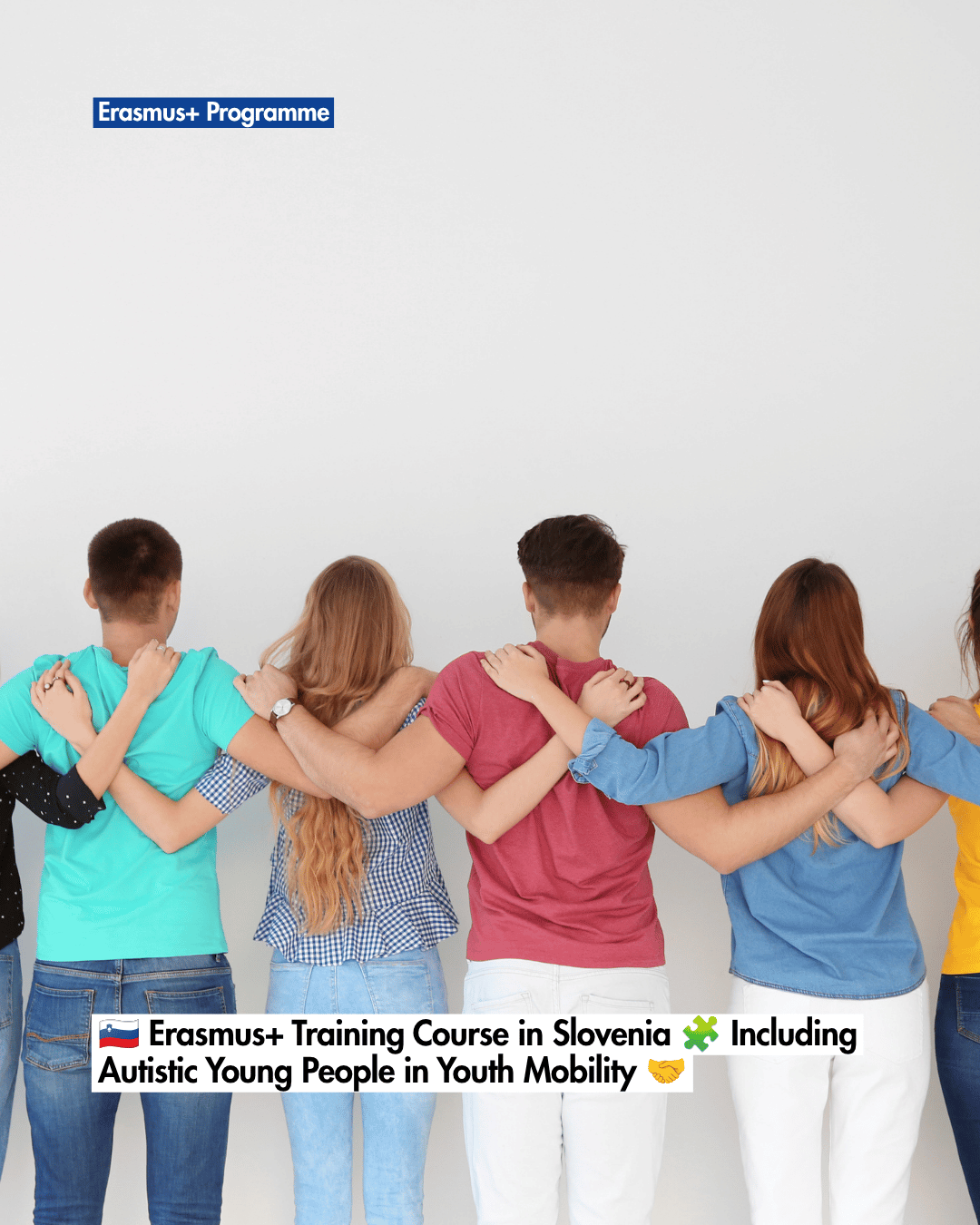
This four-day Erasmus+ training is designed for youth workers who want to include autistic young people in international youth mobility projects. Explore autism and neurodiversity, gain practical tools, exchange good practices and build partnerships.
🏘️ How Erasmus+ youth projects create lasting change in local communities. The impact of Erasmus+ goes far beyond the individuals who participate. Local communities, host organisations, and even entire neighbourhoods are shaped by the projects that take place within them. This article explores the broader social impact of Erasmus+ youth exchanges — from building intercultural understanding to empowering grassroots organisations — and makes a compelling case for why these projects matter beyond the personal level. 👉 https://youthworkshub.org/3595/
ℹ️ Description About The Opportunity
I have autism, so what – training for youth workers is a four-day international Erasmus+ training course designed for youth workers who want to make international youth mobility projects more accessible and inclusive for autistic young people.
Although inclusion is one of the core values of the Erasmus+ Programme, autistic young people remain underrepresented in international youth exchanges and other mobility opportunities. Many youth workers recognise the importance of inclusion but often lack the knowledge, practical experience and confidence to adapt activities and provide appropriate support. This training responds to these challenges by equipping participants with practical competences for planning, facilitating and implementing inclusive youth mobility projects.
Throughout the training, participants will develop a deeper understanding of autism, neurodiversity and the diversity of experiences, strengths and support needs of autistic young people. Using non-formal education methods, they will explore practical approaches to creating accessible learning environments, supporting meaningful participation, responding to sensory needs, adapting communication and facilitating inclusive group processes.
The programme combines interactive workshops, experiential learning, case studies, reflection and peer learning. Participants will have the opportunity to exchange experiences and good practices with colleagues from different European countries, reflect on challenges they encounter in their own organisations and discover practical tools that can be directly transferred into their daily youth work practice.
Beyond strengthening individual competences, the training aims to foster international cooperation between organisations working in the fields of youth work, inclusion and autism. Participants will have dedicated time to network, develop partnerships and design ideas for future Erasmus+ youth mobility projects that actively involve autistic young people.
The training itself is designed as an example of inclusive practice. Participants can expect a predictable daily structure, a balanced learning pace, regular breaks, opportunities for reflection, quiet spaces and flexible participation whenever possible. By experiencing these principles throughout the programme, participants will not only learn about inclusive youth work but also experience how an accessible learning environment can support participation and well-being for everyone.
We are looking for 20 participants (18+) from EU Member States who:
- are youth workers, youth leaders or educators;
- work in youth centres, youth organisations or organisations supporting autistic people;
- work directly with autistic young people or would like to include them in international youth activities;
- are motivated to develop more inclusive youth work practices;
- are interested in building international partnerships and future Erasmus+ projects.
Previous experience with autistic young people is welcome but not required. The most important criterion is a genuine motivation to make international youth mobility projects more inclusive and accessible for all young people.
The working language of the training is English. Participants should have sufficient English language skills (recommended level B1/B2) to actively participate in discussions and group work.
About the Organiser
Zavod Modri december is a Slovenian non-governmental organisation dedicated to improving the quality of life of autistic people and their families. Through education, awareness-raising, advocacy and international cooperation, the organisation promotes greater understanding of autism and supports the development of more inclusive communities.
In the field of youth work, Modri december focuses on increasing opportunities for autistic young people to participate in local and international activities. By working closely with youth organisations, professionals, families and autistic people themselves, the organisation develops practical approaches that make youth work more accessible and meaningful for everyone.
Venue
The training will take place at Resort Adria Ankaran, located on the Slovenian coast in a peaceful green setting by the sea. The venue offers comfortable accommodation, conference facilities and outdoor spaces that support both learning and informal networking.
Training overview
This Training Course is
for 20 participants
from Austria, Belgium - DE, Belgium - FL, Belgium - FR, Bulgaria, Croatia, Cyprus, Czech Republic, Denmark, Estonia, Finland, France, Germany, Greece, Hungary, Ireland, Italy, Latvia, Liechtenstein, Lithuania, Luxembourg, Malta, Netherlands, Poland, Portugal, Romania, Slovak Republic, Slovenia, Spain, Sweden
and recommended for
Youth workers, Youth leaders, Youth project managers
Working language(s):
English
Organiser:
Zavod Modri december (Others)
NGO working in the field of autism (awareness, support).
✅ 10 practical tips to write a stronger Erasmus+ or ESC application and actually get selected. With growing competition for spots in Erasmus+ and ESC projects, a well-crafted application can genuinely make or break your chances. This guide shares 10 concrete, actionable tips based on what selection committees actually look for — covering everything from how to frame your motivation to the common mistakes that get applications rejected. If you're serious about getting selected, take the time to read this before you hit submit. 👉 https://youthworkshub.org/8396/
📥 Contact
Contact for questions:
Martina Mrakovčić
E-Mail:
Phone: 00386 31 497 047
💶 Costs
Participation fee
There is no participation fee.
Accommodation and food
This project is funded by the Erasmus+ Programme.
The project covers:
- accommodation;
- meals and coffee breaks;
- programme costs;
- travel reimbursement according to Erasmus+ funding rules.
Travel reimbursement
Travel costs will be reimbursed in accordance with the Erasmus+ Programme rules.
Reimbursement is based on actual travel costs, up to the maximum amount determined by the Erasmus+ distance bands between the participant's place of residence and the training venue.
The maximum travel contribution is:
- €28 for standard travel or €56 for green travel (10–99 km, e.g. Slovenia);
- €211 for standard travel or €285 for green travel (100–499 km, e. g. Austria, Croatia, Italy, Hungary);
- €309 for standard travel or €417 for green travel (500–1,999 km; e. g. Germany, France, Spain, Portugal);
Travel costs will be reimbursed after the training upon submission of all required travel documents, including tickets, boarding passes, invoices and proof of payment (where applicable).
Participants are encouraged to choose green travel options (train, bus or car-sharing) whenever possible.
Please note that the reimbursement cannot exceed either the participant's actual travel costs or the maximum amount applicable to the relevant Erasmus+ distance band, whichever is lower.
📜 Certificate
Participants are entitled to receive a Youthpass certificate from the organiser, for recognition of their competence development during the activity. Read more about Youthpass:
https://youthworkshub.org/15122
⚠️ Important Dates
Application deadline (24h UTC): 20 August 2026
Date of selection: 24 August 2026
🔗 Official Link
🗂️ Documents
Call for participants_So what training course_Slovenia_2026.pdf
😄 How every Erasmus+ group chat starts vs. how it ends — a journey in messages. If you've ever been part of an Erasmus+ project group chat, you already know the energy: the awkward introductions, the overenthusiastic emojis, the plans that never happen, and the inside jokes that follow you for years. This article captures the evolution of every Erasmus+ group dynamic with humour and honesty — and if you haven't experienced it yet, consider this your preview of what's coming. 👉 https://youthworkshub.org/15112/
📖 The real story behind every Erasmus+ and ESC journey — what happens before, during, and after.Every Erasmus+ and ESC project has an official timeline: application, preparation, mobility, evaluation. But the real story is much richer than that. This article takes you through what genuinely happens at each stage of a project's life — the doubts, the breakthroughs, the unexpected friendships, and the quiet moments that change everything. A deeply human look at what these programmes mean beyond the paperwork. 👉 https://youthworkshub.org/15180/
🚨 How to spot a real Erasmus+ or ESC project — and protect yourself from fake offers. As the popularity of Erasmus+ and ESC grows, so does the number of fraudulent offers mimicking legitimate projects. Fake calls, scam organisations, and misleading listings can be difficult to identify — especially for first-time applicants. This guide gives you the specific red flags to watch for, the verification steps you should always take, and the key differences between genuine EU-funded projects and imitations. Stay informed, stay safe. 👉 https://youthworkshub.org/15135/
⚠️ Important Notice
1️⃣ Source of Information
This announcement has been prepared based on the information provided by the source.
2️⃣ No Affiliation
YouthWorks Hub is not the organiser, partner, or representative of the projects listed. All applications must be submitted directly to the project coordinator or hosting organisation through the original link, email, etc.
3️⃣ Content May Change
The project coordinator is solely responsible for the accuracy and details of the opportunity. Deadlines, eligible countries, activity dates, and other details may change, or the announcement may be withdrawn entirely, at any time after publication. Always check the original link before applying.
4️⃣ Funding
All funding, travel reimbursements, and allowances are determined and provided by the project coordinator or National Agency. YouthWorks Hub is not responsible for any payments or financial matters.
5️⃣ External Links
Listings may contain links to third-party websites, forms, or documents (e.g. the ESC Portal, infopacks, application forms). YouthWorks Hub is not responsible for the content, accuracy, or security of these external sources.
💡 Final Note: All listings are shared for informational purposes only. Please always verify details directly through the official project coordinator or programme website before applying.