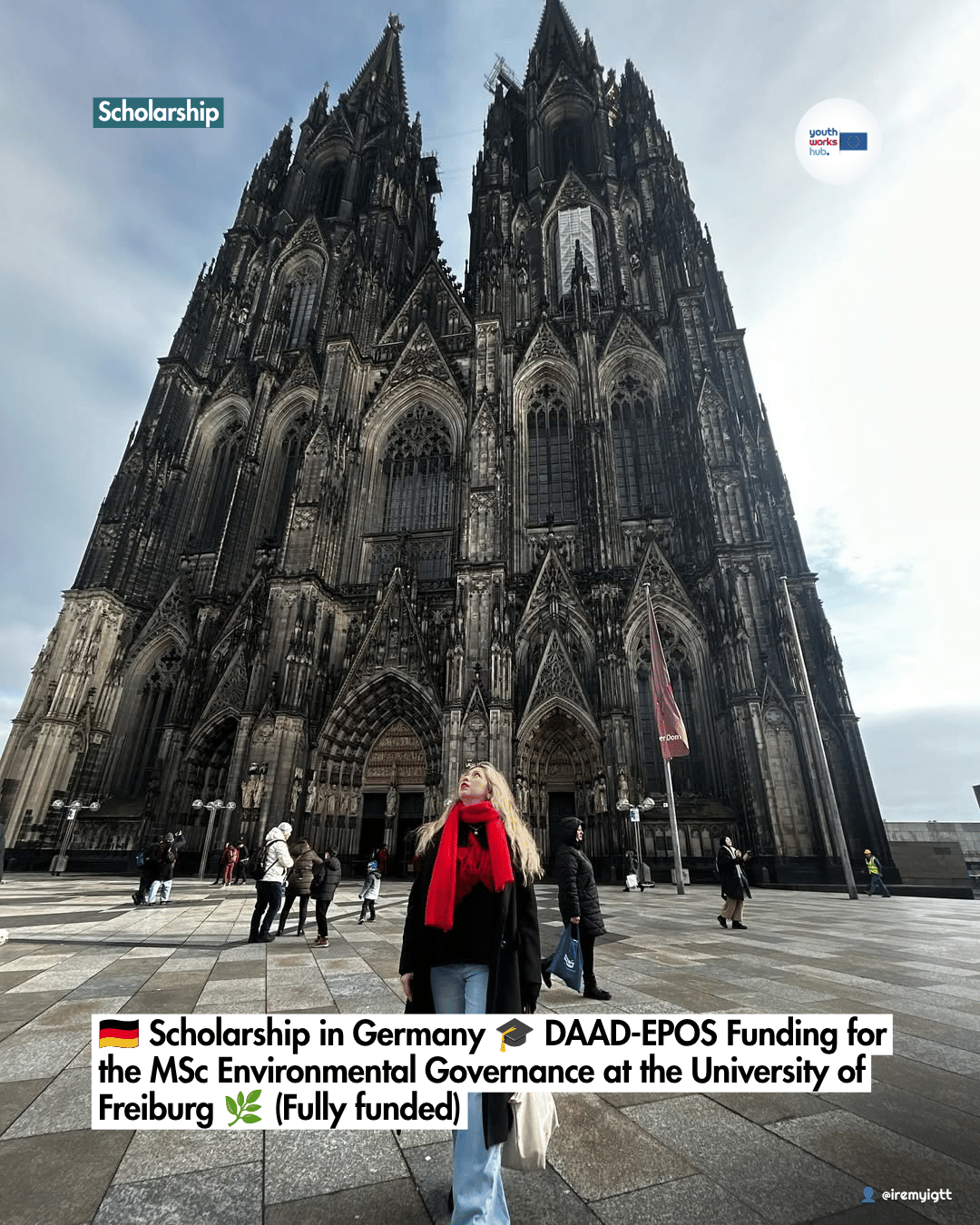
Are you a young professional from a developing country ready to advance your career in environmental governance? The DAAD-EPOS Scholarship offers a limited number of fully funded places on the MSc Environmental Governance (MEG) programme at the University of Freiburg.
About the DAAD-EPOS Scholarship
The Deutscher Akademischer Austauschdienst (DAAD) has selected the MSc Environmental Governance (MEG) as a development-related postgraduate course, so the programme can offer a limited number of EPOS Scholarships. Candidates are selected first by the programme committee of the MEG programme; in a second step, DAAD carefully checks the selection and decides upon the candidates. This is a highly competitive application process with strict requirements, and scholarship applicants must fulfil both the DAAD-EPOS requirements and the admission criteria for the MEG programme.
📌 Important: the DAAD-EPOS scholarship application must be submitted one year ahead of admission (15 October 2026 for a study start in October 2027). The applications for the MEG programme and for the scholarship are linked, meaning the required documents form an application for both. If you do not fulfil the scholarship requirements, you may apply as a regular applicant, for whom the application is due only half a year ahead of admission (15 May 2026).
Application Phase
🗓️ For the winter semester 2027/28, the application phase runs from 15 June to 15 October 2026.
Who Can Apply
🌍 Young professionals from developing countries (DAC countries) who meet all of the following requirements.
🎓 Hold an academic degree that is not older than six years at the time of application (October 2026), and above average (upper third).
💼 Have a minimum of two years of relevant professional experience (post-Bachelor) at the time of application. Internships and voluntary work are not accepted, and employment in academia such as teaching and research is generally not considered relevant work experience except in very exceptional cases.
🏠 Have resided in Germany for no more than 15 months before applying. Candidates who already hold a master's degree must make a well-argued case as to why they should be funded for another postgraduate degree.
🗓️ Still open after this one closes: ESC Volunteering in 🇸🇰 Slovakia – Youth Center Experience and Creativity → https://youthworkshub.org/14882
How to Apply
All documents must be compressed or merged into one single PDF file and sent to the MEG programme email. Incomplete applications cannot be considered, and referees must send their reference letters directly to the programme, not to the applicant.
📄 DAAD Application Form (with date of issue), with all information matching your other documents.
📄 MEG application form (submitted as part of the single PDF).
✍️ Letter of Motivation following the MEG-DAAD guideline (with date of issue, maximum 2 pages). If you also apply to other DAAD-EPOS master programmes, you must write a second motivation letter explaining your order of priority; you can apply for a maximum of three DAAD-EPOS master programmes and must indicate your choices in the DAAD application form.
📄 CV in EUROPASS format (mandatory), full and in reverse chronological order, with no unexplained gaps (explain all gaps longer than 3 months) and the date of issue.
🎓 Transcript of Records (original and certified translation if necessary). Your Bachelor's transcript must contain a final weighted average/CGPA and a numeric grading scale; only the Bachelor grade is considered even if your last degree is a Master's.
📜 University degree certificate (original and certified translation if necessary).
💼 Certificate for professional experience relevant to MEG, stating the exact dates of at least two years of relevant employment, on headed paper with an original or code-certified digital signature, date and stamp.
🖊️ Two recommendation letters, one from your current employer (DAAD requirement) and one from an academic teacher or supervisor (MEG requirement), sent directly by the referees before 15 October 2026.
🗣️ English Language Certificate (originals or certified copies): TOEFL iBT, IELTS (Band 7), Cambridge (C1) or PTE Academic (76). Native English speakers, and applicants who completed their entire university studies in English in an English-speaking country, are exempted.
✅ Signed DAAD checklist, printed and signed with a pen then scanned (a digital signature is not accepted).
🇨🇳 APS Certificate, compulsory only for applicants from China, India and Vietnam.
🎪 One more you can still catch later: ESC Volunteering in 🇵🇱 Poland – Summer Camps, Workshops and a Music Festival → https://youthworkshub.org/18975
Selection and Interview
🗓️ You are notified in February about the first results of the selection process. If you are nominated for the short-list, an interview follows, and only after the interview is the selection of scholarship candidates finalised.
Online Info Sessions
💻 Join online Q&A sessions to get answers to your DAAD Scholarship application questions, held at 14:00 CET on 7 July, 4 August and 1 September.
The Details
📍 Programme: MSc Environmental Governance (MEG), University of Freiburg, Germany.
📅 Study start: October 2027 (winter semester 2027/28).
Deadline
📅 15 October 2026
Links
🔗 MEG DAAD Scholarship page: https://www.meg.uni-freiburg.de/admissions/Scholarships/daad%20scholarship
🔗 Application email: info-meg@unr.uni-freiburg.de
🔗 Online info session (Zoom): https://uni-freiburg.zoom-x.de/j/66437791635?pwd=Sm4IaaUi6AmCcOhTtab4ogtJNVYSdV.1