🔑 Key Information
Activity ⭐️ Title
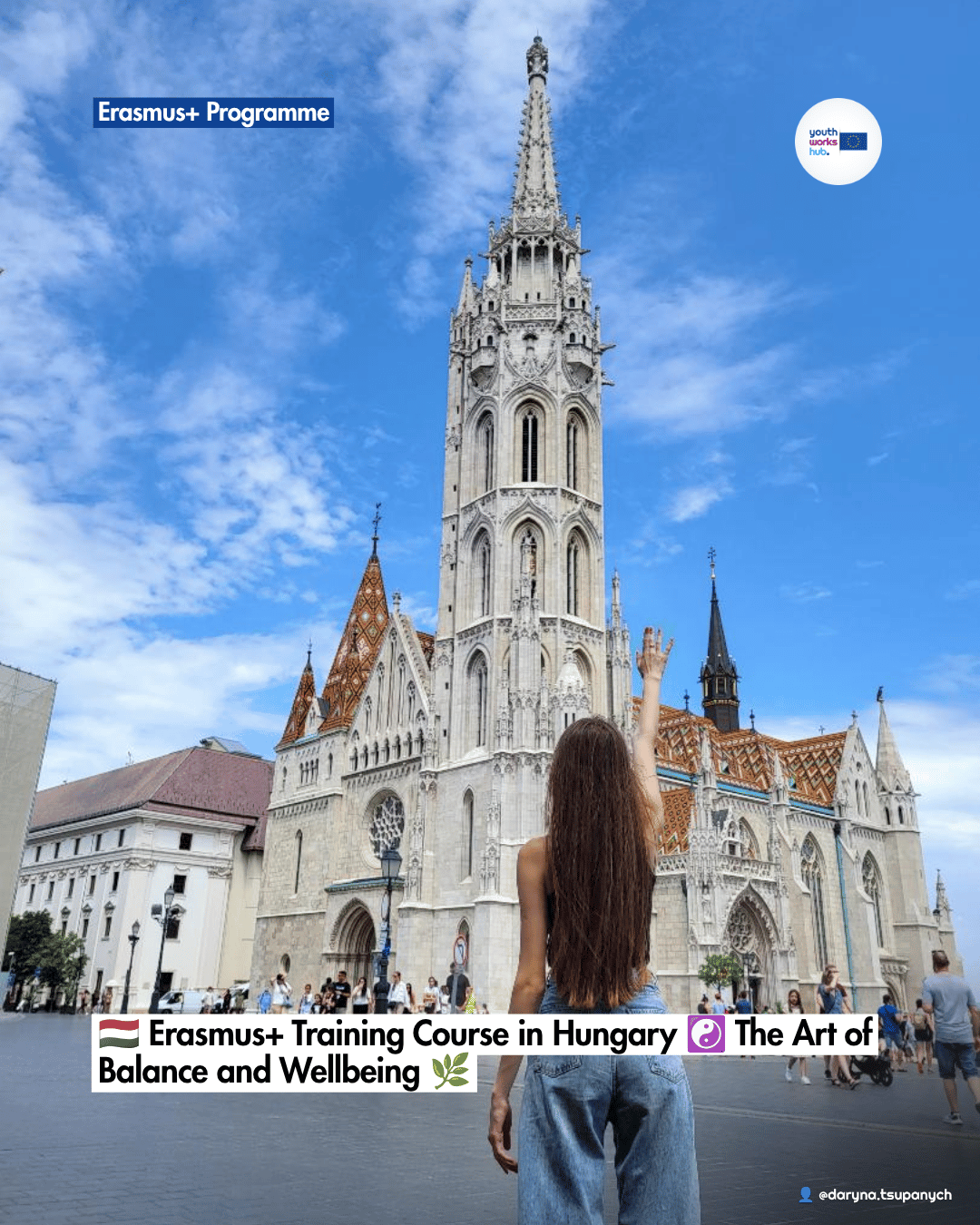
The Art of Balance through Daoist Wisdom
Activity 🔶 Type | 📆 Dates | 📍Location
Training Course
4-10 September 2026 | Bátonyterenye, Hungary
🌍 Erasmus+ explained — the complete beginner's guide to Europe's largest youth programme.Millions of young people have taken part in Erasmus+ since its launch, but many still don't fully understand what the programme actually includes, who it's for, or how to get involved. This in-depth guide breaks down everything: the different types of mobility, funding opportunities, eligibility criteria, and what you can realistically expect from participating. If you've ever wondered whether Erasmus+ is right for you, this guide gives you all the answers in one place. 👉 https://youthworkshub.org/15096/
❗️What Is This Training About?
This 7-day Erasmus+ training course invites youth workers to explore the timeless principles of Yin and Yang as practical tools for mental well-being, resilience and sustainable personal growth.
🏘️ How Erasmus+ youth projects create lasting change in local communities. The impact of Erasmus+ goes far beyond the individuals who participate. Local communities, host organisations, and even entire neighbourhoods are shaped by the projects that take place within them. This article explores the broader social impact of Erasmus+ youth exchanges — from building intercultural understanding to empowering grassroots organisations — and makes a compelling case for why these projects matter beyond the personal level. 👉 https://youthworkshub.org/3595/
ℹ️ Description About The Opportunity
The Art of Balance through Daoist Wisdom
We live in a world that constantly encourages us to do more, move faster, stay connected and perform at our best. While these expectations create many opportunities, they also contribute to increasing levels of stress, anxiety, burnout and disconnection. Young people are growing up in an environment characterised by information overload, uncertainty and social pressure, making mental well-being one of the greatest challenges of our time.
As youth workers, we often focus on supporting others while neglecting our own balance and resilience. How can we help young people build healthy lives if we ourselves struggle to find space for rest, reflection and inner stability?
This training offers an alternative perspective inspired by the ancient principles of Daoist philosophy. Rather than seeing balance as a fixed state, Daoism understands it as a dynamic process of continuously adapting to life's changing circumstances. The complementary forces of Yin and Yang remind us that action requires rest, strength requires softness, achievement requires recovery, and growth requires stillness.
The Art of Balance invites participants to explore these timeless principles as practical tools for modern life and youth work.
What will we explore?
Throughout the seven-day programme we will discover how the concept of balance can be applied in our everyday lives and professional practice.
Together we will explore:
the principles of Yin and Yang as a framework for understanding stress and resilience;
how imbalance affects our physical, emotional and mental well-being;
the relationship between body, energy and mind;
practical ways of preventing burnout and increasing personal resilience;
the importance of slowing down, reflection and conscious self-care;
how experiential learning can support mental well-being among young people.
Rather than focusing only on theory, the training offers participants an opportunity to experience these concepts through practice.
Our methodology
The programme is built on non-formal education and experiential learning, where learning happens through direct experience, reflection and application.
Participants can expect:
experiential education workshops;
group discussions and peer learning;
daily Chi Kung practice;
body awareness and movement exercises;
artistic and creative expression;
nature-based learning;
reflection circles and Family Groups;
practical tools that can be transferred into youth work.
The training creates a safe and supportive environment where participants are encouraged to explore, experiment and learn from one another.
Who is this training for?
We are looking for motivated youth workers, youth leaders, trainers and educators who:
work directly with young people;
are interested in mental well-being and resilience;
would like to explore holistic approaches to personal development;
are open to experiential learning and intercultural exchange;
wish to bring new methods back to their organisations and communities.
No previous knowledge of Daoist philosophy or Chi Kung is required—only curiosity, openness and a willingness to participate actively.
Learning outcomes
By the end of the training participants will:
better understand the relationship between balance, resilience and mental well-being;
gain practical tools for reducing stress and preventing burnout;
develop greater self-awareness and emotional resilience;
learn experiential methods inspired by Daoist wisdom;
discover creative approaches to supporting young people's well-being;
strengthen their facilitation and youth work competencies;
become part of an international network of professionals committed to promoting healthier and more sustainable ways of living and working.
About the organisers
The training is organised by Origó Workshop, a Hungarian non-profit organisation dedicated to promoting mental well-being, sustainability and personal development through non-formal education and Erasmus+ projects.
For many years, Origó Workshop has designed international learning experiences that combine experiential education, nature, movement and creative methodologies to support both youth workers and young people in building healthier, more resilient communities.
Join us!
If you are looking for more than just another training—if you would like to reconnect with yourself, discover new approaches to well-being, and experience the wisdom of balance in an international learning community—we warmly invite you to join The Art of Balance through Daoist Wisdom
"Balance is not something we find—it is something we continuously create."
Check out our last year's video: https://www.youtube.com/watch?v=blToh39qsG4&t=5s
Training overview
This Training Course is
for 24 participants
from Austria, Belgium - DE, Belgium - FL, Belgium - FR, Bulgaria, Croatia, Czech Republic, Denmark, Estonia, Finland, France, Georgia, Germany, Greece, Hungary, Ireland, Italy, Latvia, Lithuania, Malta, Netherlands, Poland, Portugal, Romania, Serbia, Slovak Republic, Slovenia, Spain, Türkiye
and recommended for
Youth workers, Trainers, Youth leaders
Working language(s):
English
Organiser:
Origó Műhely (Others)
https://www.theorigoworkshop.com/
The Origó Műhely/Origo Workshop was founded in 2021 summer as a registered Nonprofit LTD. organization, however many of its original members had already been developing and testing mental health and related non-formal (online and offline) methods for more than 10-15 years.The aim of the workshop/organization is to create space and time for well-being, recreation and resilience building for young people and for their youth workers, psychologists, social workers, teachers, youth leaders. Its ars poetica is to find inner balance, healthy relationships in life and in purpose (work), run sustainable life, and the ability to resource oneself and others.
✅ 10 practical tips to write a stronger Erasmus+ or ESC application and actually get selected. With growing competition for spots in Erasmus+ and ESC projects, a well-crafted application can genuinely make or break your chances. This guide shares 10 concrete, actionable tips based on what selection committees actually look for — covering everything from how to frame your motivation to the common mistakes that get applications rejected. If you're serious about getting selected, take the time to read this before you hit submit. 👉 https://youthworkshub.org/8396/
📥 Contact
Contact for questions:
Juhász Zsuzsanna
E-Mail:
Phone: +36302536919
💶 Costs
Participation fee
50 EUR
Accommodation and food
Accommodation, meals and coffee breaks are fully covered by the Erasmus+ Programme.
Travel reimbursement
Travel costs will be reimbursed based on actual expenses, up to the maximum travel budget allocated for your country according to the Erasmus+ distance bands.
Km Green travel Normal travel
10–99 km 56 EUR 28 EUR
Hungary, Slovakia
100–499 km 285 EUR 211 EUR
Serbia, Croatia, Romania, Slovenia, Austria, Belgium, Czechia
500-1999 km 417 EUR 309 EUR
Poland, Germany, Latvia, Lithuania, Estonia, Italy, Greece, Spain, France, Bulgaria, Turkey, Malta, Netherlands, Finland, Denmark
2000–2999 km 535 EUR 395 EUR
Portugal, Ireland, Georgia
📜 Certificate
Participants are entitled to receive a Youthpass certificate from the organiser, for recognition of their competence development during the activity. Read more about Youthpass:
https://youthworkshub.org/15122
⚠️ Important Dates
Application deadline (24h UTC): 2 August 2026
Date of selection: 5 August 2026
🔗 Official Link
🗂️ Documents
SALTO The Art of Balance training call.pdf
😄 How every Erasmus+ group chat starts vs. how it ends — a journey in messages. If you've ever been part of an Erasmus+ project group chat, you already know the energy: the awkward introductions, the overenthusiastic emojis, the plans that never happen, and the inside jokes that follow you for years. This article captures the evolution of every Erasmus+ group dynamic with humour and honesty — and if you haven't experienced it yet, consider this your preview of what's coming. 👉 https://youthworkshub.org/15112/
📖 The real story behind every Erasmus+ and ESC journey — what happens before, during, and after.Every Erasmus+ and ESC project has an official timeline: application, preparation, mobility, evaluation. But the real story is much richer than that. This article takes you through what genuinely happens at each stage of a project's life — the doubts, the breakthroughs, the unexpected friendships, and the quiet moments that change everything. A deeply human look at what these programmes mean beyond the paperwork. 👉 https://youthworkshub.org/15180/
🚨 How to spot a real Erasmus+ or ESC project — and protect yourself from fake offers. As the popularity of Erasmus+ and ESC grows, so does the number of fraudulent offers mimicking legitimate projects. Fake calls, scam organisations, and misleading listings can be difficult to identify — especially for first-time applicants. This guide gives you the specific red flags to watch for, the verification steps you should always take, and the key differences between genuine EU-funded projects and imitations. Stay informed, stay safe. 👉 https://youthworkshub.org/15135/
⚠️ Important Notice
1️⃣ Source of Information
This announcement has been prepared based on the information provided by the source.
2️⃣ No Affiliation
YouthWorks Hub is not the organiser, partner, or representative of the projects listed. All applications must be submitted directly to the project coordinator or hosting organisation through the original link, email, etc.
3️⃣ Content May Change
The project coordinator is solely responsible for the accuracy and details of the opportunity. Deadlines, eligible countries, activity dates, and other details may change, or the announcement may be withdrawn entirely, at any time after publication. Always check the original link before applying.
4️⃣ Funding
All funding, travel reimbursements, and allowances are determined and provided by the project coordinator or National Agency. YouthWorks Hub is not responsible for any payments or financial matters.
5️⃣ External Links
Listings may contain links to third-party websites, forms, or documents (e.g. the ESC Portal, infopacks, application forms). YouthWorks Hub is not responsible for the content, accuracy, or security of these external sources.
💡 Final Note: All listings are shared for informational purposes only. Please always verify details directly through the official project coordinator or programme website before applying.