Youth Works Hub
🇬🇷Erasmus+
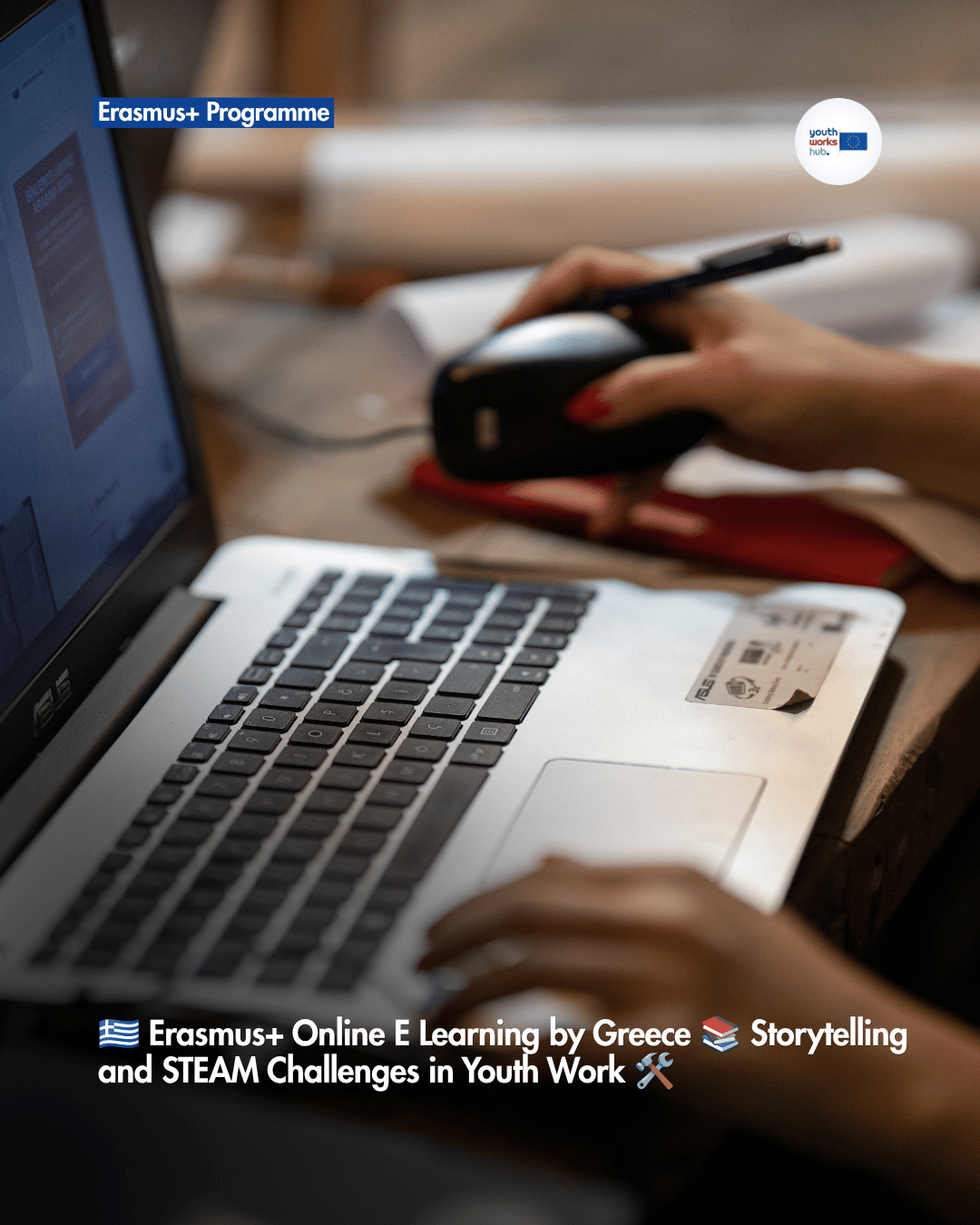
🇬🇷 Erasmus+ Online E Learning by Greece 📚 Storytelling and STEAM Challenges in Youth Work 🛠️
Posted 13 September 2026
Apply from
250 countries can apply, do not miss out!
Description
A practice-based e-learning course for youth workers, youth leaders, trainers and facilitators who want to explore how storytelling, creative construction and STEAM can become tools for participation, problem solving and non-formal learning.
Storybuilders Lab: From Story to STEAM Challenge in Youth Work is a practice-based e-learning course for youth workers, youth leaders, trainers and facilitators who want to explore how storytelling, creative construction and STEAM can become tools for participation, problem solving and non-formal learning.
Many STEAM activities start with a predefined outcome: build a bridge, create a vehicle, follow these instructions. Storybuilders Lab explores a different approach. The facilitator defines the learning intention, but participants influence the story, identify the problem and decide what needs to be created.
The methodology follows a simple learning cycle:
STORY → QUESTION → IDEAS → CHALLENGE → DESIGN → MAKE → TEST → IMPROVE → REFLECT → STORY CONTINUES
Participants will learn how to use story triggers, mystery objects and open questions to generate curiosity and meaningful challenges. They will explore Story Democracy, a participatory method for collecting, combining and developing different ideas so that the direction of a project is not predetermined by the facilitator or dominated by the strongest voices in the group.
A central part of the course is hands-on prototyping. Participants will work with accessible materials such as cardboard, recyclable materials and simple construction tools to turn ideas into physical prototypes. Makedo or similar cardboard-construction tools may be used where available, but no specialised equipment is required.
The focus is not on creating a perfect final object. Participants practise an iterative process of:
Make → Test → Notice → Change → Test again
This allows them to explore how experimentation, “failure”, debugging and redesign can become valuable learning experiences in youth work.
The course also addresses inclusive participation. Participants will explore different roles within a maker project — such as storyteller, designer, builder, tester, observer or documenter — so that young people can contribute according to different abilities, communication preferences and levels of technical confidence.
Sustainability is integrated through a Circular Making approach:
Build → Use → Disassemble → Sort → Reuse → Rebuild
Participants will consider how low-cost and reusable materials can support accessible STEAM activities while encouraging reflection on consumption, resources and sustainable design.
The learning process combines four live Zoom sessions, short asynchronous inputs, offline hands-on challenges, peer learning and reflection. Participants are encouraged to move away from the screen between sessions, experiment with materials in their own environment and bring their experiences back to the group.
The four live learning spaces focus on:
Live Lab 1 — Story & Question
Story triggers, curiosity, open questions and transforming narratives into authentic problems.
Live Lab 2 — Ideas & Make
Story Democracy, participation, cardboard prototyping and collaborative construction.
Live Lab 3 — Test, Include & Reuse
Testing, redesign, debugging, inclusive roles and sustainable making.
Live Lab 4 — Design & Transfer
Peer feedback, final project development and adaptation of the methodology to participants' own youth-work contexts.
Throughout the course, participants experience the methodology both as learners and as facilitators. They analyse not only what happens during an activity, but also how a facilitator can guide learning without prescribing the final solution.
As a final outcome, every participant will develop an original Storybuilder Mission: a complete story-driven STEAM activity designed for use with young people. The mission will include a learning intention, story trigger, open question, participation strategy, authentic problem, maker challenge, inclusive roles, testing phase and reflection process.
Participants will also create a short Local Transfer Plan identifying how the methodology can be tested or integrated into their own youth centre, NGO, Erasmus+ activity, European Solidarity Corps project, community programme or other non-formal learning environment.
No previous robotics, engineering or advanced STEAM experience is required. The course is particularly suitable for practitioners who already have some experience working with groups and want to move from ready-made activities towards participant-led learning experiences.
The facilitator designs the learning intention.
Participants create the story.
The story creates the problem.
The problem creates the need to build.
The prototype creates new questions.
Activity details
- Activity type
- Seminar
- Activity dates
- 6-29 October 2026
- Location
- Zoom, Greece
- Application deadline
- Application deadline (24h UTC): 30 September 2026
- Selection date
- 1 October 2026
- Recommended for
- Youth workers, Trainers, Youth leaders, Youth project managers, Youth policy makers, Volunteering mentors, Youth coaches, Youth researchers
- Working language
- English
Organiser
Artemis Sapountzoglou
Contact for questions: Artemis Sapountzoglou
Phone: +306944533091
Costs
- Participation fee
- 50€ contribution
- Accommodation and food
- no
- Travel reimbursement
- no
Looking for participants from
250 countries can apply. The activity takes place in Zoom, Greece.
Ready to apply?
Your next adventure could be one tap away. Open the link and take your shot.
Application linkComments · 0
Be the first to comment.