
Youth Dynamics
Nicosia, Cyprus
⭐️ Activity Title
EcoRoots: Green Skills for a Sustainable Future
🌍 What is the European Solidarity Corps (ESC)? The ESC is the EU programme that funds young people aged 18–30 (up to 35 for humanitarian aid) to volunteer on solidarity projects across Europe, with travel, accommodation, food, insurance and monthly pocket money covered. This overview explains who can join, the project types, durations and how to apply. 👉 https://youthworkshub.org/esc
🔷 Activity Details
Description
EcoRoots : Green Skills for a Sustainable Future is a ESC team volunteering project taking place in the village of Agros, Cyprus. The project will bring together 20 young volunteers to promote environmental sustainability through the principles of reduce, reuse, recycle and recover.
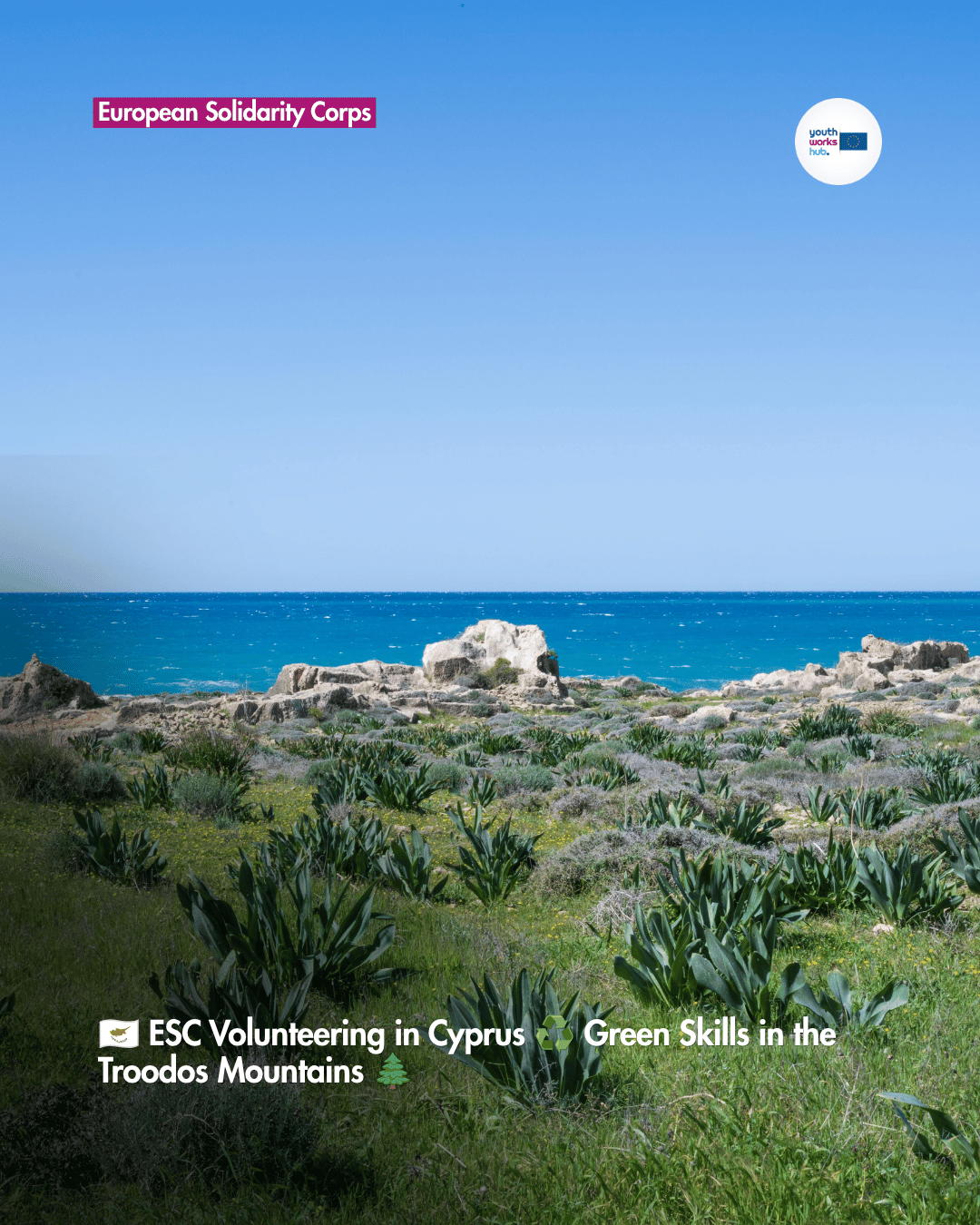
Located in the heart of the Troodos Mountains, Agros provides an inspiring natural setting in which participants can connect with the environment, engage with the local community and exchange eco-friendly practices from their home countries. Through workshops, awareness campaigns, community activities and intercultural exchanges, volunteers will help promote more sustainable lifestyles and encourage local residents to take an active role in protecting their natural surroundings.
The project aims to develop participants’ environmental knowledge, practical green skills and sense of social responsibility and contribute to a positive change in the local community by raising awareness of environmental challenges
Accommodation, food and transport arrangements
All essential costs related to participation in the ESC project will be covered by the organisers. This includes:
- Accommodation
- Food
- Travel costs, within the limits established by the EU distance calculator
- Local transportation
- €7 per day in pocket money
- Insurance coverage provided through the ESC programme
Participants will stay at Agrospito Traditional Guest House. The accommodation will provide a comfortable and welcoming environment where volunteers can live and work together.
Three meals per day—breakfast, lunch and dinner—as well as two daily coffee breaks will be provided throughout the project
Training during the activity
During the project, the young volunteers will spend three weeks in the mountainous region of Agros village. Surrounded by forests, hiking trails and diverse natural landscapes, participants will have the opportunity to explore the foothills of the Troodos Mountains, stay in campsites and forest lodges, and strengthen their connection with nature.
Volunteers will receive guidance and practical learning opportunities in areas such as:
- Reuse, recycling and recovery practices
- Environmental awareness and education
- Sustainable and eco-friendly lifestyles
- Teamwork, communication and intercultural learning
Participant profile
We are looking for open-minded, responsible and nature-loving young people who are enthusiastic about discovering Cyprus and contributing positively to the local community.
Ideal participants should:
- Be highly motivated to take part in the full project
- Have a genuine interest in environmental protection and sustainability
- Possess at least a basic level of English
- Be willing to learn, share and work cooperatively with others
- Feel comfortable participating in outdoor activities and community-based work
- Be proactive and ready to contribute to workshops, campaigns and group activities
- Show respect for different cultures, perspectives and ways of life
- Be willing to live and collaborate in an international group
- Demonstrate flexibility, responsibility and a positive attitude
Previous experience in environmental work is not required. What matters most is curiosity, commitment and the willingness to develop new knowledge and skills.
We particularly welcome young people from diverse backgrounds, including those with fewer opportunities. Above all, we are looking for participants who want to become active citizens and make a positive contribution to their local communities and to society as a whole.
✍️ How do you write a motivation letter for ESC and Erasmus+? Research the project first, then follow a five-part structure that shows motivation, relevant skills and learning goals. This guide includes a full annotated example, how to adapt it per activity, and the mistakes that cause rejection. 👉 https://youthworkshub.org/esc-motivation-letter
💡 How do you prepare a strong Erasmus+ or ESC application? Read the call carefully, write specific motivation, show skills with examples, and state clear learning goals. This guide gives 10 practical tips plus the common mistakes that lead to rejection. 👉 https://youthworkshub.org/erasmus-application-tips
🔑 Key Information
Activity dates
From 10/11/2026 to 29/11/2026
Activity location
Spiridona Trikoupi 21, Flat 10, Nicosia, Cyprus
Activity type
Volunteering teams
Looking for participants from
Austria, Belgium, Bulgaria, Croatia, Cyprus, Czechia, Denmark, Estonia, Finland, France, Germany, Greece, Hungary, Italy, Latvia, Lithuania, Malta, Netherlands, Norway, Poland, Romania, Serbia, Slovakia, Slovenia, Spain, Syria, Ukraine
Activity topics
Environment and natural protection
Creativity and culture
Physical education and sport
Deadline for applications
Application deadline: 20/09/2026 00:00
Project code
2024-1-CY01-ESC51-VTJ-000235821
⚖️ What's the difference between ESC and Erasmus+? The ESC is for volunteering and solidarity, while Erasmus+ is broad learning mobility (study, training, youth exchanges). This guide compares age, funding, duration and application route, and includes a "choose this if…" decision guide. 👉 https://youthworkshub.org/esc-vs-erasmus
🔗 Official Project Page
https://youth.europa.eu/solidarity/opportunity/54227_en
🔐 How do you register on the ESC Portal? You create an EU Login with two-factor authentication, then complete your profile on the official ESC Portal. This step-by-step guide also fixes common problems like "0 opportunities" and the country-list lock. 👉 https://youthworkshub.org/register-esc-portal
🩺 What insurance do ESC volunteers get? Every ESC volunteer gets free group insurance (currently Henner) that complements the EHIC and covers medical, accident, hospitalisation, liability and travel. This guide explains what's insured, the coverage period (home-to-return plus two months) and how your organisation enrols you. 👉 https://youthworkshub.org/esc-insurance
🌍 What is ESC Humanitarian Aid Volunteering? It's the ESC strand (EVHAC) that sends people aged 18–35 to work full-time in countries outside the EU, after mandatory two-stage training. This guide details the training, the application steps and what's covered. 👉 https://youthworkshub.org/esc-humanitarian-aid-volunteering
💰 Is ESC volunteering fully funded? Yes for core costs: travel is reimbursed by distance band (€28–1,735+), and accommodation, food, local transport, insurance, language support and daily pocket money are covered. This guide gives the official 2026 figures and the honest travel-band caveat — note there is no salary. 👉 https://youthworkshub.org/is-esc-fully-funded