Stichting Ecosystem Restoration Foundation
Association de développement à but non lucratif
Kpalime, Togo
⭐️ Activity Title
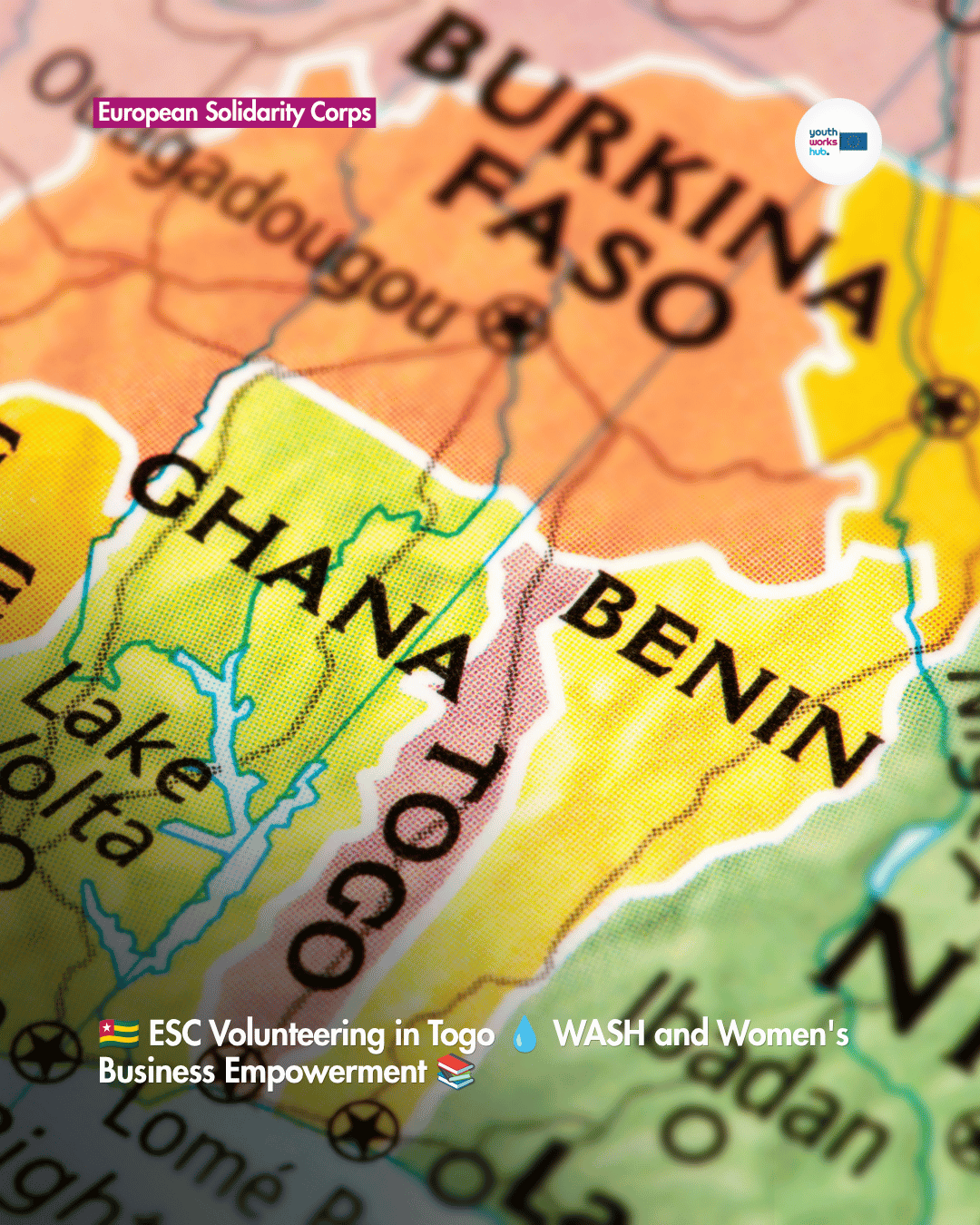
WASH, Education & Women’s Empowerment in Togo
🌍 What is the European Solidarity Corps (ESC)? The ESC is the EU programme that funds young people aged 18–30 (up to 35 for humanitarian aid) to volunteer on solidarity projects across Europe, with travel, accommodation, food, insurance and monthly pocket money covered. This overview explains who can join, the project types, durations and how to apply. 👉 https://youthworkshub.org/esc
🔷 Activity Details
Description
This two-month project supports rural communities in Agomé-Yoh and Danyi-Apéyémé through WASH, education and women’s empowerment. Volunteers will support hygiene and public-health sessions in schools and community spaces on handwashing, safe water use, sanitation, menstrual hygiene, waste management and community clean-ups. They will also support the construction of latrines in the community, help prepare awareness materials and support with community mapping. Volunteers will work with women’s groups and cooperatives through practical training on organization, record-keeping, budgeting, pricing, savings, marketing and small-business planning. Education activities may include workshops for children and young people, learning support and life-skills sessions. Volunteers will work alongside local staff and community members and take part in village life and cultural activities. Working hours are 8:00–11:00 and 15:30–18:30, with flexibility to adapt to community needs.
Accommodation, food and transport arrangements
Volunteers are hosted in safe shared flats. Single rooms may be available for individual volunteers. Basic amenities include electricity, running water, and internet (wi-fi and SIM). Meals are provided, and dietary requirements can be shared in advance. The diet is fresh, local, healthy and balanced. Activities are mostly within walking distance; when needed, AJEVES will arrange local transport (taxis & moto-taxis, helmets provided). Activities include cultural visits, traditional events, local market trips. Volunteers will also have the chance to enjoy the very beautiful natural surroundings.
Training during the activity
AJEVES provides an orientation on local culture, safety, safeguarding and community expectations. Volunteers receive practical preparation on WASH awareness, public-health communication, gender-sensitive community work and participatory training methods. They will also receive basic training on KoboToolbox for monitoring, data collection and community mapping. Volunteers will be guided in preparing workshops, educational materials and community activities. AJEVES staff provide ongoing mentoring throughout the placement. Free psychosocial support at the local hospital is available if needed.
Participant profile
We are looking for curious, proactive and respectful volunteers who are motivated to support local communities and willing to learn. Interest or experience in WASH, public health, education, training, women’s empowerment, community development, social entrepreneurship or cooperative support is especially welcome, but not required.
Useful skills include facilitation, communication, teaching, basic business or financial literacy, youth work and creation of simple educational materials.
Volunteers should be open-minded, flexible and comfortable working in a rural setting and adapting activities to local needs.
French at B1 level or above is preferred, but not mandatory, for effective communication and integration.
✍️ How do you write a motivation letter for ESC and Erasmus+? Research the project first, then follow a five-part structure that shows motivation, relevant skills and learning goals. This guide includes a full annotated example, how to adapt it per activity, and the mistakes that cause rejection. 👉 https://youthworkshub.org/esc-motivation-letter
💡 How do you prepare a strong Erasmus+ or ESC application? Read the call carefully, write specific motivation, show skills with examples, and state clear learning goals. This guide gives 10 practical tips plus the common mistakes that lead to rejection. 👉 https://youthworkshub.org/erasmus-application-tips
🔑 Key Information
Activity dates
A total of 4 week(s) during the period 31/10/2026 to 30/11/2026
Activity location
Agome' Yo, Kpalime, Togo
Activity type
Volunteering teams
Looking for participants from
Austria, Belgium, Bulgaria, Croatia, Cyprus, Czechia, Denmark, Estonia, Finland, France, Germany, Greece, Hungary, Iceland, Ireland, Italy, Latvia, Liechtenstein, Lithuania, Luxembourg, Malta, Netherlands, North Macedonia, Poland, Portugal, Romania, Slovakia, Slovenia, Spain, Sweden, Türkiye
Activity topics
Environment and natural protection
Health and wellbeing
Education and training
Employment and entrepreneurship
Creativity and culture
Nutrition and subsistence agriculture
WASH (Water, sanitation and hygiene)
Support to local Small and Medium Enterprise
Deadline for applications
Application deadline: 21/09/2026 00:00
Project code
2023-1-EACEA-VOLUN-101192143
⚖️ What's the difference between ESC and Erasmus+? The ESC is for volunteering and solidarity, while Erasmus+ is broad learning mobility (study, training, youth exchanges). This guide compares age, funding, duration and application route, and includes a "choose this if…" decision guide. 👉 https://youthworkshub.org/esc-vs-erasmus
🔗 Official Project Page
https://youth.europa.eu/solidarity/opportunity/54198_en
🔐 How do you register on the ESC Portal? You create an EU Login with two-factor authentication, then complete your profile on the official ESC Portal. This step-by-step guide also fixes common problems like "0 opportunities" and the country-list lock. 👉 https://youthworkshub.org/register-esc-portal
🩺 What insurance do ESC volunteers get? Every ESC volunteer gets free group insurance (currently Henner) that complements the EHIC and covers medical, accident, hospitalisation, liability and travel. This guide explains what's insured, the coverage period (home-to-return plus two months) and how your organisation enrols you. 👉 https://youthworkshub.org/esc-insurance
🌍 What is ESC Humanitarian Aid Volunteering? It's the ESC strand (EVHAC) that sends people aged 18–35 to work full-time in countries outside the EU, after mandatory two-stage training. This guide details the training, the application steps and what's covered. 👉 https://youthworkshub.org/esc-humanitarian-aid-volunteering
💰 Is ESC volunteering fully funded? Yes for core costs: travel is reimbursed by distance band (€28–1,735+), and accommodation, food, local transport, insurance, language support and daily pocket money are covered. This guide gives the official 2026 figures and the honest travel-band caveat — note there is no salary. 👉 https://youthworkshub.org/is-esc-fully-funded


