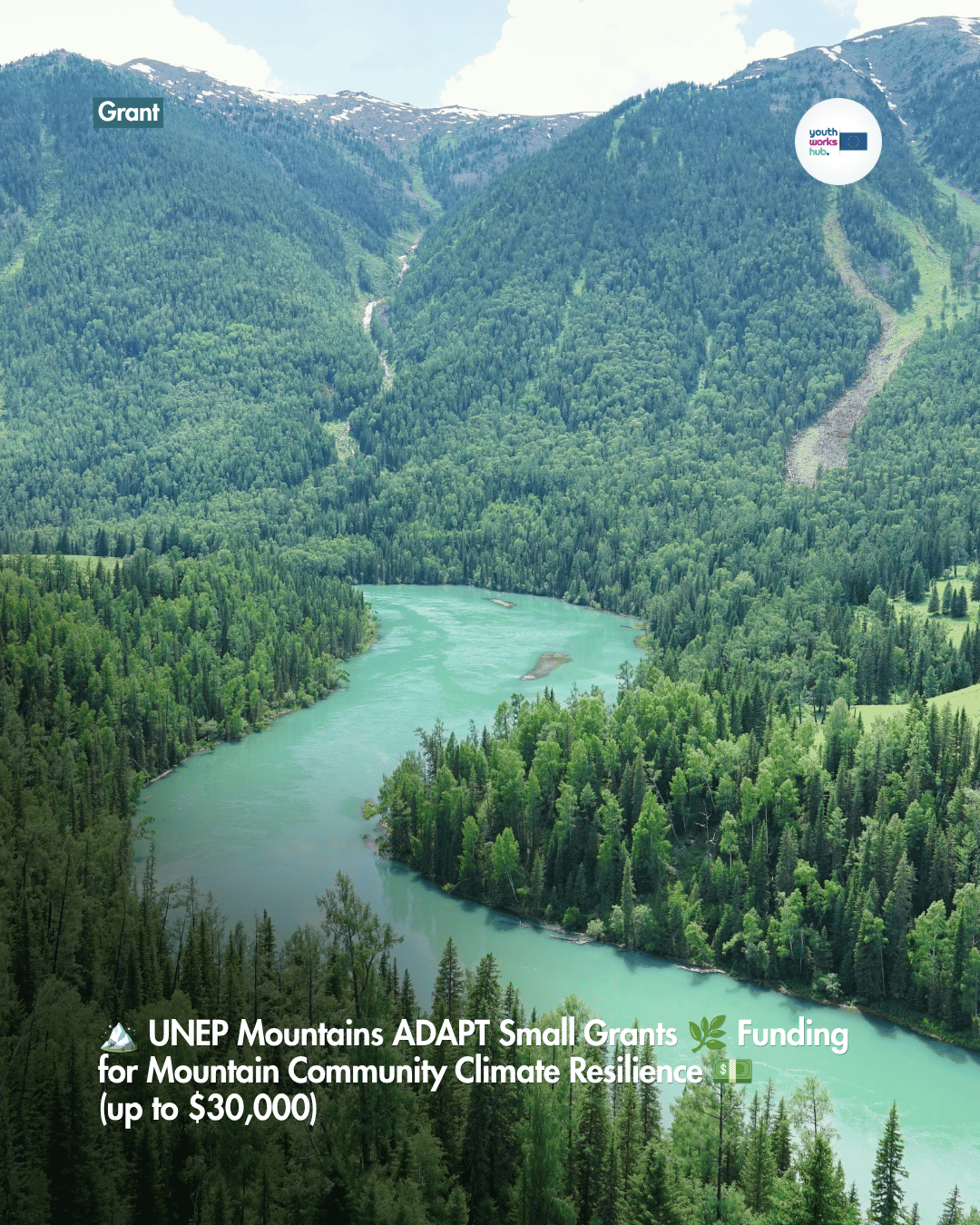
The UNEP Mountains ADAPT Small Grants support community-based organisations in the East African Community and the South Caucasus to design and implement inclusive, ecosystem-based solutions that respond to climate change impacts in mountain regions. Each grant provides up to USD 30,000, and this first round will fund up to 15 projects. The application deadline is 15 September 2026.
Fit note: this is a grant for locally registered non-governmental organisations in specific mountain regions, not for individuals, so for the wider Youth Works Hub audience it is a niche opportunity.
About Mountains ADAPT
The Mountains ADAPT small grants project supports ideas that harness community-driven solutions to adapt to climate change. It recognises the urgent need to address challenges from weather extremes causing flooding or droughts to changing ecosystem services and water availability. Whether it is implementing nature-based solutions, fostering sustainable agriculture, enhancing food security or creating alternative income opportunities while preserving natural resources, the scheme is set up as a boost for positive and long-lasting change for mountain communities, and a channel to turn ideas into reality.
What the Grant Offers
💵 Up to USD 30,000 towards the design and implementation of impactful solutions for climate change impacts on mountain communities. There is no defined minimum amount, though applicants are encouraged to request enough to implement substantive nature-based solutions and on-the-ground activities.
🎓 Successful community-based organisations also receive capacity development and training support to implement the proposed solution in their community.
🗺️ This first round of the call will fund up to 15 projects across the East African Community and the South Caucasus.
Who Can Apply
Applicants should be locally based, duly registered non-governmental organisations operating in a mountain region of the benefitting countries, and should address a mountain climate change challenge or vulnerability with a strong focus on an ecosystem-based adaptation approach, with prior experience working directly with mountain communities. The eligible countries are:
🌍 East African Community: DRC, Somalia, Burundi, Kenya, Rwanda, South Sudan, Uganda and Tanzania.
⛰️ South Caucasus: Armenia, Azerbaijan and Georgia.
Only formally registered organisations are eligible; individuals cannot apply. Applicants must upload their official registration certificate, and if selected, the organisation will need an official bank account (not a personal one) to receive the funds. Civil society organisations, preferably grassroots, community-based, youth or women's organisations, are especially encouraged. Co-funding is not mandatory, but projects with existing or anticipated co-funding are considered an asset.
What Kind of Solutions
Projects should empower local communities and respond to identified climate risks through ecosystem-based approaches and nature-based solutions, for example restoring ecosystems, harvesting rainwater, climate-smart agriculture, disaster preparedness and diversifying incomes. Applicants can draw inspiration from the Mountains ADAPT solution booklets from East Africa and the South Caucasus.
What Expenses Are Covered
Grant funds may cover a wide range of eligible expenses, including staff and hired experts' salaries, equipment and materials, training and capacity-building activities, operational and administrative costs, and other project-related expenses directly tied to implementation. All expenditures must align closely with the approved project idea, be well justified and demonstrate efficiency and sustainability. The budget cannot include any direct salary payments or allowances to government officials (including local municipality representatives); their involvement can be covered only through in-kind collaboration or government co-financing.
🌱 Focused on environment and governance? Here's a funded master's route worth a look: Scholarship in 🇩🇪 Germany: DAAD-EPOS Funding for the MSc Environmental Governance → https://youthworkshub.org/21039
How to Apply
Community-based organisations apply by filling in the online application (Lime) form with all required information, including organisation capacity and experience (registration number and previous projects), the climate change issue to solve supported by visual evidence, the proposed nature-based solution integrating gender considerations, the beneficiaries, and attachments including the organisation's registration certificate. Eligible applications move on to an evaluation of the proposal, and a regional selection committee then selects up to 15 projects across the two regions; selected proponents are contacted to develop the full proposal and implementation plan.
Selection and Timeline
Applications go through an eligibility screening to ensure they comply with the criteria, then are reviewed by a Selection Committee using an evaluation matrix. Key selection criteria include the solution's relevance to local climate vulnerabilities, technical feasibility, inclusivity (gender, youth and others), innovation and scaling potential, community ownership and participation, safeguard compliance and sustainability. Selection Committees in the South Caucasus and the East African Community make the funding decisions, and every applicant receives a notification of the outcome, with feedback provided to unsuccessful applications. Selected proponents are contacted in the third quarter of 2026, with implementation starting in the fourth quarter of 2026 and running for 12 months.
Reporting and Monitoring
Selected organisations develop a detailed implementation plan with milestones and timelines, and receive tailored capacity-building support. Grantees submit two narrative and financial reports, a mid-term report and a final report on completion, with evidence of progress against milestones, budget spending and visual materials. Projects may be randomly selected for field monitoring visits to ensure compliance and accountability.
Languages and Support
The application form can be accessed and completed in English, Armenian, Azerbaijani, French, Georgian and Kiswahili. For technical assistance or clarifications, applicants can contact the UNEP project team.
🌍 Building leadership for global impact? Here's an Africa-based opportunity worth exploring: Scholarship in 🇿🇦 South Africa: One Young World Leading Scholarship 2026 → https://youthworkshub.org/20069
Deadline
⏳ 15 September 2026
Links
📝 Application form: https://apps.unep.org/surveyunep/index.php/849129?lang=en
🌐 Official page: https://www.unep.org/events/award/2026-call-proposals-mountains-adapt-small-grants
📧 Questions: unep-mountainsadapt@un.org
⚠️ Important Notice
Youth Works Hub is not the organiser, partner, or representative of the listed projects. This listing is shared for information only, based on details from the source. Deadlines, eligible countries, dates, and other details may change or be withdrawn at any time, and all funding, reimbursements, and allowances are set by the project coordinator or National Agency. Applications go directly to the coordinator or hosting organisation through the official link. Listings may include third-party links (ESC Portal, infopacks, forms) that Youth Works Hub does not control. Always verify the details on the official project page before applying.