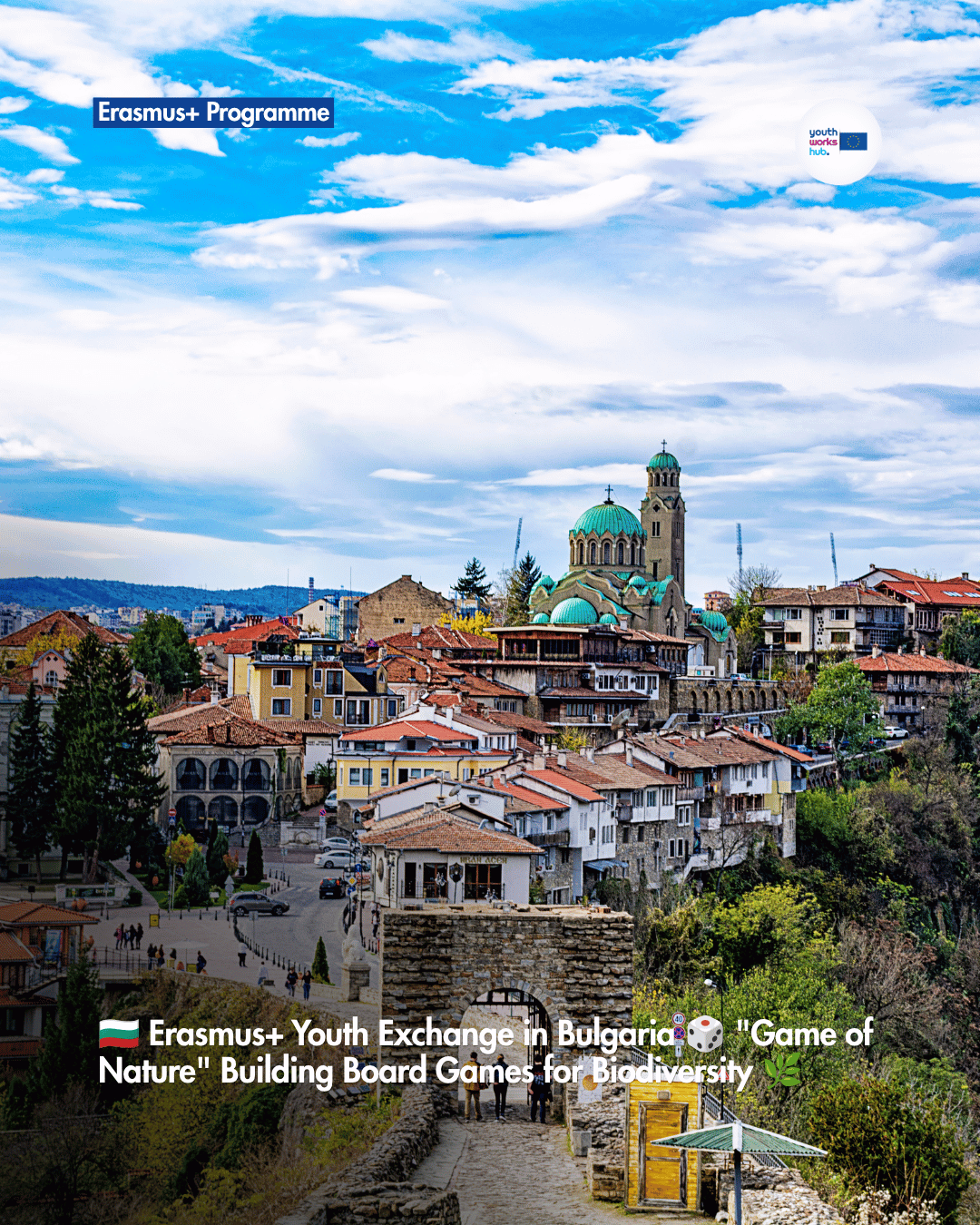
Game of Nature is a 7 day Erasmus+ Youth Exchange in Burgas, Bulgaria, running from 15 to 23 October 2026, that brings together 30 young people from five countries to explore nature and biodiversity in one of the most hands on ways possible: by designing and building educational board games. Working in small international teams, participants pick a real ecological theme and create an original game around it, from the first rough idea to a finished, playable prototype.
Turning Biodiversity Into a Board Game
Environmental topics often reach young people in a theoretical, abstract way that rarely leads to real engagement or action. Lectures and awareness campaigns come and go, but young people rarely get the chance to actually do something with the topic, to wrestle with it, argue about it and build something out of it. Game of Nature starts from a different place: instead of delivering content, it invites participants to become creators. In small international teams, they explore real ecological challenges, develop game concepts, build physical prototypes and test them with others. Board games create a natural environment for teamwork, decision making and learning through choices and consequences rather than through instruction. The game mechanic is not decoration, it is the learning method.
During the preparation phase, the organisers surveyed 72 young people from Bulgaria, North Macedonia and Spain. More than 60% said their experience with environmental topics had been mostly theoretical, and nearly 70% said they would engage much more if the topics were approached through creative, practical formats. Over half had never participated in an international youth exchange, despite being interested. That is the gap this project is trying to close.
🎲 First time hearing about a youth exchange? Here's how these week-long international projects actually run: What Is a Youth Exchange? → https://youthworkshub.org/youthexchange
The Host: Burgas Open Space
Burgas Open Space is a youth NGO based in Burgas, Bulgaria, founded in 2020. It works at the intersection of youth work, cultural initiatives and civic engagement, creating spaces where young people are not just an audience but active co creators. Over the years it has organised festivals, concerts, ecological initiatives and non formal education activities, and it has been growing its international experience through Erasmus+ partnerships. Game of Nature is its first project as a coordinating organisation, and the team is putting a lot of itself into making it genuinely good.
Five Countries, Five Games, One Toolkit
By the end of the week, five international teams will have developed five different educational board games, all centred on nature and biodiversity. These will be compiled into a Game of Nature Toolkit that all partner organisations can use, adapt and share after the project ends. Each team is made up of one member from each country, so the games are built across cultures from the very start.
The partner organisations are:
🇧🇬 Burgas Open Space (Bulgaria), the host, founded in 2020 in Burgas, organising festivals, cultural events and non formal education activities with and for young people, and responsible for the full coordination, hosting, logistics and overall quality of the learning process.
🇪🇸 Asociacion Sociocultural Papaya (Spain), based in rural Cantabria, working with young people and youth workers through non formal education, experiential learning and creative methods, with a strong focus on inclusion, particularly young people with fewer opportunities.
🇵🇹 Teatro dos Barris (Portugal), a cultural NGO from Cabanas founded in 2017, using artistic and creative methods as tools for non formal education, self expression and community engagement.
🇲🇰 Alijansa za odrzliva idnina (North Macedonia), based in Kochani, focusing on sustainability, active citizenship and youth activism, with hands on experience working with young people from vulnerable communities, including Roma youth.
🇷🇴 Asociatia Angels Wings Charity Org (Romania), a youth NGO from Pantelimon near Bucharest, working with young people from socially vulnerable backgrounds through non formal education and community based activities.
How the Week Unfolds, Day by Day
The week follows a clear arc. It is not a series of separate workshops, it is one coherent process. Each working day runs roughly from 9:30 to 18:30, with a lunch break and two shorter coffee breaks, and every day closes with a guided reflection session to step back, process what happened and connect the day's work to the bigger picture.
🧩 Day 1 (16 Oct): Arrival, orientation and group building. Through structured ice breakers, cooperative tasks and a shared creation of group rules, participants get to know each other and establish their working environment. The project and its goals are presented, the week is mapped out together, and everyone shares expectations and concerns openly.
🌿 Day 2 (17 Oct): Nature, biodiversity and game based learning. Participants explore what "nature" and "biodiversity" mean through their own local experiences and discuss ecological dilemmas and trade offs. In the afternoon, the focus shifts to game based learning: what makes a game educational, how mechanics shape behaviour and thinking, and what games could tackle environmental themes. The day ends with a first round of game brainstorming.
🦩 Day 3 (18 Oct): Field trip to Atanasovsko Lake. A full day outside at one of Bulgaria's most important wetland ecosystems, with experts from the Bulgarian Biodiversity Foundation. Participants observe the lake's ecosystem up close, hear about the real ecological pressures it faces, and collect material and inspiration. This is not a guided tour, it is fieldwork. In the afternoon, still on site, the five international working teams are formed.
🛠️ Day 4 (19 Oct): Game mechanics and first prototypes. Each team defines its game's educational angle, chooses a mechanic, writes the first version of the rules and builds a physical prototype from paper, cards and whatever is available. By the end of the afternoon, every team has something they can actually play, followed by an internal playtesting session with structured feedback forms.
🔍 Day 5 (20 Oct): Expert playtesting and quality round. The prototypes are tested with external experts: representatives from Aurora (a board game club) and Opashkata na Drakona, as well as members of the Bulgarian Biodiversity Foundation. Each game gets concrete, practical feedback on logic, clarity, engagement and educational validity, and teams then make a focused round of improvements.
🎯 Day 6 (21 Oct): Finalising games and follow up planning. The last full working day. Teams bring their games to a point where an outside group could pick them up and play without the creators explaining. Each team prepares a short presentation, and in the afternoon national groups plan their mandatory local follow up event, with a concrete format, audience and timeline.
🏁 Day 7 (22 Oct): Final presentations, evaluation and closing. Each of the five teams presents its finished board game to the group and to invited guests. The project is evaluated together, Youthpass is completed, and the exchange officially closes.
🌱 Love the idea of learning through nature? Trade the city for a rural house and mix ecology with intercultural living in ESC Volunteering in 🇪🇸 Spain: Ecology and Intercultural Exchange → https://youthworkshub.org/21542
Who Should Apply
This is not a passive experience, there are no lectures to sit through. Every day you will be making things, testing them, arguing about them and rebuilding them, as part of a small international team that owns a real result together. The organisers are looking for participants who want to be fully in it, not just present. More specifically, participants should be:
🔸 Aged 18 to 30 (group leaders may be older).
🔸 Active in youth work, NGO work, education, volunteering or community initiatives.
🔸 Curious about ecology, sustainability or game based learning, prior knowledge is not required, genuine interest is.
🔸 Comfortable working and communicating in English.
🔸 Ready to take responsibility not just for their own learning but for a shared group outcome.
🔸 Committed to organising at least one local follow up activity after returning home.
Your commitment starts before Burgas and continues after it. By joining, you are saying yes to attending the online preparatory meeting, completing your pre departure task, being fully present throughout all working days and sharing what you have learned back in your community. The project is funded by the Erasmus+ programme, and your spot has a real cost, so if you cannot commit fully, let your sending organisation know so someone else can take your place. The organisers especially encourage young people who face barriers to participating in international projects to apply, and if this would be your first exchange, that is a great reason to go for it.
A Word on Youthpass
Every participant will complete a Youthpass certificate by the end of the project. Youthpass is an official European tool that documents the learning outcomes and key competences you develop during the exchange. It is not a participation certificate, it is a document you write yourself, with support, describing what you actually did and learned, and it is worth taking seriously.
Ground Rules and Code of Conduct
The working rules are set together as a group on Day 1, but a few things are non negotiable from the start:
🚫 Zero tolerance for discrimination, harassment or disrespectful behaviour of any kind, in how participants treat each other, how they speak about communities and countries, and how they engage with local people and spaces.
🍷 Alcohol is permitted in moderation during free time; it is not part of the programme and its use must not affect participation or group dynamics. Drugs are not permitted at any point during the project.
✅ Full participation is expected during working hours; if something is not working, facilitators and group leaders are there to help you navigate it.
📵 Phones stay in your pocket during sessions unless used for something directly relevant to the work.
💬 A designated wellbeing contact person is available throughout the entire week, so if something feels wrong, whether about the programme, the group or something personal, raise it early.
Living at Burgas Coliving
Participants stay at Burgas Coliving, in the Vetren district of Burgas. The space was originally designed as a coliving hub for digital nomads and remote workers, so it is genuinely set up for people who spend their whole day working, learning and living in the same place, with comfortable indoor work areas, a fully equipped kitchen, outdoor zones and plenty of common space. Keeping accommodation and working space in one location means no daily commuting, a more cohesive group dynamic and much more informal exchange. Rooms are shared (2 to 3 people), arranged by gender and with mixed nationalities where possible, and bedsheets and towels are provided.
Breakfast, lunch and dinner are covered for all working days, prepared by a local catering partner using fresh, local produce. On the arrival day (15 October) only dinner is included, and on the departure day (23 October) only breakfast. Dietary requirements can be noted in the participant form.
Getting to Burgas
If there is a convenient direct flight to Burgas Airport (BOJ), that is the easiest option, as Burgas has seasonal connections from several European cities, so it is worth checking before assuming you need to go via Sofia. If you fly into Sofia, the onward journey is taken care of: the organisers will either arrange a shared bus from Sofia to Burgas for arriving groups, or a member of the Burgas Open Space team will meet you at the airport and travel with you on the intercity coach. No participant needs a visa to enter Bulgaria. Arriving earlier or staying a few extra days is fine, but any additional travel or accommodation costs outside the official project dates are at your own expense.
🧥 October in Burgas is mild but can be unpredictable, so bring layers and a light jacket. There is an ATM and a pharmacy within easy walking distance of Burgas Coliving, and the emergency contact for travel issues is Tsanko: +359 88 801 5777.
Travel Reimbursement
Travel costs are reimbursed up to the maximum amount per person for the full return journey. If you spend less, you get the real cost back; if you spend more, you receive up to the maximum. Before booking, send your travel proposal to your sending organisation for approval, and do not buy anything before getting the green light. Keep all original documents (tickets, invoices, receipts and boarding passes), as reimbursement is transferred to your sending organisation, who then pass it on to you. Screenshots of boarding passes are not accepted, so print the original or save the PDF before travel; if you are flying Ryanair, download your boarding pass PDF before the flight as you will not be able to access it afterwards. Green travel (train, bus, carpooling) is encouraged where it is a realistic option.
The maximum reimbursement per person by country is:
🇪🇸 Spain (Papaya): 395 EUR
🇵🇹 Portugal (Teatro dos Barris): 580 EUR
🇲🇰 North Macedonia (Alijansa za odrzliva idnina): 285 EUR
🇷🇴 Romania (Angels Wings Charity Org): 285 EUR
💶 Wondering how the travel money really works across Erasmus+ projects? This breaks down exactly what the programme pays for: What Costs Does Erasmus+ Cover? The Full 2026 Guide → https://youthworkshub.org/what-erasmus-covers
Before You Arrive
Once your selection is confirmed, you will:
📋 Fill in the participant form (dietary requirements, travel info, any access needs or things the team should know).
💻 Attend the online preparatory meeting in September 2026 (date to be confirmed), where you meet the full group, go through the programme and ask anything.
💬 Join the group chat on Discord, where updates, informal conversation and prep tasks will live.
🌍 Complete your pre departure task: find one concrete local example connected to nature or biodiversity in your area (a protected habitat, a local environmental conflict, a community initiative, an endangered species or anything relevant). Bring a photo and two sentences about it; you will share it on Day 1 and it may end up shaping your team's game.
🪪 Make sure your ID or passport is valid for the full duration of the activity.
🏥 Arrange travel insurance or check that your European Health Insurance Card is valid.
After the Exchange
The project does not end when you fly home. Each organisation is expected to organise at least one local follow up event where the games created during the exchange are used with a new group of young people, in a school, youth centre, library, cultural space or wherever fits. You plan this on Day 6 with your national group, so you leave with a concrete plan rather than a vague idea, and you complete your Youthpass certificate with the support of your group leader, including the experience from your local follow up event as part of the documentation.
🧭 Ready for another international team adventure? This Erasmus+ Youth Exchange puts connection and belonging at the centre: Crossroads: Connecting Stories, Building Belonging in 🇮🇹 Italy → https://youthworkshub.org/21934
Deadline
⏳ 15 September 2026
Links
📝 Application form: https://forms.gle/QMRf3DjuufCmAkG9A
📄 Infopack: https://drive.google.com/file/d/1FEqeZja6MdxWCeKqU4r8aZvRoKZW7zDm/view?usp=sharing
📧 Email: burgas.open.space@gmail.com
📞 Contact: Tsanko Kunchev, +359 88 801 5777
🌐 Website: https://www.burgasopenspace.com
⚠️ Important Notice
Youth Works Hub is not the organiser, partner, or representative of the listed projects. This listing is shared for information only, based on details from the source. Deadlines, eligible countries, dates, and other details may change or be withdrawn at any time, and all funding, reimbursements, and allowances are set by the project coordinator or National Agency. Applications go directly to the coordinator or hosting organisation through the official link. Listings may include third-party links (ESC Portal, infopacks, forms) that Youth Works Hub does not control. Always verify the details on the official project page before applying.


