🔑 Key Information
Activity ⭐️ Title
Your Turn (Double Training)
Activity 🔶 Type | 📆 Dates | 📍Location
Training Course
5-12 November 2026 | Albania
🌍 Erasmus+ explained — the complete beginner's guide to Europe's largest youth programme.Millions of young people have taken part in Erasmus+ since its launch, but many still don't fully understand what the programme actually includes, who it's for, or how to get involved. This in-depth guide breaks down everything: the different types of mobility, funding opportunities, eligibility criteria, and what you can realistically expect from participating. If you've ever wondered whether Erasmus+ is right for you, this guide gives you all the answers in one place. 👉 https://youthworkshub.org/15096/
❗️What Is This Training About?
Youth workers from across Europe will explore inclusion, Roma realities, intercultural dialogue and gamification. In the second training Poland, a professional game designer will help create a board game promoting inclusion.
🏘️ How Erasmus+ youth projects create lasting change in local communities. The impact of Erasmus+ goes far beyond the individuals who participate. Local communities, host organisations, and even entire neighbourhoods are shaped by the projects that take place within them. This article explores the broader social impact of Erasmus+ youth exchanges — from building intercultural understanding to empowering grassroots organisations — and makes a compelling case for why these projects matter beyond the personal level. 👉 https://youthworkshub.org/3595/
ℹ️ Description About The Opportunity
Despite Europe becoming increasingly diverse, many young people from minority backgrounds continue to experience exclusion, discrimination and limited opportunities to participate fully in society. Roma communities in particular face deeply rooted stereotypes, antigypsyism and structural barriers that affect their access to education, employment, housing, healthcare and participation in society.
At the same time, youth workers often lack engaging and practical tools to help young people understand these complex realities and question the social structures behind exclusion.
This project responds to this challenge through a two-stage learning journey, combining experiential learning, intercultural exploration and gamification.
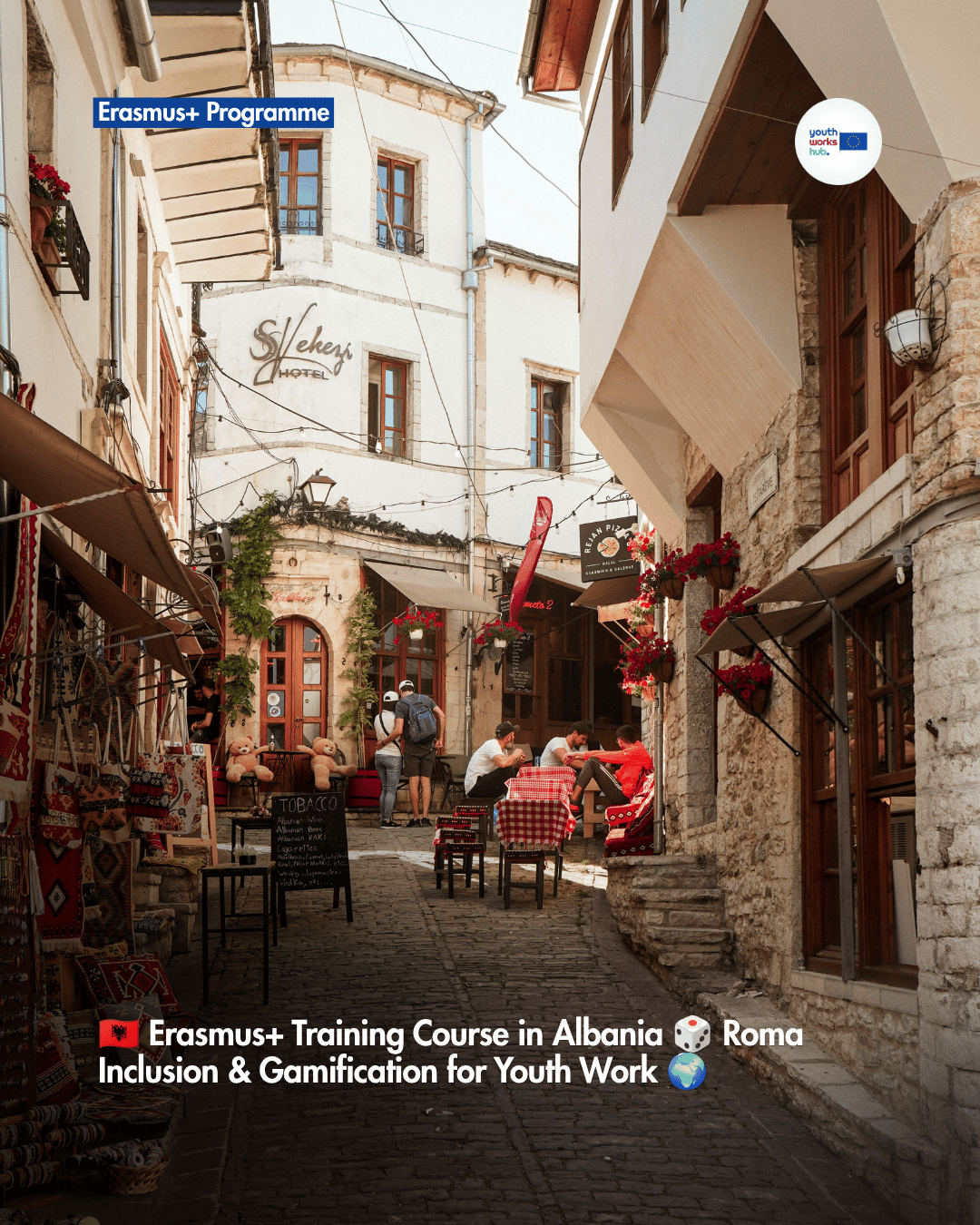
The first training will take place in Albania, where participants will explore the reality of a local Roma neighbourhood through community visits, observation, dialogue, experiential activities and contextual learning. Rather than learning about social exclusion only through theory, participants will have the opportunity to encounter the realities of a Roma community, understand the barriers and challenges people face, and reflect on the relationship between discrimination, social structures and everyday life.
First training in Albania: 5th to 12 November
Second training in Poland: 17th to 24th January
PARTICIPATING IN BOTH TRAININGS IS REQUIRED
The experience in Albania will become the starting point for the second phase of the project.
The second training will take place in Poland, where participants will use the knowledge, experiences and reflections gained in Albania to collaboratively design and develop an educational board game addressing social exclusion.
Through game design, participants will explore how complex social realities can be transformed into meaningful learning experiences. The game will incorporate elements inspired by the realities explored during the first training, such as unequal starting positions, access to resources, discrimination, stereotypes, institutional barriers and different forms of participation.
Once both training activities have been completed, the participants will take the board game back to their local communities and organise a testing event. These local events will provide an opportunity to introduce the game to young people and other community members, test its usability and effectiveness, and gather feedback from the players.
The main goals of the project are:
- To increase youth workers’ understanding of the social realities and challenges faced by Roma communities and other minorities.
- To strengthen youth workers’ competences in addressing discrimination, exclusion, antigypsyism and stereotyping through non-formal education.
- To explore gamification and game-based learning as innovative tools for inclusion and human rights education.
- To develop participants’ skills in facilitation, experiential learning, critical thinking and intercultural dialogue.
- To exchange good practices among youth workers from different European contexts on inclusive youth work and community engagement.
- To create safe educational spaces where young people can explore difficult topics, challenge stereotypes and engage in meaningful dialogue.
- To co-create an educational board game based on Roma and minority experiences, social inequalities and human rights.
- To transform complex social realities into accessible, engaging and interactive learning experiences.
- To promote empathy and critical thinking while challenging hate speech, disinformation and discriminatory narratives.
- To provide youth workers with a reusable educational tool that can be adapted to different local contexts.
- To encourage young people to become more active in their communities and participate in social change and inclusive citizenship.
Training overview
This Training Course is
for 21 participants
from Albania, Cyprus, Germany, Iceland, Poland, Spain, Türkiye
and recommended for
Youth workers, Trainers, Youth leaders, Youth project managers
Working language(s):
English
Organiser:
Peace Ambassadors Poland (Youth NGO)
Co-organiser(s):
- Deixant Empremta 2019 (Youth NGO)
✅ 10 practical tips to write a stronger Erasmus+ or ESC application and actually get selected. With growing competition for spots in Erasmus+ and ESC projects, a well-crafted application can genuinely make or break your chances. This guide shares 10 concrete, actionable tips based on what selection committees actually look for — covering everything from how to frame your motivation to the common mistakes that get applications rejected. If you're serious about getting selected, take the time to read this before you hit submit. 👉 https://youthworkshub.org/8396/
📥 Contact
Contact for questions:
Nil Ballarà Junyent
E-Mail:
Phone: +34650676789
💶 Costs
Costs
Participation fee
None
Accommodation and food
Fully covered by Erasmus+ program
Travel reimbursement
Yes. According to Erasmus+ Guide
📜 Certificate
Participants are entitled to receive a Youthpass certificate from the organiser, for recognition of their competence development during the activity. Read more about Youthpass:
https://youthworkshub.org/what-is-youthpass
⚠️ Important Dates
Application deadline (24h UTC): 31 August 2026
Date of selection: 7 September 2026
🔗 Official Link
⚠️ Important Notice
Youth Works Hub is not the organiser, partner, or representative of the listed projects. This listing is shared for information only, based on details from the source. Deadlines, eligible countries, dates, and other details may change or be withdrawn at any time, and all funding, reimbursements, and allowances are set by the project coordinator or National Agency. Applications go directly to the coordinator or hosting organisation through the official link. Listings may include third-party links (ESC Portal, infopacks, forms) that Youth Works Hub does not control. Always verify the details on the official project page before applying.