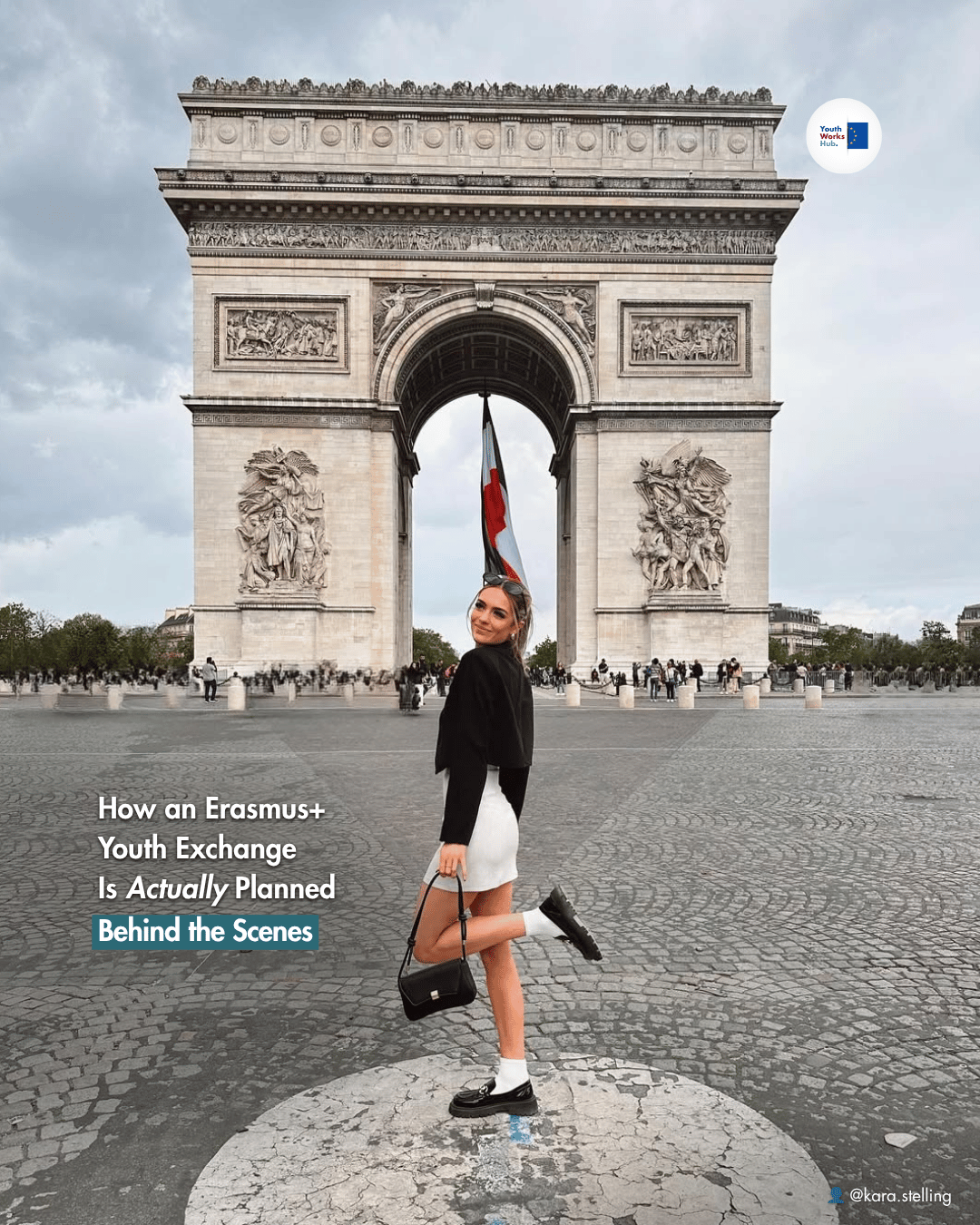
How an Erasmus+ Youth Exchange Is Actually Planned — Behind the Scenes
Everyone sees the final call. Few see what happens before it. Here's a real step-by-step breakdown of how a youth exchange gets built — from the first idea to a fully calculated budget.
When you see an open call for an Erasmus+ Youth Exchange, the application deadline is usually just weeks away. What most people don't realise is that for the project coordinators behind it, the work started months earlier.
This is what that process actually looks like — from identifying a problem to calculating travel costs by distance band.
"Behind every approved youth exchange there is planning like this. Not random. Structured."
Step 1 Start with a problem, not with activities
The most common mistake new project coordinators make is starting with activities — workshops, sessions, excursions. That's backwards.
An Erasmus+ Youth Exchange starts with identifying a real problem. Something young people in your community are genuinely struggling with. Something that is missing from their reality. Something that a single workshop cannot fix.
Step 2 Build the concept
Once you have the problem, you build the concept around it. This means being able to answer four questions clearly:
Why a youth exchange — and not something else?
Some problems are better addressed by a training course, a solidarity project, or local work. A youth exchange specifically brings together young people from multiple countries for a shared non-formal learning experience. The international dimension needs to be essential to the solution, not just a nice addition.
Why now?
Is there a specific context — a social trend, a policy window, a moment in young people's lives — that makes this the right time for this project? Evaluators want to see urgency and relevance, not a project that could have happened any year.
Why this topic?
The topic needs to connect directly to the problem you identified in Step 1. It should be specific enough to be actionable but broad enough to be meaningful across different national contexts.
Why these young people?
Who exactly are the participants? What is their background? Why are they the right group to be involved in this project? The more precisely you can describe your target group, the stronger your application.
The concept is not just the introduction to your application — it defines everything that comes after it: the programme, the partners you need, the budget you can justify, and the impact you can credibly claim.
Step 3 Build the partnership structure
For this example, we're working with a fictional but fully realistic youth exchange hosted in Italy 🇮🇹, involving 8 partner organisations across 8 countries.
Partnership & Participation Structure
- Host country: Italy 🇮🇹
- Partner countries: France 🇫🇷, Germany 🇩🇪, Spain 🇪🇸, Türkiye 🇹🇷, Poland 🇵🇱, Greece 🇬🇷, Georgia 🇬🇪
- Organisations: 8 total (1 per country)
- Per organisation: 4 young participants + 1 group leader = 5 people
- Total participants: 40 people
- Activity duration: 11 days including travel days
Each partner organisation is responsible for selecting and preparing their participants, supporting them during the project, and following up after they return. The host organisation coordinates the overall programme, venue, accommodation, and logistics.
Step 4 Define the programme basics
Before you can build a budget, you need two fixed numbers: the number of participants and the number of days. Everything else follows from these.
In this project: 40 participants, 11 days (including arrival and departure days). This is within the standard range for Erasmus+ Youth Exchanges, which typically run between 5 and 21 days.
The programme itself — the daily schedule, the non-formal learning activities, the intercultural evenings, the reflection sessions — is built around the concept from Step 2. It's not filled in randomly. Every activity should connect back to the original problem and the learning outcomes you defined.
Step 5 Calculate the budget — no guessing, only formulas
This is the part most people avoid talking about. The Erasmus+ budget for a Youth Exchange is not flexible — it is calculated using fixed unit costs set by the European Commission. Here is exactly how the core budget for this project breaks down.
Organisational Support — for young participants only, not group leaders:
| Item | Formula | Amount |
|---|---|---|
| Organisational Support | 4 young people × 8 countries × €125 | €4,000 |
This covers coordination and organisational work — not salaries, not profit.
Travel Costs — calculated based on distance bands between the participant's home country and the host country:
| Countries | Distance Band | Formula | Amount |
|---|---|---|---|
| France, Germany, Spain, Türkiye, Poland, Greece | 500–1999 km | 6 countries × 5 people × €309 | €9,270 |
| Georgia | 2000–2999 km | 5 people × €395 | €1,975 |
| Italy (host country local travel) | Local | 5 people × €56 | €280 |
| Total Travel | €11,525 | ||
Individual Support — accommodation, food, and daily expenses for all participants:
| Item | Formula | Amount |
|---|---|---|
| Individual Support (Italy daily rate: €69/person/day) | 11 days × 40 people × €69 | €30,360 |
This is the largest budget line in any youth exchange — and the most strictly regulated. The daily rate is fixed by country and cannot be exceeded.
Full Budget Summary:
| Budget Line | Amount |
|---|---|
| Organisational Support | €4,000 |
| Travel Costs | €11,525 |
| Individual Support | €30,360 |
| Total Project Budget | €45,885 |
There are also possible additional costs that can be included if needed — but these must be planned and justified at the application stage, not added later:
Visa costs: If participants from certain countries require visas, these costs can be included in the budget if properly justified.
What this means for you as a participant
If you are applying to join an Erasmus+ Youth Exchange — not coordinate one — understanding this structure helps you in two ways.
First, it explains why applications ask about your background, your motivation, and your connection to the project topic. Coordinators have spent months building a project around a specific problem and a specific group of young people. Your application needs to show you belong in that group.
Second, it confirms that participation is genuinely fully funded. Travel, accommodation, food, and insurance are all covered through the budget lines above. You are not expected to pay for any of these costs out of pocket.
Ready to Find an Erasmus+ Youth Exchange?
Youth Works Hub lists open Erasmus+ Youth Exchange opportunities across Europe, updated regularly — with all the details you need to apply.
Browse Open Opportunities →